DeepSeek V4.1-Flash-1017 raises agent scores, keeps price
DeepSeek's V4.1-Flash-1017 update scores 77.0% on DeepSWE, up from 74.2%, at unchanged API prices, and adds Search and Fetch APIs at $0.75 per 1,000 calls.
3 min read
By the numbers
- parameters in the open-weight model
- 763B
- tokens of context
- 1M
- DeepSWE v1.1 score, up from 74.2%
- 77.0%
- per 1,000 calls to the new Search or Fetch API
- $0.75
- V4.1-Flash-1017
- 77%
- V4.1-Flash (September)
- 74.2%
- Opus 5
- 74%
- GPT-5.6 Sol
- 73%
DeepSeek released DeepSeek-V4.1-Flash-1017 on October 17, 2026, an update to the V4.1 Flash model it shipped on September 10. The new version scores higher on coding and agent benchmarks and costs the same to call. Developers on the deepseek-flash API name get it automatically, and the weights are free to download under the MIT license.
What DeepSeek changed
DeepSeek's API changelog says V4.1 Flash "has been upgraded" to the 1017 version. Callers do not need to change anything: the deepseek-flash model name now serves the new checkpoint. A checkpoint is one saved version of a trained model. "The API calling method and pricing remain unchanged," the changelog says.
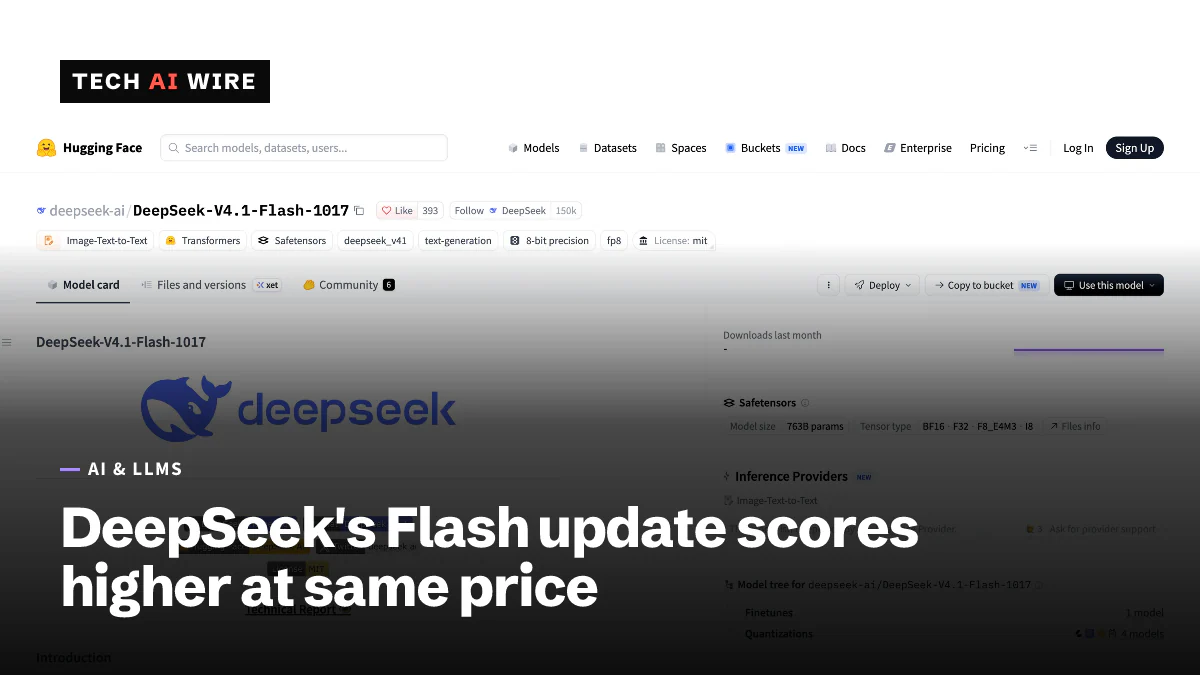
The model card on Hugging Face lists 763 billion parameters and a context window of 1 million tokens. The context window is how much text the model can read at once. DeepSeek did not state how many parameters are active for each token.
The Decoder reports that DeepSeek calls the update "a Pareto improvement" in the trade-off between performance and cost. In plain terms, it is better without being more expensive.
How the benchmarks moved
DeepSeek's own table compares the update with the September release and with two closed frontier models. These are DeepSeek's numbers, not independent tests.
| Benchmark | V4.1-Flash-1017 | V4.1-Flash | GPT-5.6 Sol | Opus 5 |
|---|---|---|---|---|
| Terminal-Bench 4.0 | 42.3 | 31.2 | 39.9 | 51.8 |
| DeepSWE v1.1 | 77.0 | 74.2 | 73.0 | 74.0 |
| ProgramBench | 29.1 | 20.3 | 23.0 | 37.0 |
| NL2Repo-Bench | 68.2 | 65.4 | 56.8 | 75.3 |
| Automation-Bench v1.0.6 | 60.5 | 54.8 | 45.8 | 50.3 |
| Humanity's Last Exam, no tools | 42.6 | 36.8 | 44.5 | 56.3 |
The biggest jump is on Terminal-Bench 4.0, a test of command-line tasks, which DeepSeek ran inside Claude Code. It rose 11.1 points. On the table's coding and agent tests, Opus 5 still leads on three of five, while 1017 leads on DeepSWE and Automation-Bench.
The cost per task
Price per token is only half the story for agents, which can run for many steps. The Decoder looked at cost per finished task on DeepSWE. At its top setting, 1017 scored 77.0% for just under $0.20 per task. A lower setting still passed 72% for about $0.10.
The September version scored 74.2% at around $0.50 per run. The Decoder puts GPT-6 Astra, Gemini 3.8 Flash and Claude Opus 5 at $2 to more than $10 per task. So the new checkpoint is both more accurate and cheaper per job than the one it replaces.
New Search and Fetch APIs
DeepSeek also made a Search and Fetch API available the same day, according to its changelog. Agents use tools like these to look things up on the web while they work. The Decoder reports a price of $0.75 per 1,000 calls for each endpoint.
Both are free until 4:00 PM UTC on October 31, 2026, for API users who call them through server-side tools in DeepSeek Harness, Claude Code or Codex, The Decoder says.
DeepSeek says the model is tuned for DeepSeek Harness, Tencent CodeBuddy and WorkBuddy, and recommends Harness 0.2.1-rc.1 or later. Harness is DeepSeek's own open-source agent runtime, which gained a desktop app for macOS and Windows on October 2.
Where to get it
| Channel | Detail |
|---|---|
| DeepSeek API | deepseek-flash, same price as before |
| Weights | Hugging Face, MIT license |
| OpenRouter | deepseek/deepseek-v4.1-flash-1017 |
| EU in-region routing on OpenRouter | Not available yet |
What this means for developers
If you already call deepseek-flash, your traffic moved to 1017 today. Rerun your own evaluation set this week, because a silent model swap can change output length and formatting. Shorter answers save money but can break parsers that expect a fixed shape.
If you pick models by cost per finished task, retest DeepSeek against your current choice. The Decoder's figures put 1017 at a tenth or less of the closed models' cost on DeepSWE. Your own agent loop is the only number that counts.
The free Search and Fetch window ends October 31. Use it to test whether DeepSeek's search can replace a paid search API in your agent, then budget $0.75 per 1,000 calls per endpoint after that.
Teams in the EU that need in-region processing should note the OpenRouter gap. For now, the self-hosted MIT weights are the way to keep data local.
Sources
- Change Log - DeepSeek API Docs
- deepseek-ai/DeepSeek-V4.1-Flash-1017 - Hugging Face
- Deepseek V4.1 Flash 1017 beats larger rivals in agentic tasks while once again massively cutting per-task costs - The Decoder
- DeepSeek: DeepSeek v4.1 Flash 1017 - OpenRouter
Related articles

Reflection AI launches Beam, a 501B open-weight model
Reflection AI's Beam has 501B parameters but uses 23B per token, scores 80.9 on SWE-Bench Verified, and ships weights under Apache 2.0 later in October.

DeepSeek warns developers a significant API price rise is coming
DeepSeek warned developers on August 6 that API prices will rise 'significantly' soon, with no figures or dates - while V4-Flash is the cheapest well-known model to run.
StepFun Step 5 Preview: 600B open-weight agent model
StepFun's Step 5 Preview, a 600B-parameter model with 27B active and a 1M-token context, is on Hugging Face after an API-only month at $1/$2.70 per M.
The weekly digest
One email every Friday with the week's top stories from all six desks: AI, dev tools, coding, the tech industry, startups and what's next. Free, no spam.