DeepSeek's open-source agent runtime makes everything a plugin
DeepSeek Harness shipped on August 13, 2026 under the MIT license. Its model adapter, tool registry and even the agent loop are all swappable plugins.
3 min read
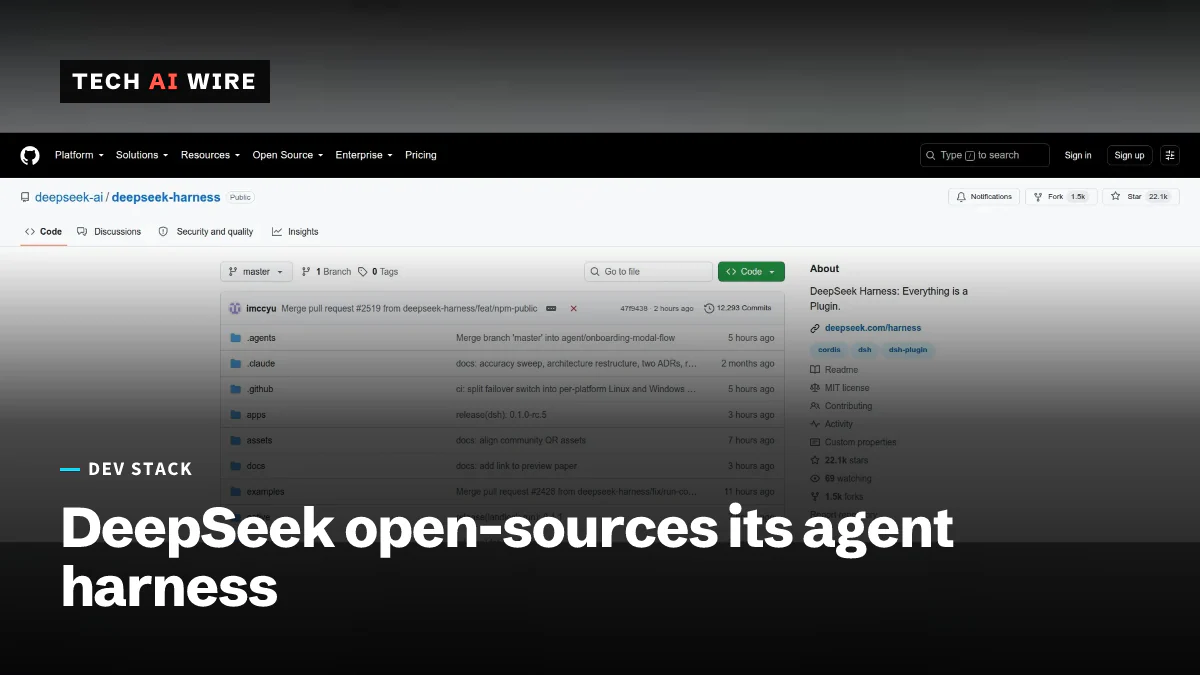
DeepSeek released an open-source agent runtime called DeepSeek Harness on August 13, 2026, under the MIT license. Its design bet is that every part of a coding agent should be replaceable, including the agent loop itself. For developers tied to one vendor's agent today, it is the clearest argument yet that the pieces can come apart.
A harness is the software wrapped around a model that turns it into an agent. It holds the tools the model can call, the record of the session, the sandbox commands run in, and the loop that decides what happens next. DeepSeek's framing is that an agent is a model plus a harness, and the two need not come from the same company.
What "everything is a plugin" means in practice
VentureBeat reports the runtime installs as dsh and launches with npx @deepseek-ai/dsh web. Underneath, the parts you would normally consider fixed are extensions.
According to InfoQ, the interchangeable units include the model adapter, the tool registry, the sandbox, the session state handler, the event dispatcher and the user interface. VentureBeat adds skills, filesystems, loops and orchestration to that list.
The architecture underneath is called Cordis, a meta-framework built around composable plugins. It handles how plugins mount, unmount and depend on one another. InfoQ notes the published material is thin on Cordis implementation detail, which is fair to keep in mind before betting a project on it.
The runtime ships four modes, per InfoQ:
| Mode | Purpose |
|---|---|
| Standard | The full environment |
| Code | An SDK interface |
| Minimal | Shell plus text editing only |
| Creator | Testing your own plugins |
Model choice is configuration, not code. Developers point the runtime at different endpoints or local servers through YAML or JSON, without touching core logic. DeepSeek, Anthropic, OpenAI and any compatible endpoint work out of the box.
How it compares with Claude Code
VentureBeat positions Harness as an open-source rival to Anthropic's Claude Code, and its comparison is usefully unflattering in places.
Harness covers the core agent work: inspecting a repository, editing files, running shell commands, searching, planning and delegating to subagents. What it lacks is the surrounding product. VentureBeat lists mature permission systems, hosted background agents, GitHub-native workflows and multi-platform support across VS Code, JetBrains, mobile and Slack as things Claude Code has and Harness does not.
The trade is stated plainly. Claude Code is primarily Claude; Harness is model-agnostic. One is a finished product tied to a vendor, the other is infrastructure you assemble.
The price move alongside it
DeepSeek raised API prices for its V4-Pro model at nearly the same time, effective August 16, 2026. VentureBeat records off-peak rates of $0.66 per million input tokens and $1.98 output, with peak hours at $1.32 and $3.96. Previous pricing was $0.435 input and $0.87 output.
That is roughly a 50% increase off-peak and more at peak, from a company whose reputation was built on undercutting rivals. Open-sourcing the harness while raising model prices is a coherent strategy: give away the part that locks developers in, charge for the part that costs money to run.
What this means for developers
This is a foundation, not a replacement. If your team runs Claude Code or Codex today and is happy, nothing here justifies switching. The permission model and the hosted pieces Harness lacks are exactly what makes an agent safe to leave running.
The reason to look anyway is the abstraction. If you are building an internal agent, read how Harness splits the loop from the tools from the sandbox. That decomposition is worth stealing even if you never install it, because most home-grown agents fuse those layers and become impossible to swap later.
Test the escape hatch before you need it. The pitch is that changing model providers is a config edit. Prove that on your own workload now, while it is a curiosity, rather than during an outage. This month's Cursor news is a reminder that model supply can be withdrawn by a party you never signed anything with.
Watch the pricing pattern rather than the numbers. A vendor open-sourcing its harness and raising its token prices in the same week tells you where the margin is. Expect more runtimes to be given away, and budget for inference to be the line that grows.
Sources
Related articles
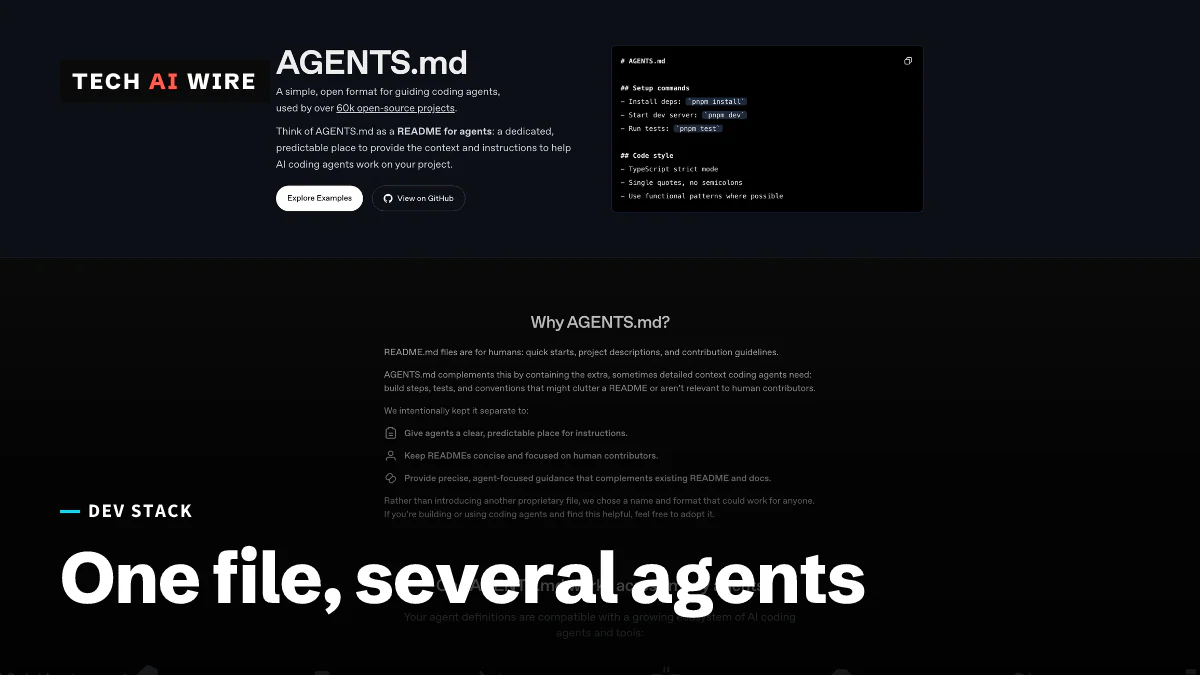
Claude Code 2.1.277 reads AGENTS.md as a fallback
Claude Code 2.1.277 reads AGENTS.md when a project has no CLAUDE.md. Over 60,000 open-source projects already ship that file.

Researchers document a near-autonomous AI-agent attack on Taiwan
Israeli firm Dream says AI agents built on open-source frameworks Hermes and OpenClaw ran a four-day intrusion on Taiwan's government, compromising 85 accounts with little human input.
Git 2.56.0 ships faster merge-base and smaller repacks
Git 2.56.0 cuts a Linux kernel merge-base walk from 167,441 steps to 3,887 and shrinks one test repository's pack by 71%. It shipped September 28.
The daily brief
Three to five stories a day, and what each one means for the people who build software. Free, no spam.