DeepSeek warns developers a significant API price rise is coming
DeepSeek warned developers on August 6 that API prices will rise 'significantly' soon, with no figures or dates - while V4-Flash is the cheapest well-known model to run.
3 min read

By the numbers
- per 1M input tokens on DeepSeek V4-Flash today
- $0.14
- cheaper than GPT-4.1 for comparable input, per Eden AI
- ~14×
- the day DeepSeek notified developers, with no date or figure
- Aug 6
DeepSeek notified developers on August 6, 2026 that a "significant" API price increase is coming across its pricing tiers, according to The Next Web - without saying how much, when, or for which models first. For the many teams that standardized on DeepSeek precisely because it is cheap, that is a budgeting problem with no numbers attached: the only stated timeline is "the near future."
The warning lands differently than a routine price change because low cost is DeepSeek's identity. The Next Web notes DeepSeek V4-Flash was recently identified as "the cheapest well-known model to run," and Eden AI's analysis puts V4-Flash at roughly 14 times cheaper than OpenAI's GPT-4.1 for comparable input processing.
What DeepSeek said, and what it left out
The notice itself is thin: a significant increase, all tiers, near future. No percentage, no effective date, no per-model breakdown, according to both The Next Web and Eden AI's reading of the announcement.
It is not the first signal, though. The Next Web reports DeepSeek has already experimented with peak-hour surge pricing and floated plans to "double rates at busy times." A provider testing time-of-day multipliers is a provider probing how much of its traffic is price-sensitive - the August 6 notice reads as the conclusion of that experiment.
Why the cheapest model is getting more expensive
The Next Web attributes the increase to a demand surge straining DeepSeek's computational resources, and frames the underlying economics plainly: "Every query costs real money in chips and power, and a provider that prices below cost to win share eventually has to reckon with the bill."
The competitive cover for a price rise also exists now. Per The Next Web, rivals - it names Meta's Muse Spark and OpenAI's newest offerings - have closed the capability and pricing gap that previously differentiated DeepSeek, which means DeepSeek no longer has to be dramatically cheaper to stay in the consideration set.
The numbers as they stand today
Eden AI's analysis records DeepSeek's current list prices, the baseline any increase will move from:
| Model | Input ($ per 1M tokens) | Output ($ per 1M tokens) |
|---|---|---|
| DeepSeek V4-Flash | $0.14 | $0.28 |
| DeepSeek V4-Pro | $0.55 | $1.10 |
What this means for developers
The uncomfortable premise under this story is the one Eden AI states outright: "LLM pricing is not a contract." Any provider can reprice mid-stream, and an application whose unit economics only work at $0.14 per million input tokens is carrying that risk silently.
Three concrete moves follow. First, measure before the change lands: know your token spend per feature today, so you can model what a 2× or a peak-hour multiplier does to your margin the day DeepSeek publishes real numbers - the company's earlier float of doubled busy-time rates, per The Next Web, is a reasonable stress-test scenario. Second, make switching cheap: Eden AI recommends multi-provider routing infrastructure so workloads can shift between vendors when pricing moves - even a thin abstraction layer over your completion calls turns a repricing event from a rewrite into a config change. Third, re-benchmark the field before the hike takes effect: if the capability gap has narrowed the way The Next Web describes, the cheapest-adequate model for your workload may no longer be DeepSeek once the new prices land.
The strategic frame worth naming: subsidized inference pricing is a customer-acquisition cost, and acquisition subsidies end. Whatever the new DeepSeek prices turn out to be, the safe planning assumption is that nobody's list price today is a floor.
Sources
Related articles
TypeSafe's Jev returns typed decisions, not text
Jev answers in 70 to 500 milliseconds and charges $0.042 per million input tokens, with output free. It cannot generate text at all.
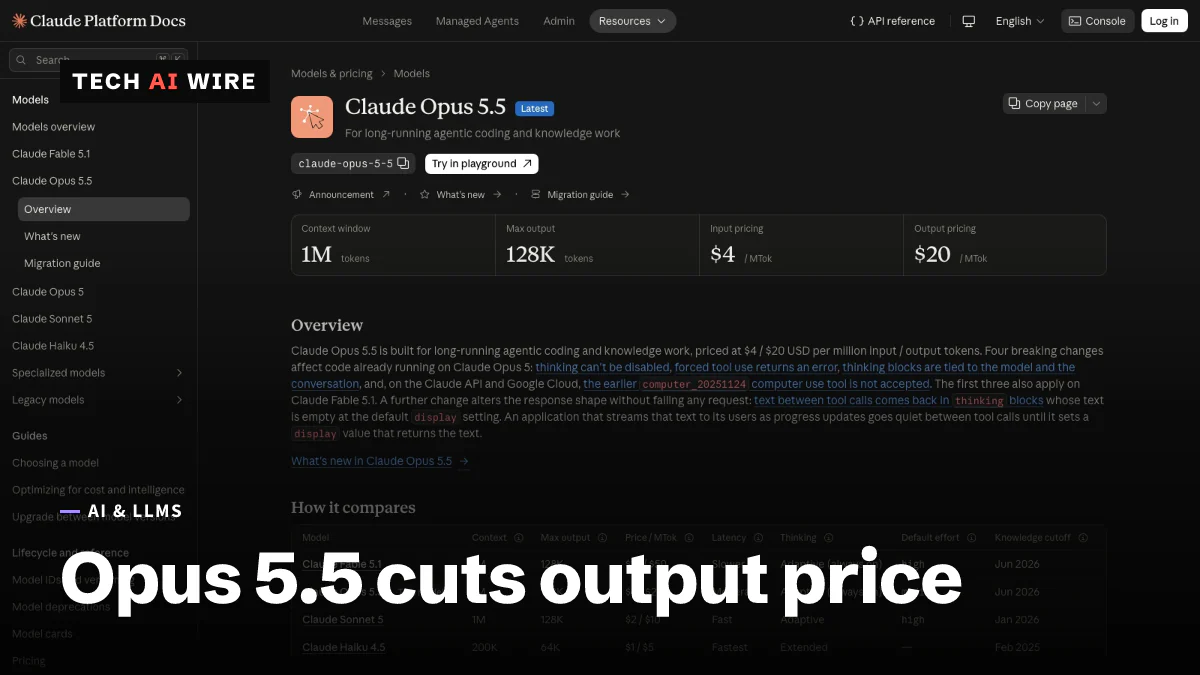
Claude Opus 5.5 cuts output price to $20 per million
Anthropic released Claude Opus 5.5 on September 22, 2026, at $4 input and $20 output per million tokens, with thinking always switched on.

GPT-6 Astra is generally available on Bedrock and Copilot
GPT-6 Astra is GA on Amazon Bedrock at $10 per million input tokens, and in GitHub Copilot for Pro+, Max, Business and Enterprise plans.
The weekly digest
One email every Friday with the week's top stories from all six desks: AI, dev tools, coding, the tech industry, startups and what's next. Free, no spam.