StepFun Step 5 Preview: 600B open-weight agent model
StepFun's Step 5 Preview, a 600B-parameter model with 27B active and a 1M-token context, is on Hugging Face after an API-only month at $1/$2.70 per M.
3 min read
By the numbers
- total parameters, about 27B active per token
- 600B
- token context window
- 1M
- per million input tokens on OpenRouter
- $1.00
- H200 GPUs for the FP8 version on one node
- 8
- GPT-6 Astra (Max)
- 74.1%
- Claude Opus 5 (Max)
- 74%
- Step 5 Preview
- 67.7%
- Kimi K3 (Max)
- 67.5%
- GLM-5.3 (Max)
- 66.9%
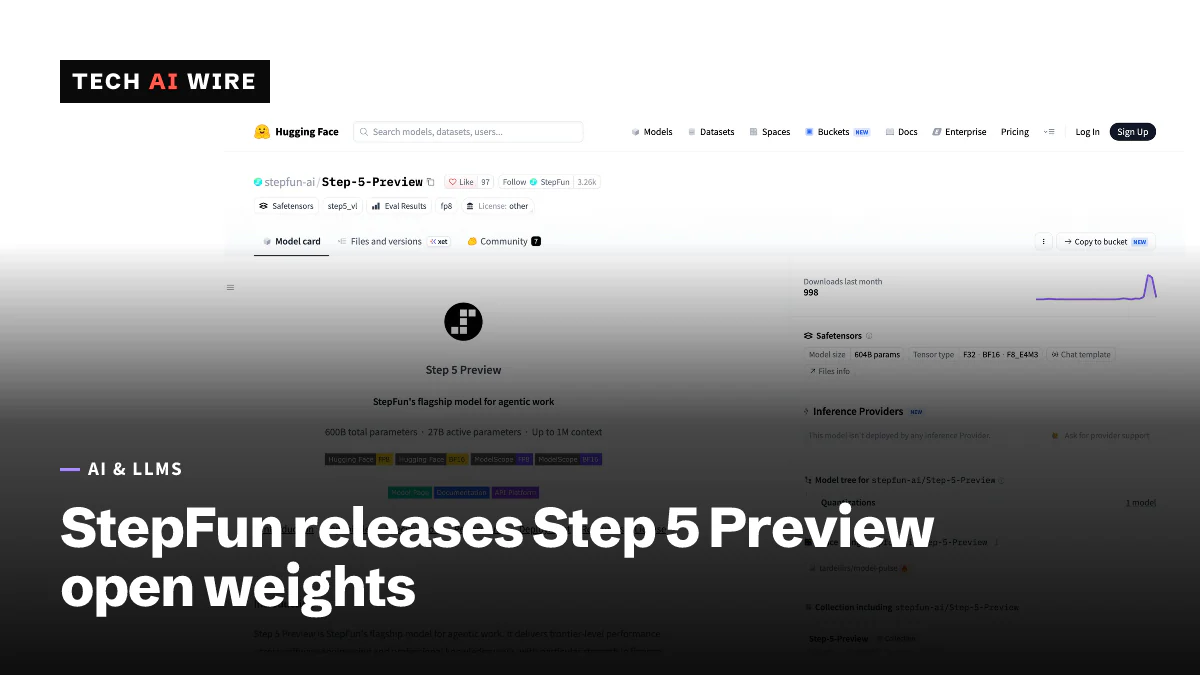
StepFun's Step 5 Preview, a 600-billion-parameter model built for AI agents, now has its weights on Hugging Face. StepFun promised the files for October 15, 2026, after a month in which the model was available only through its API. Developers can now download a large coding-focused model and run it themselves, though it needs a server full of data-center GPUs.
Weights are the trained numbers that make up a model. "Open weights" means anyone can download them, run the model locally and fine-tune it, within the license terms.
What Step 5 Preview is
The Hugging Face model card calls it "StepFun's flagship model for agentic work." It is a sparse mixture-of-experts (MoE) model. An MoE model splits its parameters into many smaller expert networks and uses only a few of them for each word, so it runs faster than its size suggests.
| Spec | Step 5 Preview |
|---|---|
| Total parameters | 600B (604B in the file metadata) |
| Active per token | About 27B |
| Context window | Up to 1M tokens |
| Input | Text and images |
| Weight formats | BF16 and FP8 |
| License | StepFun Model License 1.0 |
| Downloads | 998 in the last month |
The card describes the license as "an Apache-2.0-Style license" with extra attribution and commercial-license conditions. That differs from earlier reports. In October, Developers Digest noted that StepFun's announcement named no license and that the benchmarking firm Artificial Analysis listed the model as proprietary.
From placeholder to download
StepFun announced the model on September 20, with API access the same day. On that date its Hugging Face repository for the BF16 weights held a single file and no weights, OrcaRouter reported. "The repo is a placeholder, and that is the story," wrote Gideon Frost, the author of that post.
The model reached OpenRouter, a service that resells access to many AI models, on October 8. A day later, Developers Digest wrote that the weights were "promised for October 15, 2026." StepFun's GitHub repository for the model was updated on October 15. The model card now carries weight-format metadata and a download count.
Benchmarks and price
StepFun's own figures put it close to, but behind, the best closed models on coding tasks. The chart shows its DeepSWE v1.1 score next to rivals run at their "Max" settings, from the table Developers Digest reproduced. StepFun's announcement concedes that "a meaningful gap to the frontier remains."
The model card adds a 33.3 score on Terminal-Bench 4, a test of command-line tasks. On the independent Artificial Analysis Intelligence Index it scores 44. It ranked 24th of 200 models on September 18, per OrcaRouter, and 40th of 226 by October 9, per Developers Digest.
On OpenRouter it costs $1.00 per million input tokens and $2.70 per million output tokens. Developers Digest lists cached input at $0.05. Artificial Analysis also found it "very verbose": it produced 160 million output tokens on the index, against a median of 81 million.
What it takes to run
The model card lists example setups. In FP8, a compressed 8-bit format, vLLM runs it on four B300 GPUs or eight H200 GPUs in one server. In full BF16 it needs eight B300s, or 16 H200s across two servers. vLLM and SGLang are popular open-source programs for serving models.
That puts self-hosting out of reach for laptops and single workstations. It lands among other very large open releases this week, including Meta's 816B Muse Spark Open.
What this means for developers
- Read the license before you ship. The card's StepFun Model License 1.0 adds attribution and commercial-license conditions to an Apache-style base. Check whether your product triggers them before building on it.
- Budget for output, not just price. At $2.70 per million output tokens the rate is low, but the model writes a lot. Measure real tokens per task on your own workload, not the list price.
- Try the API before buying GPUs. Eight H200s is the smallest server setup listed. Test it through OpenRouter first, then decide whether self-hosting saves money.
- Treat vendor scores as a starting point. DeepSWE and StepCodeBench numbers come from StepFun. Run it on your own repositories and agent tasks before you switch.
- Use the recommended settings. The card suggests temperature 1.0, top_p 0.95 and top_k 0, with results reported at the "High" reasoning setting. Different settings may not match the published scores.
Sources
- stepfun-ai/Step-5-Preview model card - Hugging Face
- Step 5 Preview: Pricing, Benchmarks and the October 15 Open Weights - Developers Digest
- Step 5 Preview open weights - OrcaRouter
Related articles
Ling-3.1-flash: Ant Group opens 560B model under MIT
Ant Group's inclusionAI published Ling-3.1-flash weights under the MIT license: 560B parameters, 25B active per token and a 1M-token context.
Jais 3 brings six open Arabic models, up to 375B
MBZUAI's IFM and Inception42 released Jais 3 on October 15: six open Arabic models from 0.9B to 375B parameters, plus Jais Speech, under Apache 2.0.
Meta Muse Spark Open ships 816B open weights
Meta released Muse Spark Open, an open-weight model with 816B parameters, 42B active and a 1M-token context, on Hugging Face and three cloud platforms.
The weekly digest
One email every Friday with the week's top stories from all six desks: AI, dev tools, coding, the tech industry, startups and what's next. Free, no spam.