DeepSeek open-sources DeepInfer inference engine
The engine behind DeepSeek's own API is now Apache 2.0 code. It runs V4.1-Flash on Nvidia SM100 GPUs and Huawei Ascend 950 chips, minus a KV cache layer.
3 min read
By the numbers
- license for the DeepInfer code
- Apache 2.0
- chip families: Nvidia SM100 and Huawei Ascend 950
- 2
- pieces of a full service left out of this release
- 3
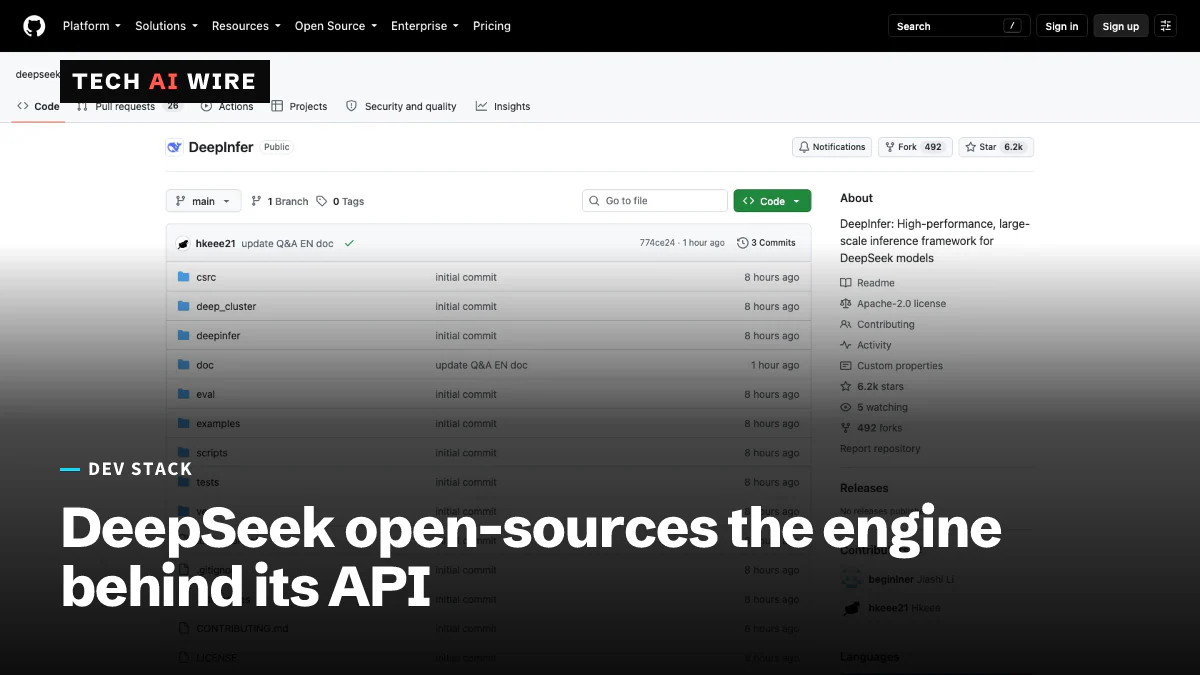
DeepSeek released DeepInfer on October 20, 2026, the software it uses to run its own AI models in production, as open source. The code is under the Apache 2.0 license and supports both Nvidia and Huawei chips. It shows outsiders how DeepSeek serves its own models, though a few key parts are held back.
What DeepInfer is
An inference engine is the software that runs a trained AI model and turns requests into answers. It decides how the model is split across chips, how requests are batched together, and how fast tokens come out. That work largely sets the cost of an AI service.
"DeepInfer is the high-performance inference framework that powers DeepSeek's large-scale production services," says the project's GitHub page. The repository says it was originally built mainly on vLLM, a popular open-source engine, with ideas from SGLang and Nvidia's TensorRT-LLM.
For now it supports one model: DeepSeek-V4.1-Flash, using the V4.1-Flash-1017 update as its default. DeepSeek plans to land code for future models in the same framework, according to its announcement as relayed by TechFlow.
Nvidia and Huawei hardware
DeepInfer runs on two kinds of chips: Nvidia's SM100-generation data center GPUs and Huawei's Ascend 950 NPUs. An NPU is a processor built for AI work. Support for Huawei's chips matters because DeepSeek has planned large orders of them.
| Requirement | Detail |
|---|---|
| Operating system | Linux |
| Compiler | GCC 13 or newer |
| Python | 3.12 |
| Nvidia software | CUDA 13 |
| Huawei software | CANN 9.2 |
| License | Apache 2.0 |
Setup is short, per the README. You set DEEPINFER_ACCELERATOR to nvidia or ascend, run ./build.sh, then run python examples/offline_inference.py. The default model downloads from Hugging Face on first run.
Features in the release
The README lists the main pieces:
- Custom kernels. Hand-tuned chip code, including FlashMLA, DeepGEMM, DeepEP and kernels written in TileLang.
- Parallelism. Work is split across chips by data and by experts. DeepSeek's models are mixture-of-experts designs, which route each token to a few specialist sub-networks.
- Speculative decoding. A feature called DSpark guesses several tokens ahead and checks them, which speeds up output.
- Structured outputs. Answers can be forced to match a regular expression, a JSON schema or a grammar.
- Repeatable results. On Nvidia chips, a batch-invariant mode with fixed seeds gives identical outputs for identical inputs.
DeepSeek also released deepseek-recipe, a tool that converts text to tokens and back, built to match its official API, Crypto Briefing reports.
What is missing
The release is not a full service. "This open-source release provides offline inference with the core features needed for serving at scale," the README says. It names three parts needed for a complete service that are "not included in this release":
- A KV cache system, which stores earlier work so repeated prompts are cheaper.
- Prefill and decode disaggregation, which runs the reading and writing stages on separate machines.
- Load balancing across copies of the model.
Performance claims are also unclear. The README shows only charts, measured on 4 SM100 GPUs for prompt processing and 64 for output. Crypto Briefing cites figures such as 155 trillion tokens a day per cluster and a 96% input cache hit rate. Those numbers do not appear in the README, and a Hacker News thread traced the token figure to a post on Zhihu, a Chinese Q&A site.
What this means for developers
DeepInfer is less a drop-in server than a detailed look at how DeepSeek runs its models cheaply. Its value depends on your hardware and how much you are willing to build.
- Check your hardware first. It targets SM100-class Nvidia GPUs and Ascend 950 NPUs only. Older GPUs are not listed, so teams without that hardware cannot run it as is.
- Plan to build the missing pieces. Without a KV cache, disaggregation or load balancing, you will need your own serving layer for production traffic.
- Read the kernels, even if you never deploy it. Teams running mixture-of-experts models on vLLM or SGLang can study the parallelism and speculative decoding code for ideas.
- Use the repeatable mode for testing. Identical outputs for identical inputs make regression tests on model changes much easier on Nvidia hardware.
- Treat throughput claims as unverified. Run the repository's sweep script on your own chips before comparing it with your current engine.
Sources
- deepseek-ai/DeepInfer - GitHub
- DeepSeek open-sources DeepInfer, the inference engine behind its production models - Crypto Briefing
- DeepSeek Announces Full Open-Sourcing of Its Internal Inference Framework, DeepInfer - TechFlow via KuCoin
Related articles
NVIDIA Run:ai goes open source, GPU sharing included
NVIDIA released the full Run:ai GPU orchestration platform as open source on October 13, split into four modules teams can adopt one at a time.
DeepSeek Harness Desktop arrives for macOS and Windows
DeepSeek's MIT-licensed Harness agent now ships as an official desktop app for Apple-silicon Macs and 64-bit Windows, with no Node.js install needed.

SDL3 gains HarmonyOS support, headed for SDL 3.6.0
Ryan Gordon's port, sponsored by Outfit7 and squashed from 77 commits, merged upstream on September 15, 2026 with video, audio and touch working.
The weekly digest
One email every Friday with the week's top stories from all six desks: AI, dev tools, coding, the tech industry, startups and what's next. Free, no spam.