SDL3 gains HarmonyOS support, headed for SDL 3.6.0
Ryan Gordon's port, sponsored by Outfit7 and squashed from 77 commits, merged upstream on September 15, 2026 with video, audio and touch working.
3 min read
By the numbers
- original commits squashed into the one that merged
- 77
- the SDL release that will carry the port
- 3.6.0
- subsystems still missing or only partly done
- 4
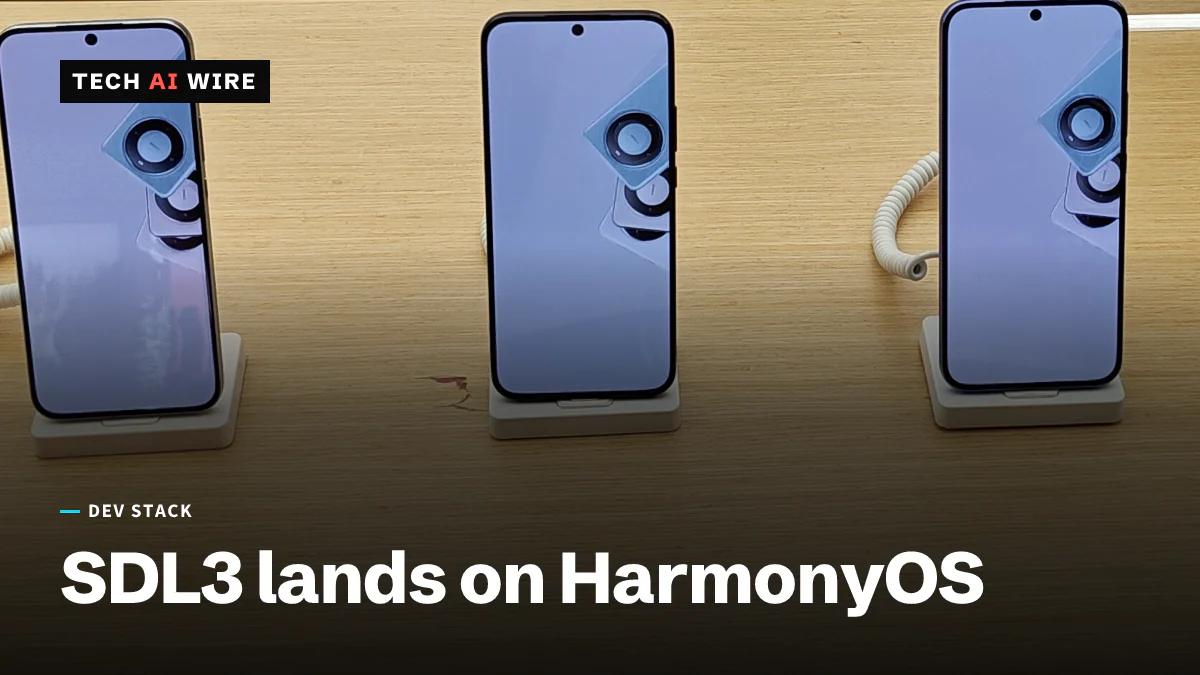
SDL3 now runs on HarmonyOS and OpenHarmony. Ryan Gordon's port merged into the upstream SDL repository on September 15, 2026 as pull request #16281, and it is slated for SDL 3.6.0. The work was sponsored by the game studio Outfit7.
SDL, the Simple DirectMedia Layer, is the library that sits under a large share of cross-platform games and media applications. It gives one program the same way to open a window, draw, play sound and read input on every platform it supports. A new platform in SDL is therefore a new platform for everything built on it, with far less porting than starting from scratch.
What the port covers
The pull request is one commit, squashed down from 77. Gordon, who publishes as icculus and is SDL's long-time maintainer, lists what works and what does not.
| Subsystem | Status in the merged port |
|---|---|
| Video | Working, via OpenGL ES 2.0 and 3.0 |
| Audio | Working |
| Input and touch | Working |
| Sensors | Working |
| Power management | Working |
| Window management | Working |
| Joystick and game controller | API present, not implemented |
| Pen and stylus input | Missing |
| System dialogs | Missing |
| 2-in-1 device support | Partial |
The gaps are the ones a game studio would notice first. Controller support is stubbed rather than done, and pen input is absent. Everything a touch-first phone or tablet game needs is present.
"It has been tested on real hardware from Huawei, and commercial games are being prepped to ship with it already," Gordon writes in the pull request. That last clause is the practical signal: this is a port with paying users waiting on it, not an experiment.
Building for it
Phoronix describes HarmonyOS as Huawei's proprietary operating system with a microkernel design, and OpenHarmony as its open-source variant. Both are covered by the same port.
The developer workflow follows the platform rather than the library. Applications are built in DevEco Studio, Huawei's development environment. Your program includes SDL3/SDL_main.h and provides a standard main(int argc, char **argv), the same entry-point convention SDL uses elsewhere. The full setup lives in the repository at docs/README-harmonyos.md.
The port arrives as Huawei pushes its own stack on several fronts at once. This site has covered its chip side, with DeepSeek ordering 160,000 Ascend processors for a new data center. A mature games library on the operating system side is a different kind of signal, because games are what fill an app store.
What this means for developers
If you already ship on SDL3, HarmonyOS just moved from impossible to a build target. That does not make it free. Read the subsystem table above against your own game before promising anyone a date. A title that depends on a gamepad will hit the unimplemented controller API in the first hour.
The version to plan around is SDL 3.6.0. The code is in the main branch today, so you can build against it now. Shipping on a tagged release is what lets you file a bug that a maintainer can reproduce. Track the 3.6.0 milestone rather than pinning a commit.
Budget real time for the toolchain, not the code. Because the workflow runs through DevEco Studio, the porting work for most SDL projects will be in project setup, signing and store packaging rather than in C. Read the README in the repository first and count how many of its steps you have never done.
The larger point is about who pays for platform support in open source. Outfit7 wanted its games on HarmonyOS and paid the library's maintainer to make the platform work for everyone. Every SDL user now gets a platform none of them funded. If your studio needs a platform SDL lacks, this pull request is the model for how to get it: sponsor the port upstream, and the whole ecosystem inherits it.
Sources
- harmonyos: Port SDL3 to HarmonyOS/OpenHarmony (pull request #16281) - libsdl-org on GitHub
- SDL3 Ported To HarmonyOS / OpenHarmony - Phoronix
Related articles
Git 3.0 will default to SHA-256 and require Rust
Git 2.56-rc0 arrived on September 11, 2026, and the 3.0 release behind it switches new repositories to SHA-256, reftable and the main branch.
ZCode uploaded whole Git histories; Zhipu apologizes
One snapshot reached 313MB and 42,411 files, and 86.6% of it was the .git directory, sent to cloud storage the user cannot decrypt.
Linux 7.4 kbuild patches cut kernel build times
A kbuild series aimed at Linux 7.4 cuts no-op builds by roughly 80% and trims 37.6 seconds off a full allmodconfig rebuild.
The daily brief
Three to five stories a day, and what each one means for the people who build software. Free, no spam.