NVIDIA Run:ai goes open source, GPU sharing included
NVIDIA released the full Run:ai GPU orchestration platform as open source on October 13, split into four modules teams can adopt one at a time.
4 min read
By the numbers
- modules that can be adopted one at a time
- 4
- partner platforms integrating it at launch
- 8
- of full-GPU throughput at half a GPU, in Nebius tests
- 77%
- subscription needed; NVIDIA support not included
- $0
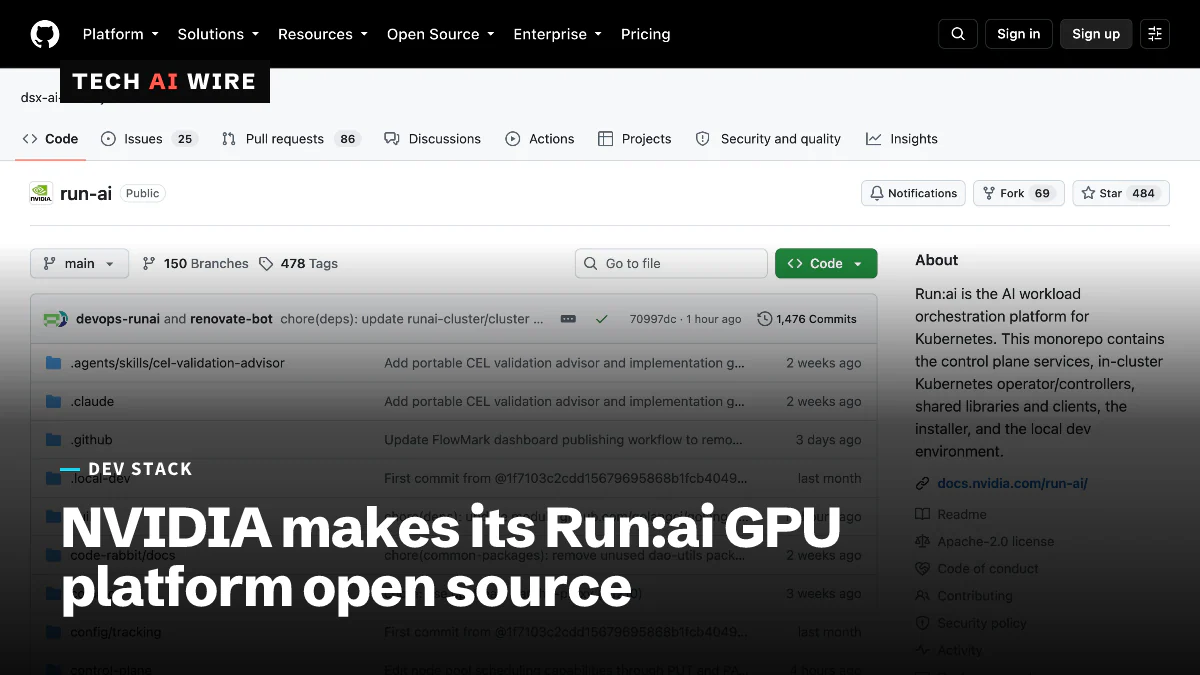
NVIDIA released its full Run:ai platform as open source on October 13, 2026. Run:ai is software that decides which AI jobs run on which GPUs across a cluster, and until now most of it was a paid product. Any team running NVIDIA GPUs on Kubernetes can now install it without a subscription.
That matters because GPUs are expensive and often sit idle. Run:ai's main job is packing more work onto the same chips.
What NVIDIA released
According to NVIDIA's announcement, the whole platform is now open source as part of its DSX AI Factory Platform. NVIDIA bought Run:ai at the end of 2024, Techstrong.ai notes.
The platform runs on Kubernetes, the widely used system for running software across many servers. NVIDIA split it into four parts that teams can adopt separately: KAI Scheduler, the GPU Fractioning Operator, KAI Resource Management and Workload Map.
| Item | Detail |
|---|---|
| Released | October 13, 2026 |
| Modules | KAI Scheduler, GPU Fractioning Operator, KAI Resource Management, Workload Map |
| Where to get it | NGC Community Product, installed with a Helm chart |
| Price | No paid subscription required |
| Support | NVIDIA enterprise support not included |
| KAI Scheduler license | Apache 2.0, a CNCF Sandbox project |
| Launch partners | 8 |
NGC is NVIDIA's software catalog. A Helm chart is a ready-made install package for Kubernetes.
KAI Scheduler itself is not new to open source. It has been available under the Apache 2.0 license since April 2025 and was contributed to the CNCF, the foundation behind Kubernetes, as an early-stage Sandbox project. The code for the rest sits in NVIDIA's DSX AI Factory organization on GitHub. NVIDIA's post says it ships under "applicable open source licenses" without naming one for the whole platform.
How GPU sharing works
The headline feature is fractioning, which means splitting one GPU between several jobs. A small model serving a chatbot rarely needs a whole data-center GPU. Without sharing, it still gets one, and the rest sits unused.
Techstrong.ai reports that fractioning now moves from NVIDIA's proprietary version to native support in CUDA 13.4, NVIDIA's GPU programming toolkit. The open-source operator adds the Kubernetes layer on top.
Nebius, a cloud provider and launch partner, published test results. They used the commercial Run:ai version 2.24, not the new open release:
- At half a GPU, workloads kept 77% of full-GPU throughput.
- At half a GPU, they kept 86% of the users a full GPU could serve: 8,768 versus 10,200.
- Running chat, reasoning and embedding models together on shared GPUs served roughly three times more users than giving each its own.
"If half a GPU delivers 77% of the throughput, all-or-nothing allocation is leaving capacity idle," Nebius writes.
Who is backing it
Eight partners integrate the platform at launch, NVIDIA says: Crusoe, Mirantis, Nebius, OpenNebula Systems, Rafay, Saturn Cloud, Spectro Cloud and vCluster. Nebius offers it on its managed Kubernetes service.
NVIDIA also cites results for Model Streamer, a related tool that loads model files onto GPUs faster. Microsoft Azure reports loading three to six times faster, at a steady 80 Gbps against about 40 Gbps on the default path.
The catch: it still runs on CUDA
Techstrong.ai points to the limit. GPU sharing depends on CUDA, so it only works on NVIDIA hardware. Run:ai once said it would support AMD and Intel chips, and this release does not address that.
"Open source doesn't equate to hardware-neutral, and buyers should judge this release on that line," said Mitch Ashley of The Futurum Group. "The real check comes when a second accelerator vendor enters the data center."
What this means for developers
For platform teams that run GPUs on Kubernetes:
- Start with one module. KAI Scheduler is the most mature piece, with over a year as open source. Try it on a test cluster before adding GPU sharing.
- Benchmark sharing on your own models. The 77% figure came from Nebius's tests on the commercial version. Inference jobs with steady, small traffic are the best candidates. Large training jobs usually still want whole GPUs.
- Plan for support yourself. The free release comes without NVIDIA's enterprise support. Budget engineering time to run it, or use one of the eight partners.
- Check licenses repo by repo. NVIDIA names Apache 2.0 for KAI Scheduler but no single license for the full platform. Have legal review each component you deploy.
- Count the lock-in. Native fractioning needs CUDA 13.4. If you expect to add AMD or other accelerators, keep scheduling choices that do not depend on it.
Sources
Related articles
ZLUDA adds cuFFT support for AMD GPUs via hipFFT
A merged pull request adds NVIDIA's cuFFT library to ZLUDA, letting AMD GPUs run CUDA-based Folding@Home units with no code changes.

Nouveau boots on Nvidia's DGX Spark GB10, unofficially
A Red Hat engineer got the open-source Nouveau driver and NVK running on Nvidia's DGX Spark GB10. It took about 100 patches, and upstreaming isn't settled yet.

Microsoft reportedly exits Nscale's Loughton data center
Microsoft has reportedly dropped its deal to anchor Nscale's Loughton site, where power may not arrive until the 2030s, weeks before a $3 billion IPO.
The weekly digest
One email every Friday with the week's top stories from all six desks: AI, dev tools, coding, the tech industry, startups and what's next. Free, no spam.