Mistral Large 4 open weights land on Hugging Face
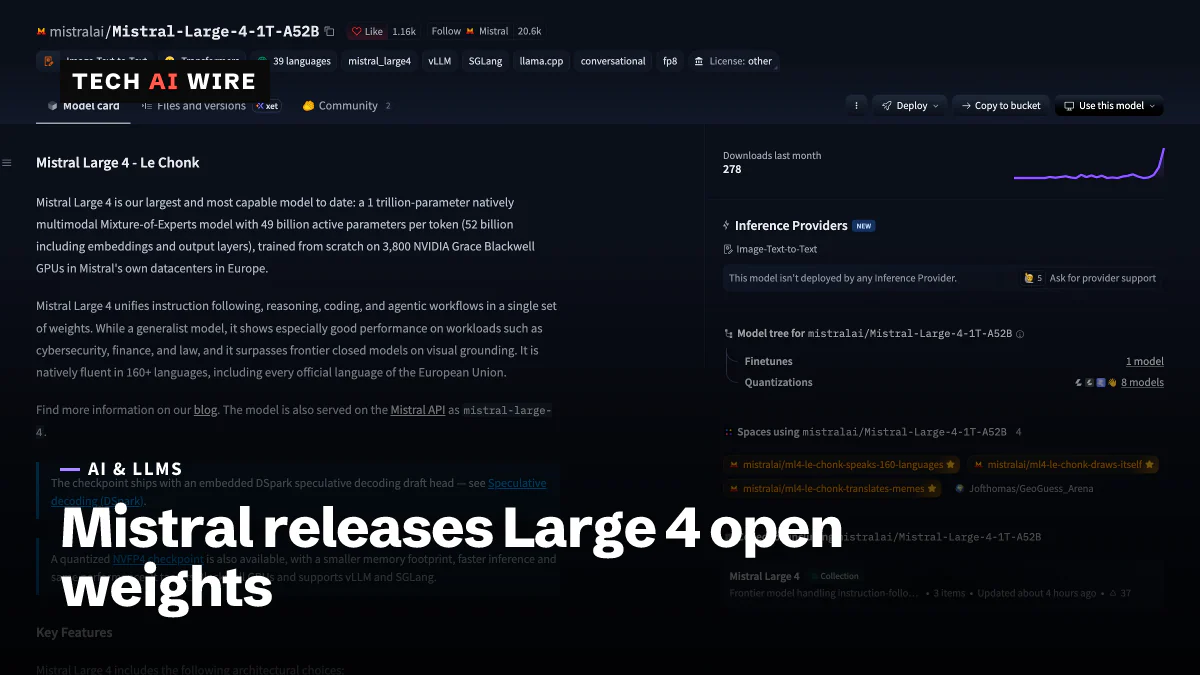
Mistral Large 4's weights went public on October 29 as a 1,060.6 GB download under a modified MIT license. Hosting it as a service needs a separate deal.
5 min read
By the numbers
- size of the bf16 weights, per OrcaRouter
- 1,060.6 GB
- Terminal-Bench 4.0 score, up from 28% in preview
- 41%
- token context window, per the model card
- 1M
- Nvidia B200 or B300 GPUs for the quantized build
- 4
- Mistral Large 4
- 41%
- GLM-5.3
- 40%
- DeepSeek V4.1 Flash
- 31%
- Large 4 preview
- 28%
- Kimi K3
- 21%
Mistral AI published the open weights of Mistral Large 4 on Hugging Face on October 29, 2026, about three weeks after the model's API preview. Anyone can now download the roughly 1 trillion parameter model and run it on their own servers. The catch is in the license: a company that sells access to it as a hosted service needs a separate deal with Mistral.
The release follows the public preview on October 6, when Mistral said the weights would come later in the month. They arrived with better benchmark scores, two new reasoning modes and a license that is close to MIT but not quite.
What Mistral released
Mistral's announcement calls the model "Le Chonk." It is a mixture-of-experts model, or MoE. That design splits the network into many smaller "expert" parts and sends each token through only a few of them. So the model is huge on disk but does far less work per word than its size suggests.
The Hugging Face model card lists the main specs:
| Spec | Mistral Large 4 |
|---|---|
| Repository | mistralai/Mistral-Large-4-1T-A52B |
| Total parameters | About 1 trillion |
| Active parameters per token | 49B, or 52B with embedding and output layers |
| Experts | 128 routed, 4 active, plus 1 shared |
| Context window | 1M tokens |
| Inputs | Text and images |
| Languages | 160+ |
The card also lists a built-in DSpark draft head. It powers speculative decoding, a trick where a small, fast helper guesses the next few tokens and the big model checks them. Mistral says this raises throughput by up to 1.9x in its own measurements.
OrcaRouter, an AI routing company, inspected the repository on release day. It counted 54 weight files totaling 1,060.6 GB in bf16, a 16-bit number format, and found no access gate. A second repository holds an NVFP4 build, which uses Nvidia's 4-bit format, at 610.1 GB.
What the license allows
The weights ship under the Mistral Ecosystem Open-Weight License. Mistral describes it as a modified MIT license, and MIT is one of the most permissive licenses in software. Use, changes, fine-tuning and commercial products are all allowed.
The change is one clause. A company that "operates a Model as a Service business" must get a separate commercial license from Mistral first, according to OrcaRouter's reading of the license file. That means letting outside customers send prompts to the model and control its inputs or settings.
OrcaRouter says these uses fall outside that clause:
- Products that build the model into their own features
- Services that only relay requests to models hosted by others
- Internal use with no access for third parties
- Use through Mistral's own products
Benchmarks after three more weeks of training
Mistral spent the time since the preview on more reinforcement learning, a training stage that rewards the model for good answers. The Next Web reports that this lifted its Terminal-Bench 4.0 score from 28% to 41%. Terminal-Bench measures how well a model completes tasks at the command line.
Mistral reported these other results for the released model:
| Benchmark | Score | Note |
|---|---|---|
| Artificial Analysis Coding Agent Index | 48% | 47% fewer tokens per task |
| Artificial Analysis Cyber Index | 51% | Mistral's figure |
| CyberGym-E2E | 79% | Equal to MiMo-V2.6-Pro, per The Next Web |
| BrowseComp | 84.5% | Mistral's figure |
| B3 Agent Security Benchmark | 97.1% | Up from 93.3% in preview |
The Next Web says the coding index result ties GLM-5.3 while using 47% fewer tokens per task. Fewer tokens means smaller bills and faster replies for the same job. Mistral also added low and medium reasoning modes, and says the default high mode is now 50% more efficient.
On safety, Mistral says the model refused 96.6% of malicious cyber requests on average. It says the model still handles legitimate defensive security work.
These are vendor numbers. OrcaRouter notes that no third party had re-run the benchmarks on the released files. It adds that Artificial Analysis rebased its Intelligence Index on October 27. The model's new v5 score of 26 therefore does not compare with the 38.4 it posted in preview.
Price and hardware
The hosted API prices conflict. Mistral's announcement lists $0.70 per million input tokens, $0.07 for cached input and $2.10 for output. OrcaRouter says those are rounded promotional prices of $0.68 and $2.09, against list prices of $1.36 and $4.18. The Next Web reported that API pricing was not yet published.
Running it yourself takes a server, not a workstation. The model card's vLLM example splits the model across 8 GPUs. OrcaRouter puts the bf16 build on eight accelerators with 141 GB of memory each. The Next Web reports that the quantized build runs on four Nvidia B200 or B300 GPUs.
Mistral trained the model on 3,800 Nvidia Grace Blackwell GPUs in Europe. The Next Web says the extra training drew about 10 megawatts in France. "Other labs have raised hundreds of billions to develop equivalent capabilities," CEO Arthur Mensch told the outlet.
The model is also offered through OpenRouter, Nvidia's endpoints and Microsoft Foundry, according to Mistral. Earlier open models it now competes with include Xiaomi's MiMo-V2.6-Pro, which shipped under a plain MIT license.
What this means for developers
- Read clause 2 before you build a product on it. If your customers send their own prompts and choose model settings, you may count as a Model-as-a-Service business. Ask Mistral before launch, not after.
- Expect your license scanner to flag it. Hugging Face tags the license as "other," not MIT. Add it to your approved list on purpose, after a legal review.
- Plan the download like a data migration. More than a terabyte of weights needs fast storage and hours of transfer. Teams with Blackwell GPUs can start with the 610.1 GB NVFP4 build.
- Test on the hosted API first. Every score above is vendor-reported. Run your own coding and agent tasks through the API before you buy or rent eight GPUs.
- Count tokens as well as scores. When you pay per token, a 47% cut in tokens per task can matter more than a one-point lead on a benchmark.
Mistral also plans smaller distilled versions of the model, The Next Web reports, but it has given no dates.
Sources
- Mistral Large 4 (Le Chonk) is now open weight - Mistral AI
- mistralai/Mistral-Large-4-1T-A52B - Hugging Face
- Mistral releases open weights for its 1 trillion-parameter Large 4 model - The Next Web
- Mistral Large 4 Open Weights: 1.06 TB, No Gate, One Catch - OrcaRouter
Related articles
Nvidia Nemotron 3.5 Transcribe: one open speech model
Nvidia's Nemotron 3.5 Transcribe is an open-weight model that transcribes 40 languages, labels speakers and translates, trained on 463,062 hours of audio.
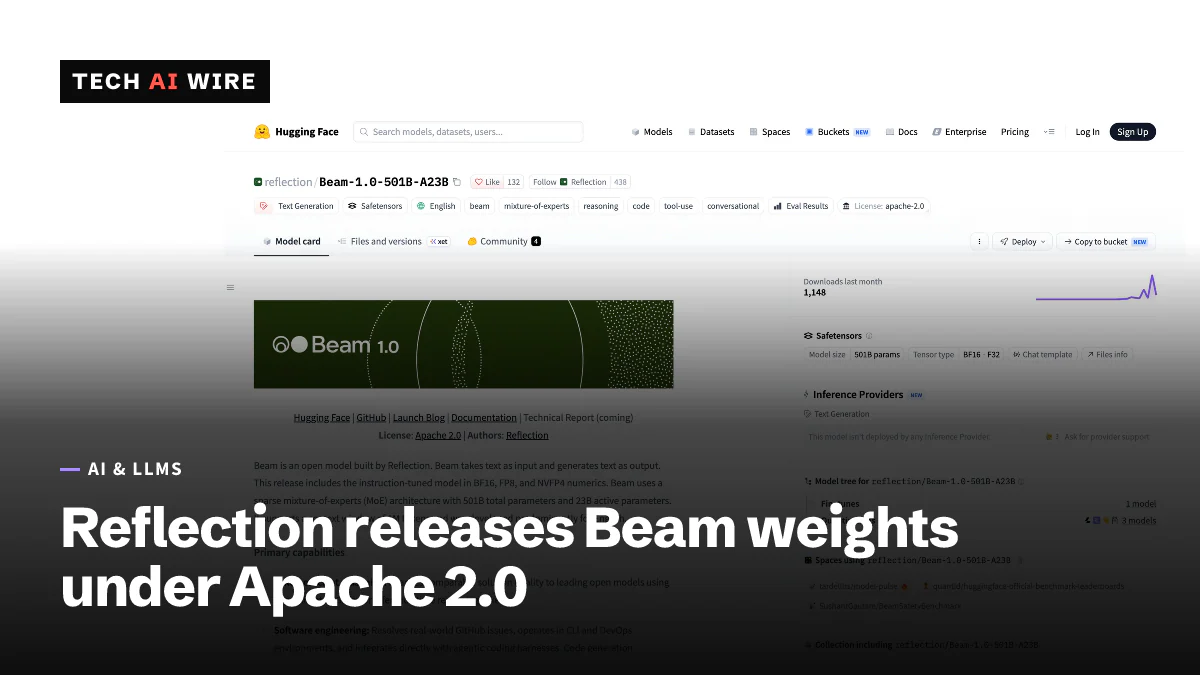
Reflection Beam open weights land under Apache 2.0
Reflection put Beam's 501B-parameter weights on Hugging Face on October 16, 2026 under Apache 2.0. The FP8 and 4-bit versions fit on one 8-GPU server.
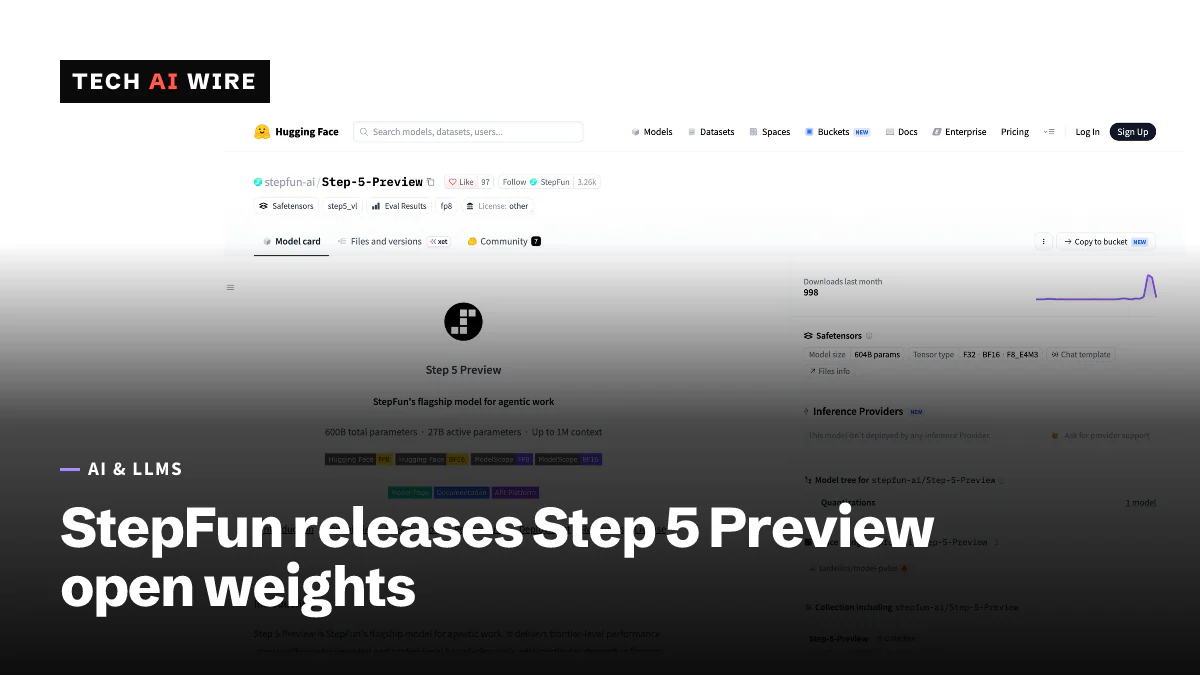
StepFun Step 5 Preview: 600B open-weight agent model
StepFun's Step 5 Preview, a 600B-parameter model with 27B active and a 1M-token context, is on Hugging Face after an API-only month at $1/$2.70 per M.
The weekly digest
One email every Friday with the week's top stories from all six desks: AI, dev tools, coding, the tech industry, startups and what's next. Free, no spam.