Nvidia Nemotron 3.5 Transcribe: one open speech model
Nvidia's Nemotron 3.5 Transcribe is an open-weight model that transcribes 40 languages, labels speakers and translates, trained on 463,062 hours of audio.
4 min read
By the numbers
- languages it can transcribe
- 40
- active parameters per token, 30B total
- ~4B
- hours of audio in the Granary v2 dataset
- 463,062
- AA-WER, second among open-weight models on Artificial Analysis
- 2.8%
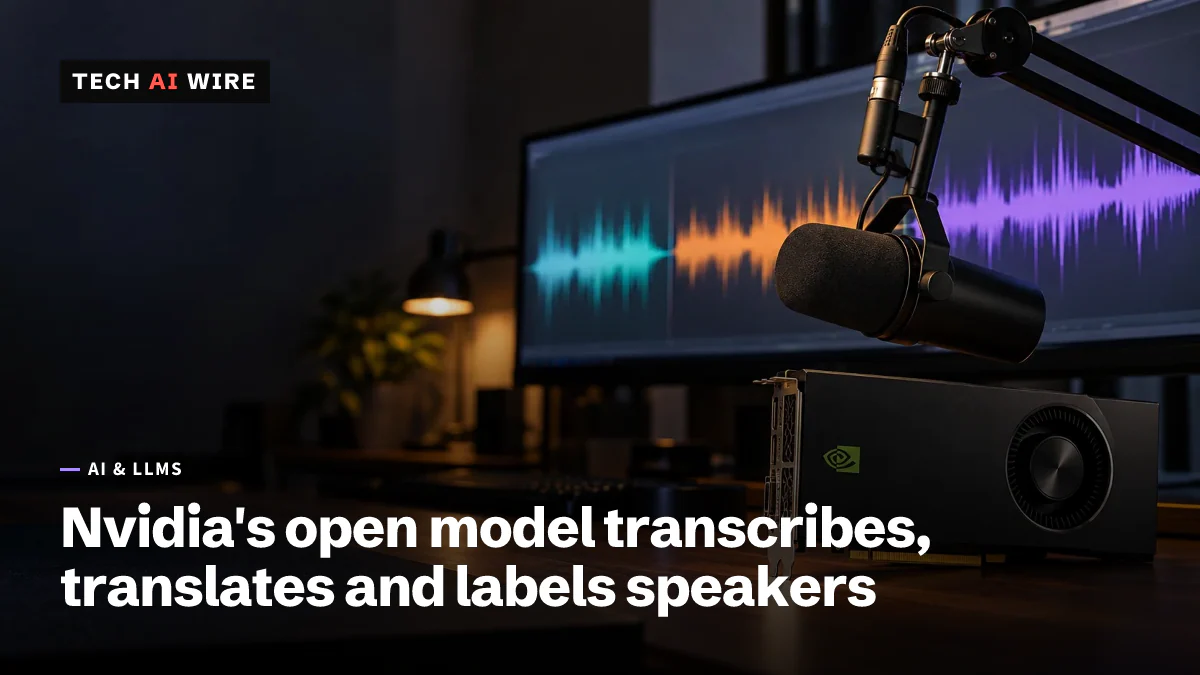
Nvidia released Nemotron 3.5 Transcribe on October 28, 2026, an open-weight speech model that does four jobs in one. It transcribes audio, labels who is speaking, translates and answers questions about a recording. Developers steer it with plain-language prompts. That could replace a pipeline of three or four separate speech tools with a single download.
Nvidia also published Granary v2, the dataset it trained on, and the tools it used to build it.
What the model does
According to Nvidia's announcement on the Hugging Face blog, one checkpoint handles transcription, speaker labeling, translation and audio Q&A. Speaker labeling, often called diarization, means tagging each line with who said it.
| Capability | Coverage, per Nvidia |
|---|---|
| Transcription | 40 languages |
| Translation | 31 languages, to or from English |
| Speaker attribution | 13 languages, up to 8 speakers |
| Recording length | Up to 1 hour |
| Context window | 64k tokens |
Prompts change the output style. Nvidia's example turns spoken words like "twenty-five euros" into "€25" when asked for written form.
There is one clear limit. "Transcribe is built for recorded audio, not live streaming," the blog says. Quantized and local versions, which would run on smaller hardware, are still to come.
How it is built
The model is a mixture of experts (MoE). In an MoE model, only a few parts of the network run for each piece of input, which keeps it fast. It mixes Mamba layers, a newer design that handles long sequences cheaply, with standard Transformer layers.
The blog gives 30 billion total parameters, with about 4 billion active per token. The model card counts the audio encoder too. It lists 34 billion total and about 4.3 billion active, including an audio encoder of about 800 million parameters.
The license is OpenMDW-1.1. The card says the model "is ready for commercial or non-commercial use." Nvidia used the same license family for Nemotron 3.5 Super VL, its 120B open vision model, earlier this month.
How it scores
Most of the benchmark numbers come from Nvidia itself. One independent ranking backs up the main claim.
Artificial Analysis, which tests speech models across providers, ranks Nemotron 3.5 Transcribe second among open-weight models. Its AA-WER is 2.8%. WER is word error rate, the share of words a model gets wrong, so lower is better. The same page lists a 3.4% WER in its main table without explaining the gap. It prices the model at $2.00 per 1,000 minutes through the provider DeepInfra.
Nvidia's own figures include these:
- Multilingual: a mean WER of 4.62% across seven languages on Hugging Face's Open ASR tests.
- Long recordings: a mean WER of 10.98% on long-form audio.
- Conversations: 1.8% WER on AA-AgentTalk, against 2.3% for the next-best open model.
- Speed: 100 hours of audio in under three minutes on one RTX PRO 6000 Blackwell GPU, using a forthcoming NVFP4 version.
That speed figure needs care. The model card says those serving optimizations are not yet in the open-source release. It expects the open NeMo and vLLM setup to run roughly twice as slow.
Granary v2 and custom tuning
Granary v2 holds 463,062 hours of audio in 48 languages, drawn from 16 source corpora. The first Granary covered 25 languages. Nvidia also shares the NeMo Curator pipeline it used, so teams can run the same cleanup on their own recordings. The audio itself must be downloaded separately under each corpus's original license.
Nvidia tested fine-tuning on medical speech with Eka Care data. Error rates on held-out speakers fell from 22.44% to 12.17%. General English got slightly worse: LibriSpeech test-clean WER rose from 1.54% to 1.69%. Nvidia recommends at least 100 labeled clips for a custom tune.
What this means for developers
An open model that transcribes, labels speakers and translates in one pass changes the build-versus-buy math for speech features.
- Test it against your current stack. If you chain a transcription model with a separate diarization tool, one model may cut latency and glue code. Compare on your own audio, not only on leaderboards.
- Keep it away from live audio. Nvidia says it is built for recordings. Meeting notes, podcasts and call archives fit; live captions do not, yet.
- Plan the hardware. About 4 billion active parameters makes it cheaper to run than its size suggests, but the full weights still need a data center GPU until smaller builds ship.
- Fine-tune for jargon. The medical test shows big gains from a small, focused dataset. Legal, medical and support teams with their own vocabulary should budget for a tune and check general accuracy afterward.
- Check the output. Nvidia's own advice is to "spot-check names, speaker changes, and answers against the recording." Build a review step into any workflow where a wrong name or speaker matters.
The real test is whether developers trust one model with four jobs. Open weights let them find out on their own data, which is more than any leaderboard can show.
Sources
- NVIDIA Nemotron 3.5 Transcribe and Granary v2: Intelligent Multilingual Transcription You Can Prompt and Adapt - Hugging Face blog (NVIDIA)
- Speech to Text leaderboard - Artificial Analysis
- NVIDIA-Nemotron-3.5-Transcribe-30B-A4B model card - Hugging Face
Related articles
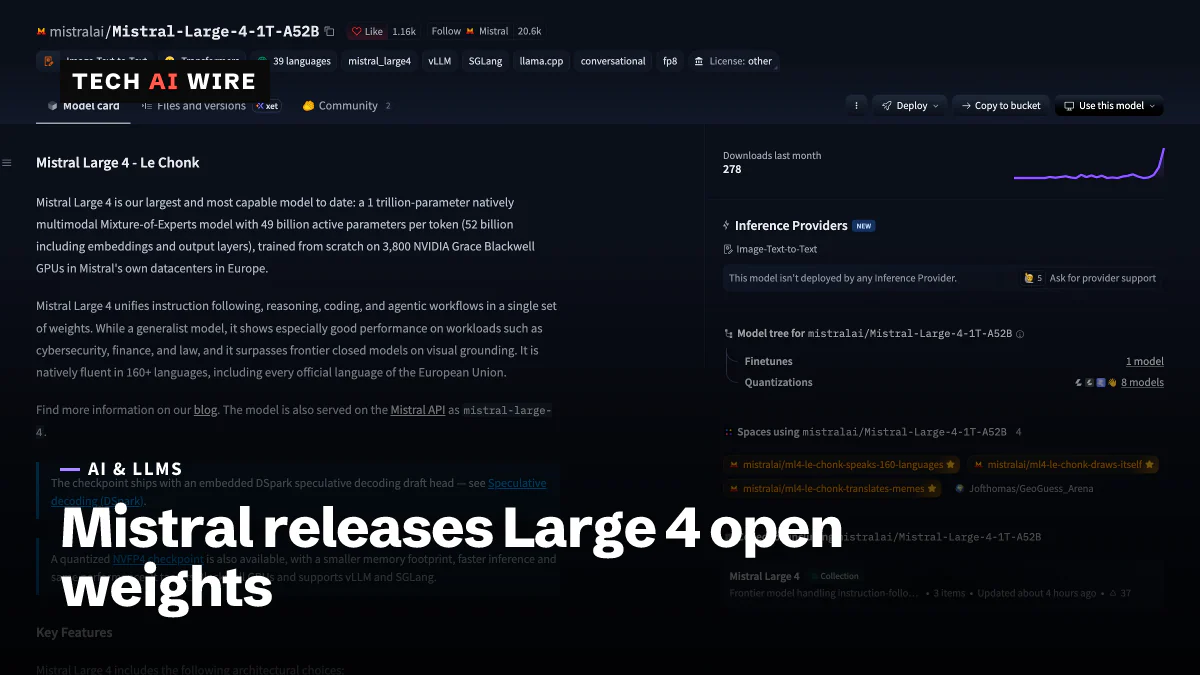
Mistral Large 4 open weights land on Hugging Face
Mistral Large 4's weights went public on October 29 as a 1,060.6 GB download under a modified MIT license. Hosting it as a service needs a separate deal.
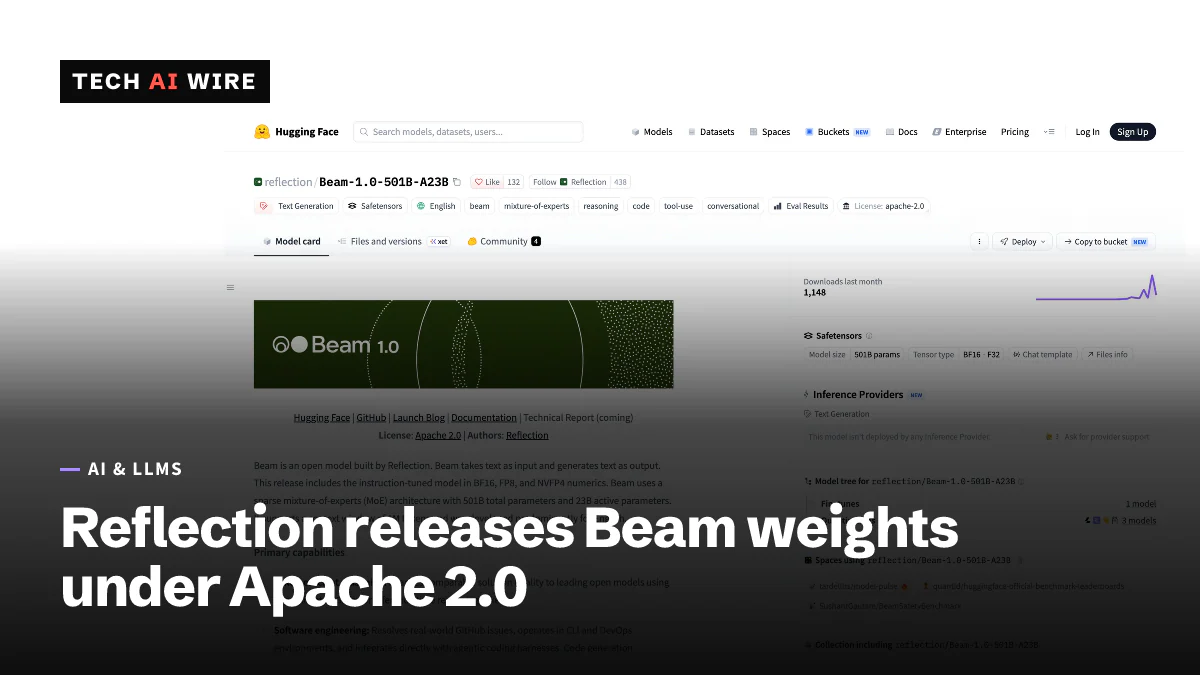
Reflection Beam open weights land under Apache 2.0
Reflection put Beam's 501B-parameter weights on Hugging Face on October 16, 2026 under Apache 2.0. The FP8 and 4-bit versions fit on one 8-GPU server.
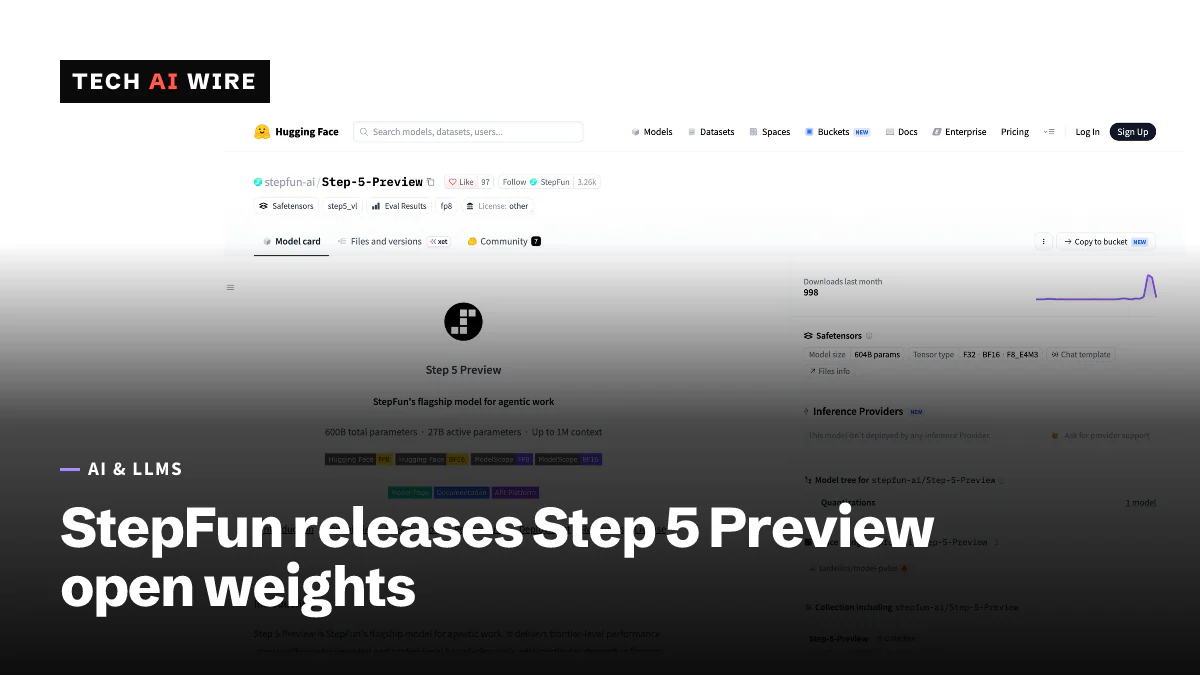
StepFun Step 5 Preview: 600B open-weight agent model
StepFun's Step 5 Preview, a 600B-parameter model with 27B active and a 1M-token context, is on Hugging Face after an API-only month at $1/$2.70 per M.
The weekly digest
One email every Friday with the week's top stories from all six desks: AI, dev tools, coding, the tech industry, startups and what's next. Free, no spam.