Reflection Beam open weights land under Apache 2.0
Reflection put Beam's 501B-parameter weights on Hugging Face on October 16, 2026 under Apache 2.0. The FP8 and 4-bit versions fit on one 8-GPU server.
4 min read
By the numbers
- total parameters, 23B active per token
- 501B
- token context window
- 1M
- enough for the FP8 and 4-bit versions
- 8 GPUs
- Terminal-Bench 2.1 score, BF16
- 80.1
- DeepSeek V4.1 Flash
- 90.6%
- Kimi K3
- 85%
- Reflection Beam
- 80.1%
- Muse Spark Open
- 76.4%
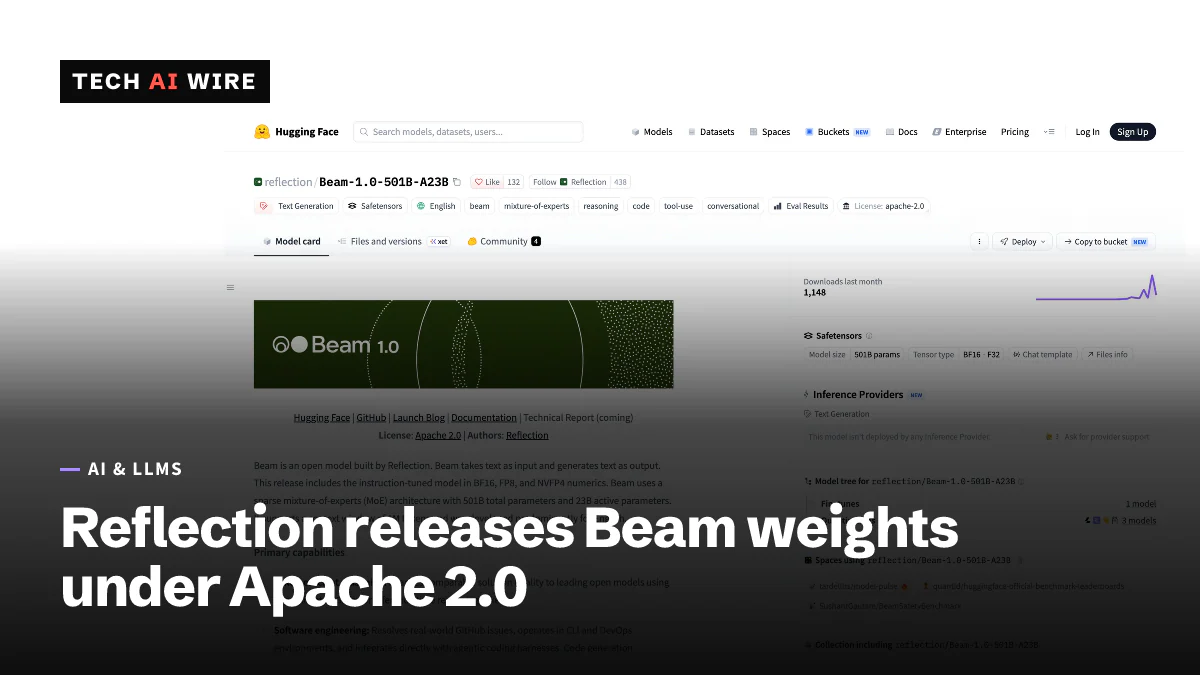
Reflection released the weights of Beam, its 501-billion-parameter AI model, on Hugging Face on October 16, 2026, under the Apache 2.0 license. Apache 2.0 lets anyone use, change and sell products built on the model with few conditions. That makes Beam one of the largest models available with no custom license terms, and its compressed versions fit on a single eight-GPU server.
The release keeps the promise Reflection made when it announced Beam on October 5, when the weights were due "later this month." "Beam is our first open-weight model," the company wrote in its release post.
What Reflection released
Beam is a sparse mixture-of-experts (MoE) model. Its parameters are split into many smaller expert networks, and only a few run for each token, a word or part of a word. The Hugging Face model card lists the details:
| Spec | Beam-1.0-501B-A23B |
|---|---|
| Total parameters | 501.3B |
| Active per token | 23.4B |
| Experts and layers | 256 experts, 52 layers |
| Context window | 1M tokens |
| Input | Text only, mainly English |
| Weight formats | BF16, FP8 and NVFP4 |
| License | Apache 2.0 |
The card describes this as the instruction-tuned model, the version trained to follow requests. Reflection also shipped a smaller draft model for speculative decoding, a trick that speeds up text generation. It added fused kernels, ready-made settings for several serving programs and a Beam Safety Technical Report. A full technical report is still listed as coming. Recipes for self-distillation will follow "in the coming days," SiliconANGLE reports.
Reflection also released Mirror CLI, a coding agent that runs in a terminal, VentureBeat reports. The company calls the whole package an "open operating system for agents."
How the compressed versions score
Quantization stores a model's numbers with fewer bits, which cuts memory at some cost in accuracy. On Reflection's own tests, that cost is small:
| Benchmark | BF16 | FP8 | NVFP4 |
|---|---|---|---|
| SWE-bench Verified | 81.6 | 80.2 | 80.7 |
| SWE-Bench Pro v1 | 66.1 | 65.9 | 65.6 |
| Terminal-Bench 2.1 | 80.1 | 78.9 | 78.4 |
| GPQA Diamond | 90.6 | 90.3 | 89.3 |
| LiveCodeBench | 88.3 | 88.1 | 87.4 |
The 8-bit and 4-bit versions fit on one server with eight H100, H200 or GB300 GPUs, VentureBeat reports. The full 16-bit version needs "tens of GPUs."
Against rivals, Beam is not the top scorer. The chart shows the Terminal-Bench 2.1 figures VentureBeat compiled. DeepSeek's V4.1 Flash leads at 90.6, ahead of Beam's 80.1. Beam beats Meta's Muse Spark Open, which scored 76.4.
The pitch: fewer tokens
Reflection's case rests on efficiency, not raw scores. It claims Beam matches GLM-5.2 on advanced reasoning while using three to four times less inference compute, not counting prompt processing. The model is trained to reach answers with fewer reasoning tokens.
"You don't give up anything. You just penalize it in terms of how many tokens it can use," Ioannis Antonoglou, Reflection's co-founder and CTO, told VentureBeat. VentureBeat estimates that Muse Spark Open uses about 1.8 times Beam's compute per token.
Reflection has not set a price. Its platform beta is "free to start," the company says, and it lists more than 40 launch partners. Dell and HPE will install Beam on customers' own hardware.
The release follows a Financial Times report on October 10 that Nvidia is in early talks to buy Reflection or invest more. Antonoglou called that "baseless rumors" without confirming or denying talks, VentureBeat reports. He described Nvidia as "a close partner and investor."
What this means for developers
- Start with FP8 or NVFP4. Reflection's numbers show the compressed versions within about two points of full precision. They fit on one eight-GPU server instead of a multi-server cluster.
- Count tokens per task, not price per token. Reflection's claim is that Beam reaches answers with fewer tokens. Measure total tokens and time on your own tasks to test it, because that is where any saving appears.
- The license is the simple part. Apache 2.0 carries no revenue caps or custom terms. Legal review should be shorter than for models under custom licenses, such as Muse Spark Open's.
- Treat the scores as vendor numbers. Every benchmark here comes from Reflection or a model card. Independent tests can now start because the weights are public.
- Watch the follow-ups. The full technical report and the self-distillation recipes are still to come. So is any outcome of the reported Nvidia talks, which could change who controls the model's roadmap.
Sources
- Beam is now available - Reflection
- reflection/Beam-1.0-501B-A23B model card - Hugging Face
- Reflection's Beam aims to undercut Chinese open models with fewer tokens, not cheaper tokens - VentureBeat
- Reflection AI open-sources Beam's weights, post-training recipes - SiliconANGLE
Related articles
StepFun Step 5 Preview: 600B open-weight agent model
StepFun's Step 5 Preview, a 600B-parameter model with 27B active and a 1M-token context, is on Hugging Face after an API-only month at $1/$2.70 per M.

Reflection AI launches Beam, a 501B open-weight model
Reflection AI's Beam has 501B parameters but uses 23B per token, scores 80.9 on SWE-Bench Verified, and ships weights under Apache 2.0 later in October.
Ling-3.1-flash: Ant Group opens 560B model under MIT
Ant Group's inclusionAI published Ling-3.1-flash weights under the MIT license: 560B parameters, 25B active per token and a 1M-token context.
The weekly digest
One email every Friday with the week's top stories from all six desks: AI, dev tools, coding, the tech industry, startups and what's next. Free, no spam.