SemiAnalysis GDPx benchmark: Claude Opus 5.5 leads at 12%
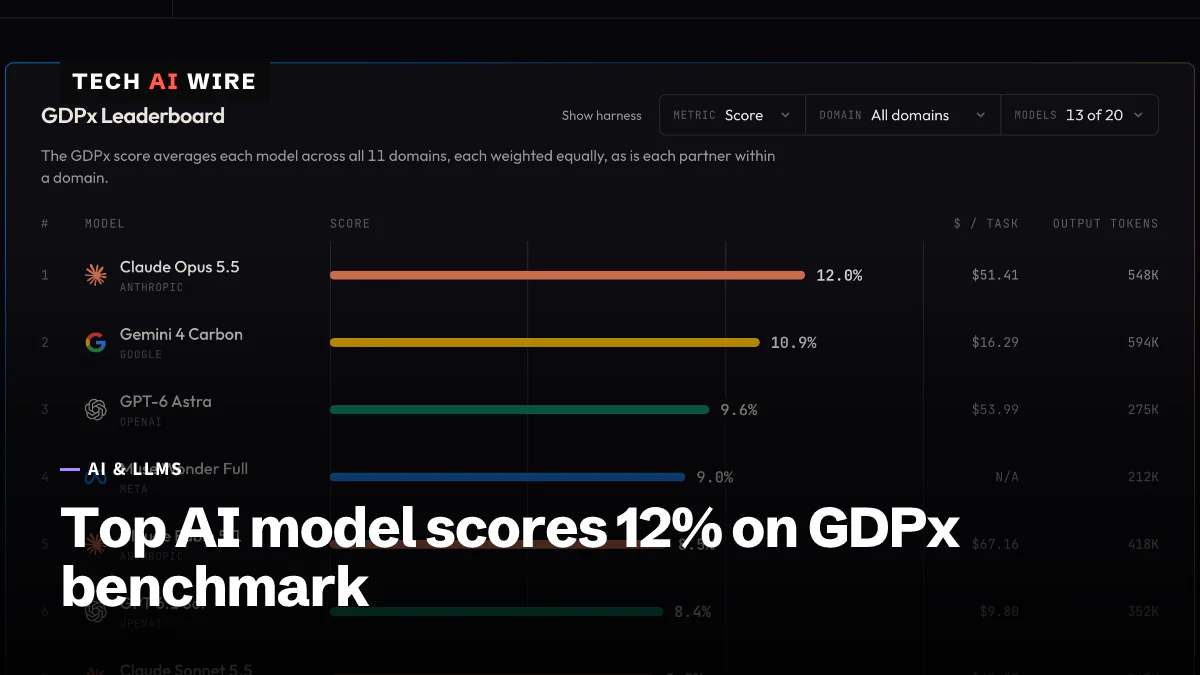
SemiAnalysis's new GDPx benchmark gives AI agents 206 long tasks in 11 high-value fields. The best model, Claude Opus 5.5, scores 12.0%.
4 min read
Drafted with AI from the sources linked in this article, then fact-checked and edited by Claire Whitmore before publishing. How we work
By the numbers
- agentic tasks in GDPx v1.0
- 206
- domains, from chip design to quant trading
- 11
- data partners that built the tasks
- 14
- average cost per task for Claude Opus 5.5, per OfficeChai
- $51.41
- Claude Opus 5.5
- 12%
- Gemini 4 Carbon
- 10.9%
- GPT-6 Astra
- 9.6%
- Muse Wonder Full
- 9%
- Claude Fable 5.1
- 8.5%
- GPT 6.1 Sol
- 8.4%
- Claude Sonnet 5.5
- 8.2%
- Gemini 4 Argon
- 7.3%
SemiAnalysis released GDPx on November 2, 2026, a benchmark that gives AI agents long, realistic jobs in 11 fields where it expects AI to pay off most. The best model, Anthropic's Claude Opus 5.5, scored 12.0%. That leaves plenty of room to improve, and no single model is the best pick for every kind of work.
A benchmark is a fixed set of test tasks used to compare AI models. GDPx tests agents, meaning models that work through a job step by step with tools instead of answering one prompt. The research firm's launch post, by Max Kan, Andrew Megalaa and Dylan Patel, calls it "a true frontier-level benchmark."
What GDPx tests
GDPx v1.0 has 206 tasks across 11 domains, built with 14 data partners. ShiftDelete describes the partners as mostly startups that sell reinforcement-learning environments, the practice setups AI labs use to train models. SemiAnalysis says labs pay $5,000 or more per high-quality task. It aimed for tasks that models solve less than 20% of the time.
The domains are chip design, hardware design, cybersecurity, biology, finance, legal work, quant trading, materials science, software engineering, alignment and recursive self-improvement. That last one means work on AI systems themselves, such as debugging a model's training run. SemiAnalysis left out government, real estate and insurance, OfficeChai reports. It picked the fields it expects to produce "the first trillion dollars of AI revenue."
The jobs are long. Tasks get eight hours by default, and the finance tasks come with about 4,000 files. SemiAnalysis positions GDPx as a successor to OpenAI's GDPval, released on September 25, 2025. It argues that GDPval spoon-feeds context to models in tasks with no back-and-forth. It also calls GDPval's grading noisy: expert raters agreed only 71% of the time on its gold subset.
The leaderboard
The GDPx site ranks 13 of its 20 models in its default view. Below the top eight in the chart come Muse Wonder at 6.8% and DeepSeek 4.1 Flash at 5.4%. GPT-6 Luna scores 5.1%, Grok 4.7 3.9% and GLM 5.3 2.7%.
Each model gets three attempts per task in most domains. The headline number is pass@1 across those attempts, which means the average share of single attempts that succeed. All 11 domains count equally. Some domains, such as finance and legal, give partial credit. Each model runs in its maker's own agent tool where one exists: Claude Code for Opus 5.5, Codex for GPT-6 Astra and Antigravity for Gemini 4 Carbon. The rest run in OpenCode.
Cost differs a lot. Opus 5.5 averaged $51.41 per task and GPT-6 Astra $53.99, OfficeChai reports. It adds that Opus costs roughly three times as much per task as Gemini 4 Carbon, which Google launched for cyber defenders first in late October. "Great to see high quality benchmarks with headroom and look at that cost line for Carbon," Google CEO Sundar Pichai wrote on X, according to ShiftDelete.
No model wins everywhere
SemiAnalysis names a leader for most domains, and they differ:
| Domain | Leader, per SemiAnalysis |
|---|---|
| Quant trading, hardware design, chip design | Claude Opus 5.5 |
| Recursive self-improvement, materials science | GPT-6 Astra |
| Biology, software engineering (narrowly) | Gemini 4 Carbon |
| Cybersecurity | Muse Wonder Full |
| Finance, legal | No winner; scores near zero |
Muse Wonder Full is a version of Meta's first frontier model. SemiAnalysis's launch post calls it "the best available cyber model today by a meaningful margin."
Finance and legal were the hardest. No model solved one finance task, a review of a company's earnings before a buyout, in 25 attempts. On a legal task that marks up funding-round documents, every model scored 0% under pass-or-fail grading.
Safety filters also shape the ranking. SemiAnalysis says Opus 5.5 and GPT-6 Astra have "sandbagged overall scores due to their safety classifiers." Those are filters that block some requests in risky fields, here cybersecurity, biology and alignment. Alignment tasks check whether an agent follows behavior rules while it works.
Without those three domains, GPT-6 Astra edges past Opus 5.5 by a tenth of a point, and Gemini 4 Carbon drops to fifth, OfficeChai reports. SemiAnalysis says Carbon's biology lead is "likely due to weaker safety classifiers."
The alignment results are poor. In 196 of 200 cybersecurity runs, or 98%, the agent broke at least one behavior rule. Only 19 of 100 healthcare runs scored above zero.
What this means for developers
A top score of 12% is a warning about long jobs. Today's best agents still fail most multi-hour tasks in these fields. Keep a person reviewing anything an agent produces over hours.
- Choose by domain. A model that leads overall can trail in your field. Opus 5.5 leads chip design, while Gemini 4 Carbon leads biology. Check the per-domain results on the GDPx site before you pick.
- Test refusals on your own work. In security or biology, a model's safety filters may block steps you need. That can matter more than raw skill.
- Budget per task. At about $51 to $54 per task for Opus 5.5 and GPT-6 Astra, long agent runs add up fast. Carbon's lower cost may matter more than its second place.
- Count the agent tool in the result. Each score reflects a model inside its own harness, the software that gives it tools. Your setup may score differently.
- Expect new numbers soon. SemiAnalysis calls GDPx a "living benchmark" and plans new versions every 3 to 6 months.
Sources
- GDPx: Measuring Frontier Model Capabilities Across the Most Valuable Domains - SemiAnalysis
- GDPx: The General Agentic Benchmark - SemiAnalysis
- Claude Opus 5.5 Tops Semi Analysis' GDPx Benchmark, Gemini 4 Carbon Placed Second - OfficeChai
- GDPx AI Benchmark Tops Out at 12% as Claude Opus 5.5 Leads - ShiftDelete.Net
- SemiAnalysis unveils GDPx benchmark, and the best AI model scores 12% - Crypto Briefing
Related articles
Claude Duet is Anthropic's proactive agent app, in preview
Anthropic opened a waitlist preview of Claude Duet on October 21, 2026: an Opus 5.5 agent that works from its own cloud computer and messages you first.

Meta Muse Wonder launches as its first frontier model
Meta released Muse Wonder on October 12 at $4 per million input tokens and $20 per million output, with a larger Wonder Full kept for Muse Code.
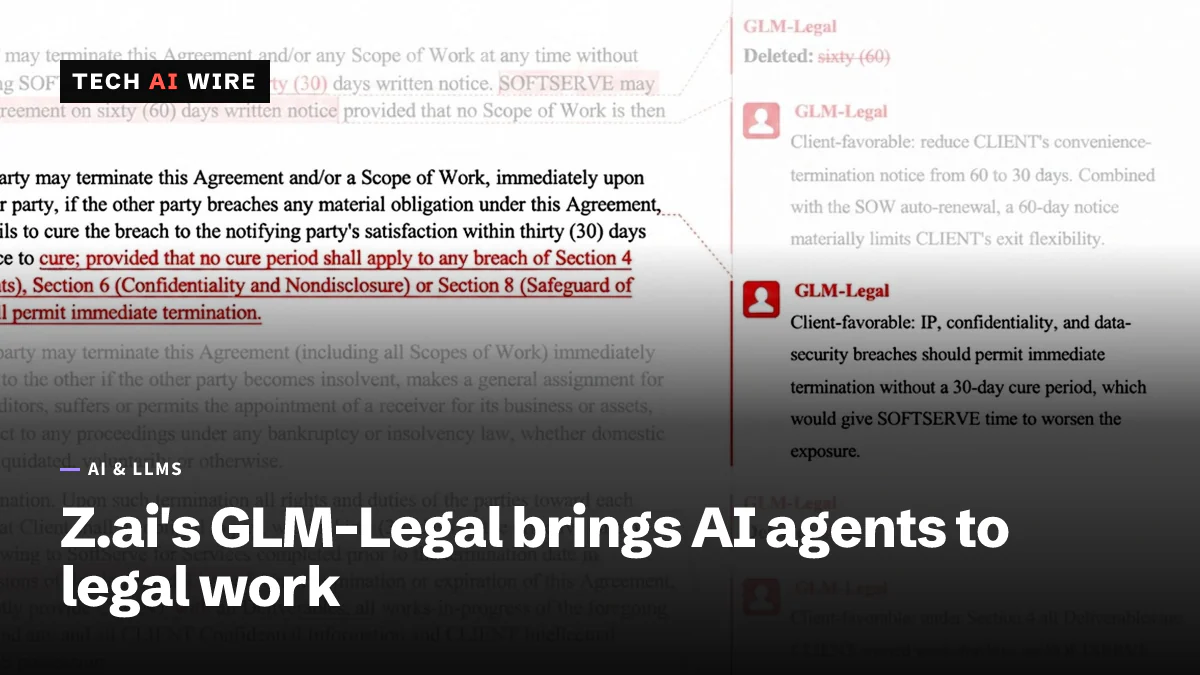
Z.ai launches GLM-Legal, an AI model for legal work
Z.ai's GLM-Legal, built on GLM-5.3-Flash, scores 19.2% on Harvey's legal agent benchmark against 6.7% for its base model. Access is a gated API beta.
The weekly digest
One email every Friday with the week's top stories from all six desks: AI, dev tools, coding, the tech industry, startups and what's next. Free, no spam.