Z.ai launches GLM-Legal, an AI model for legal work
Z.ai's GLM-Legal, built on GLM-5.3-Flash, scores 19.2% on Harvey's legal agent benchmark against 6.7% for its base model. Access is a gated API beta.
4 min read
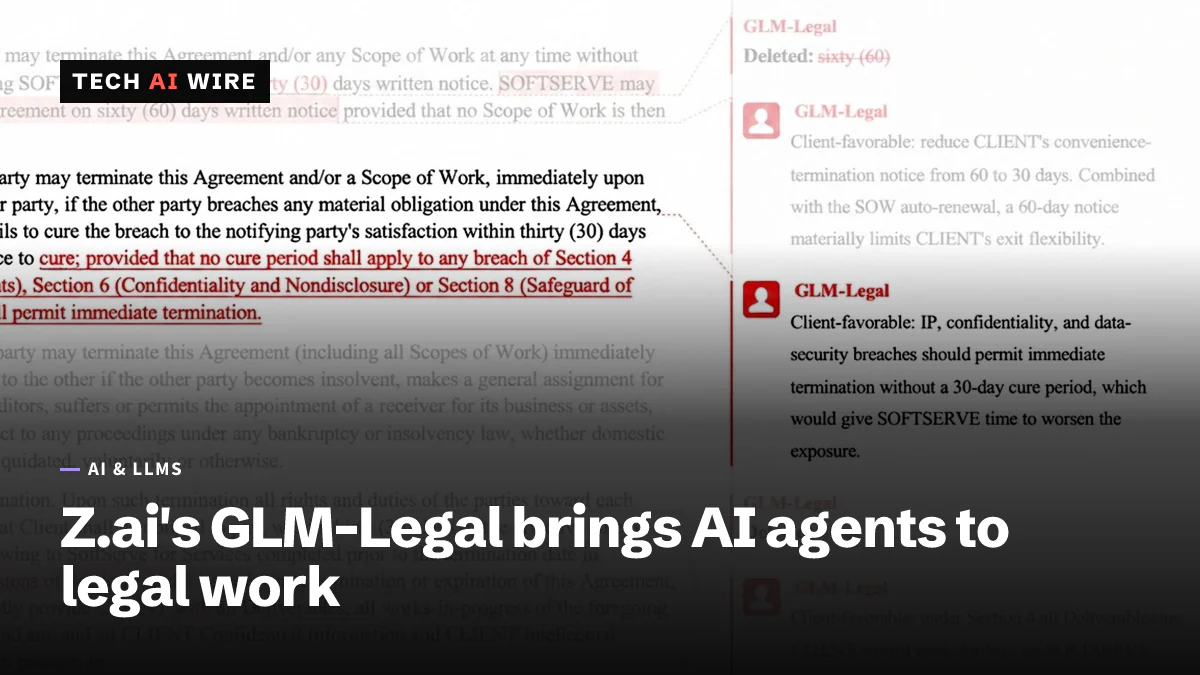
Z.ai, the company behind the GLM family of AI models, announced GLM-Legal on October 12, 2026. It is a version of its GLM-5.3-Flash model trained for legal work such as contract review, evidence analysis and compliance research. Z.ai says it scores 19.2% on Harvey's Legal Agent Benchmark, up from 6.7% for the base model. For now, access is limited to a beta that firms must apply for.
What GLM-Legal is
Z.ai's announcement says GLM-Legal is "built on the lightweight GLM-5.3-Flash foundation." Z.ai released GLM-5.3-Flash with open weights in August. AlphaSignal lists the base model as a mixture-of-experts design, which uses only part of the model for each word it processes. It has 320 billion parameters in total, 18 billion active at a time, and an advertised context window of 1 million tokens.
Z.ai's page gives no size for GLM-Legal itself. It says only that the model runs on a "significantly leaner parameter footprint" than closed frontier models.
Training came in two stages. First, Z.ai trained the model further on a larger set of legal texts. Then it used reinforcement learning, which rewards a model for good results, across "tens of thousands of realistic legal environments." Z.ai built the model together with its "Harness," the software that runs the agent and its tools. "Harness architecture and model training iterate in lockstep," the post says. Unite.AI adds that one stage turns feedback from legal professionals into training signals.
Z.ai explains why it chose law: "Legal work concentrates on these challenges, providing an ideal stress test for training models to operate in high-stakes professional environments."
GLM-Legal benchmark scores
Z.ai published a chart comparing GLM-Legal with its base model and three rival models. All figures below come from that chart.
| Benchmark | GLM-Legal | GLM-5.3-Flash | Kimi K3 | Claude Fable 5 | GPT-6 Astra |
|---|---|---|---|---|---|
| Harvey's Legal Agent Benchmark | 19.2 | 6.7 | 12.9 | 11.3 | 5.4 |
| LegalBench | 86.2 | 83.9 | 86.2 | 88.6 | 87.1 |
| PLawBench | 77.3 | 73.8 | 76.2 | 77.7 | 69.1 |
Harvey's benchmark tests multi-step legal workflows that need planning and tool use, according to AlphaSignal. Z.ai says it covers 24 practice areas. Its score is an all-pass rate: a task counts only if the answer meets every grading criterion. LegalBench tests single legal reasoning tasks. PLawBench, Z.ai says, covers Chinese legal practice: consultation, case analysis and document drafting.
GLM-Legal leads the chart on Harvey's benchmark. On LegalBench it ties Kimi K3 and trails Claude Fable 5 and GPT-6 Astra. On PLawBench it trails Claude Fable 5 by 0.4 points. Z.ai calls these results "matching frontier closed-source models."
The base-model figures line up with outside testing. AlphaSignal published scores from Vals AI, an evaluation firm, for GLM-5.3-Flash: 83.93% on LegalBench and 6.7% on Harvey's benchmark.
How to get access
GLM-Legal is in beta. API access requires an application form on Z.ai's site. Z.ai invites law firms, legal tech companies, in-house legal teams and independent practitioners. Z.ai and Unite.AI both say the model will "soon" come to AutoClaw, Z.ai's desktop agent app. AlphaSignal says new AutoClaw users get 200 million promotional tokens, which Z.ai values at $24.
Several things are not disclosed. They include the price, GLM-Legal's licence, whether its weights will be released, regions, rate limits and data retention. The base model uses the MIT license, per AlphaSignal.
What the demos show
Z.ai's post runs three demos that compare GLM-Legal with its base model:
- Contract review: the model revises the termination and handover terms of a software services contract. AutoClaw writes the edits into Word "with tracked changes and comments."
- Evidence analysis: it finds contradictions in a provider's progress reports across 40 documents from a dispute. Each finding cites the document's Bates number, the ID lawyers stamp on files shared in a lawsuit.
- Compliance research: it drafts a privacy plan for a website launching in Singapore, Malaysia and Indonesia, citing sections of each country's data protection law.
What this means for developers
- Treat the scores as vendor claims. Z.ai picked the benchmarks and ran the comparison. Test GLM-Legal on your own documents before building on it.
- Plan for human review. A 19.2% all-pass rate means about four in five multi-step tasks missed at least one check. Legal tools built on it still need a lawyer in the loop.
- Ask about data before sending client files. Retention and regions are not published. Get both in writing during the beta.
- Check the jurisdiction. PLawBench covers Chinese practice and the demos cover Southeast Asia. Results may not carry over to the law your users work under.
- Self-hosting starts with the base model. GLM-5.3-Flash has open weights under MIT. GLM-Legal is offered only through a gated API for now, so teams that must run models in-house cannot use it yet.
Sources
Related articles
Claude Haiku 5.5 cuts prices 90% below Haiku 4.5
Claude Haiku 5.5 costs $0.10 per million input tokens and $0.50 output, 90% below Haiku 4.5, and scores 39.2% on Terminal-Bench 4.0, up from 0%.
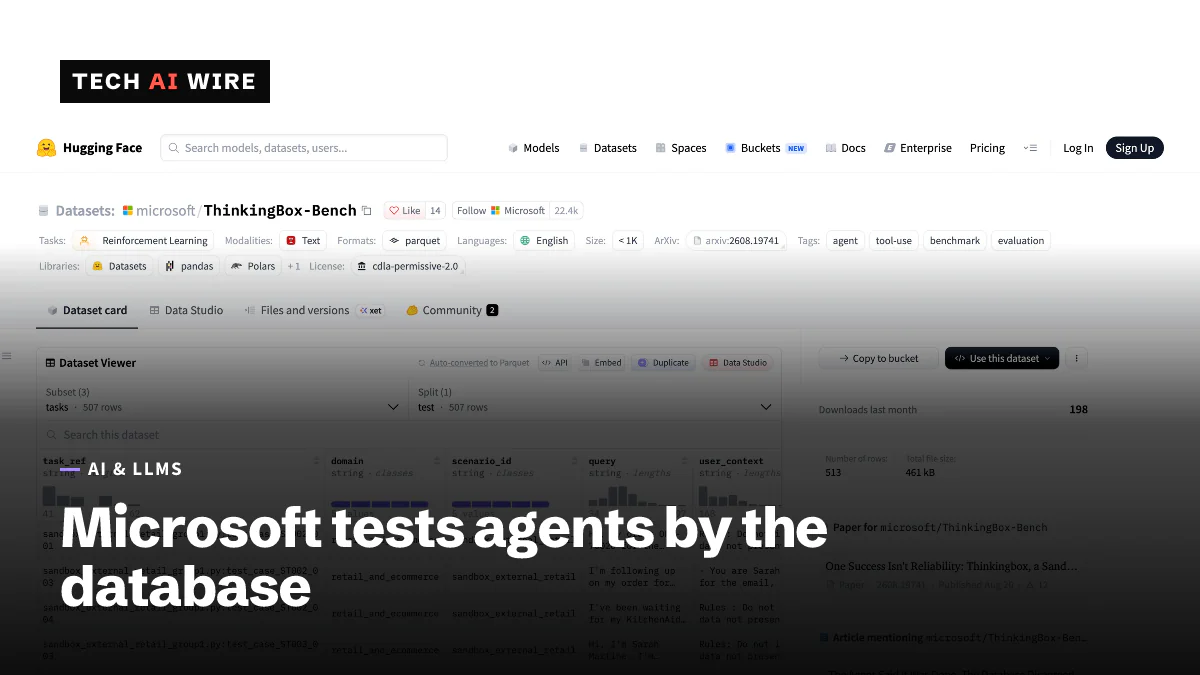
Microsoft ThinkingBox grades AI agents by the database
Microsoft's ThinkingBox checks what an AI agent wrote to the database. 67.24% of 79,853 failed runs ended cleanly, with valid tool calls and wrong data.
Claude Sonnet 5.5 nears Opus 5.5 at half the price
Claude Sonnet 5.5 scores 70.6% on Terminal-Bench 4.0 at $2/$10 per million tokens, half Opus 5.5's price. Sonnet 4.5 retires on November 30, 2026.
The weekly digest
One email every Friday with the week's top stories from all six desks: AI, dev tools, coding, the tech industry, startups and what's next. Free, no spam.