Oura sues Ultrahuman again to block Ring Pro US sales
Oura says Ultrahuman's Ring Pro infringes two patents, one issued October 20, two days before the suit. It wants damages and a US sales ban.
4 min read
By the numbers
- Oura patents the new suit says the Ring Pro infringes
- 2
- between patent 12,769,363 issuing and the lawsuit
- 2 days
- smart rings IDC expects to ship worldwide this year
- 4.9M
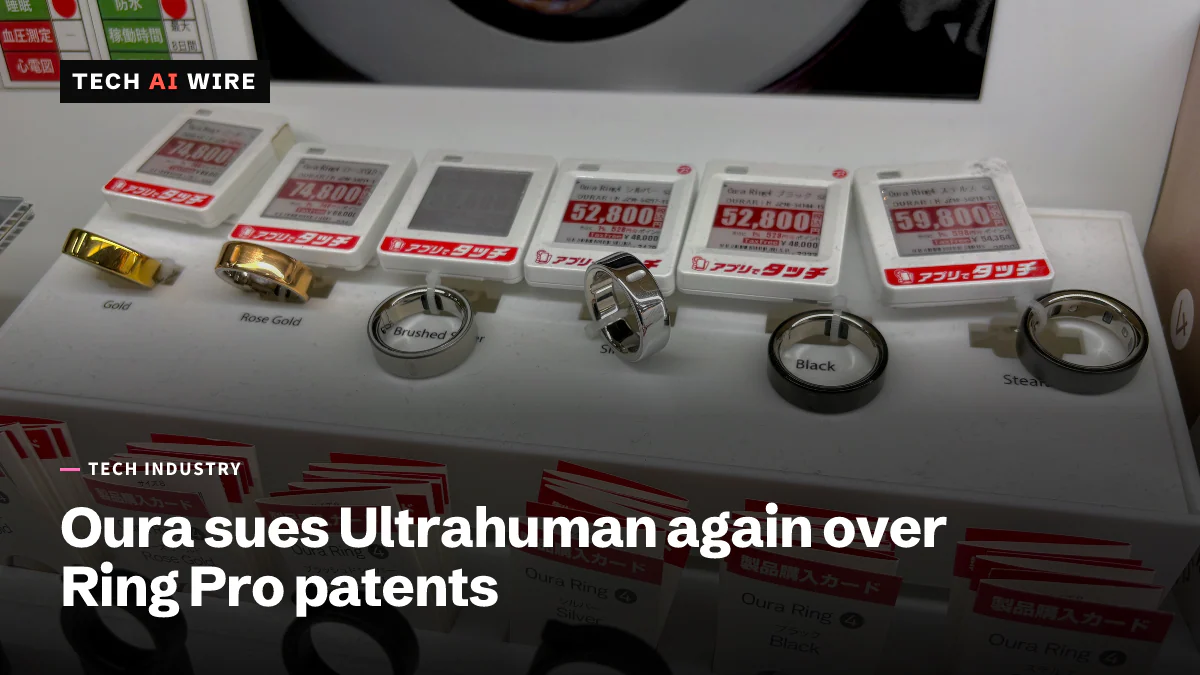
Oura, the Finnish maker of the best-known health-tracking smart ring, sued its Indian rival Ultrahuman again on Thursday, October 22, 2026. The new suit says Ultrahuman's Ring Pro infringes two Oura patents, and it asks a Texas federal court to stop US sales of the ring. It is the third legal round between the two companies, and it targets the very device Ultrahuman built to get back into the US market.
A smart ring is a finger-worn sensor that tracks sleep, heart rate and temperature, then syncs the data to a phone app. The category is small but growing. TechCrunch, citing the research firm IDC, reports smart-ring shipments will grow 12.8% this year to 4.9 million units, reaching about 6.3 million by 2030.
What Oura claims in the new lawsuit
Oura filed the complaint in the US District Court for the Eastern District of Texas, according to Oura's own announcement as quoted by Gadgets & Wearables. It names two defendants: Ultrahuman and SVTronics, a Texas electronics maker. Oura alleges SVTronics builds the Ring Pro at a facility in Plano, Texas, under Ultrahuman's direction.
The suit rests on two patents.
| Patent | What it covers | Issued |
|---|---|---|
| D804,471 | A design patent on the look of a wearable computing device | Not stated in the reports |
| 12,769,363 | A ring with a curved battery, circuit board, charging magnets, and optical, temperature and movement sensors | October 20, 2026 |
The second patent was granted just two days before Oura sued. The outlets differ slightly on the first. TechCrunch describes both patents as covering the ring's design and internal parts, while Gadgets & Wearables calls D804,471 a design-only patent.
Oura asks for money damages and a permanent injunction. That is a court order that would bar Ultrahuman from selling the Ring Pro in the US. An Oura spokesperson told TechCrunch that "Ultrahuman has a history of copying Oura's innovations," pointing to a 2025 trade ruling.
How the dispute got here
The fight is three years old. Each step below comes from TechCrunch, Engadget and Gadgets & Wearables.
| Date | Event |
|---|---|
| 2023 | Oura sues Ultrahuman over the Ring Air |
| 2024 | Oura files a separate case at the US International Trade Commission (ITC) |
| August 2025 | The ITC rules for Oura, and a US import ban on the Ring Air follows |
| February 2026 | Ultrahuman unveils the redesigned Ring Pro |
| March 2026 | US Customs and Border Protection rules in Ultrahuman's favor on the Ring Pro |
| October 22, 2026 | Oura files the new suit in Texas |
The ITC is a federal agency that can block imports of products that infringe US patents. The Ring Air is still sold in Europe and other markets, according to Engadget. A third ring maker, RingConn, settled with Oura and signed a multi-year licensing deal, Gadgets & Wearables reports.
The customs ruling is the crux. Ultrahuman says customs found the Ring Pro "did not infringe the Oura patent considered in that proceeding." Oura's argument is that the ruling covered only that earlier patent, not the two in the new case. In a blog post quoted by Engadget, Oura said "Ultrahuman's latest ring still incorporates many of Oura's patented innovations."
What Ultrahuman says
Ultrahuman says it will fight. "We will address these claims through the appropriate legal process and will defend our position vigorously," the company said. TechCrunch attributes that line to co-founder and CEO Mohit Kumar, while Engadget credits a spokesperson.
The company also says nothing has changed for buyers yet. "There is no court order affecting Ring Pro, and it remains available to customers in the U.S.," it told TechCrunch. In a statement to Gadgets & Wearables, it added that the new claims "have not been adjudicated by a court."
What this means for developers
For anyone who builds or buys health wearables, the practical picture is simple for now. The Ring Pro is on sale in the US, and no court has ruled on the new claims. A permanent injunction would need a ruling first, so nothing changes today.
Three points are worth acting on:
- A customs clearance is narrow. It answered one question about one patent. Hardware teams relying on a similar ruling should map which patents it did not cover.
- New patents can appear mid-fight. Patent 12,769,363 issued two days before the suit. A rival's pending applications are a live risk, not old history, so track them.
- Building in the US is not a shield. The ITC route targets imports. By naming the Plano manufacturer, Oura is also going after a ring made inside the country, through a regular court.
Teams that bought Ring Pro devices for staff wellness programs should watch for an injunction request. That would be the first sign US availability could change.
Sources
Related articles
Zetwerk IPO opens October 15 at Rs 143-151 a share
Indian manufacturing startup Zetwerk set a price band of Rs 143-151 for its Rs 5,012 crore IPO, which runs from October 15 to 19.

ARCTIC dual-licenses its Linux fan driver for the BSDs
ARCTIC's arctic_fan_controller driver moves from GPLv2+ to GPLv2+ and BSD-2-Clause in Linux 7.4, so other systems can reuse the $8.99 device's code.

TP-Link taps Key Tronic for US Wi-Fi 8 router assembly
TP-Link plans to assemble Wi-Fi 8 routers at Key Tronic's Mississippi plant from 2027, part of a nearly $1 billion pledge to get past the FCC's router ban.
The weekly digest
One email every Friday with the week's top stories from all six desks: AI, dev tools, coding, the tech industry, startups and what's next. Free, no spam.