TP-Link taps Key Tronic for US Wi-Fi 8 router assembly
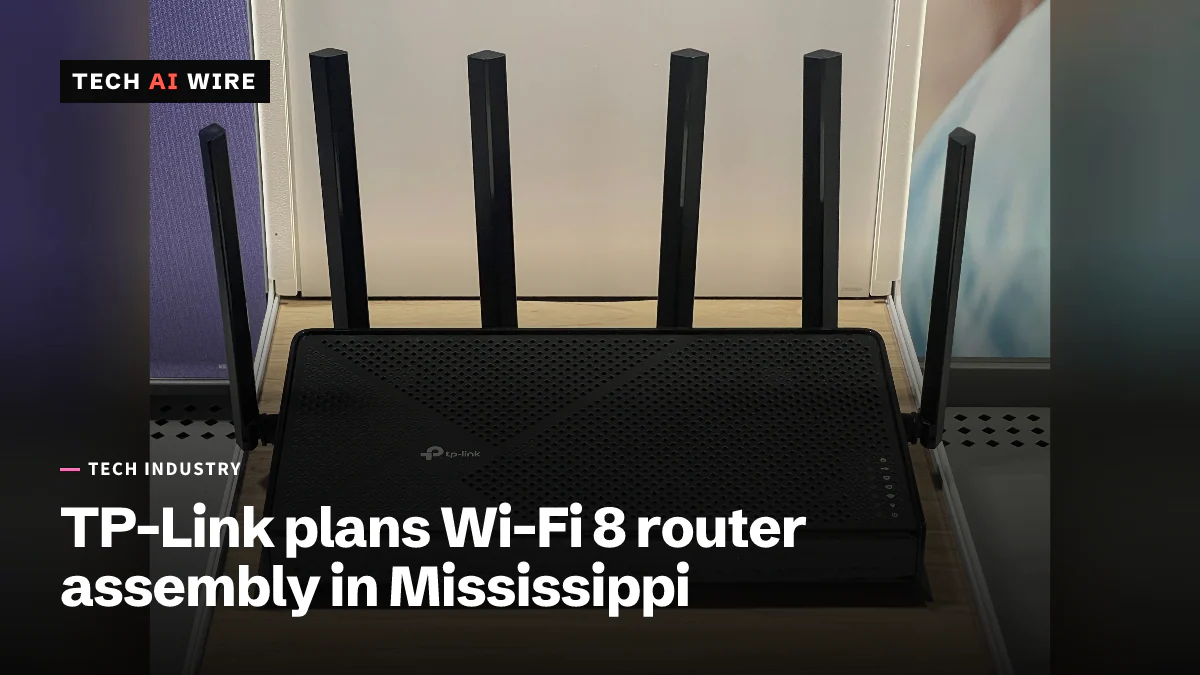
TP-Link plans to assemble Wi-Fi 8 routers at Key Tronic's Mississippi plant from 2027, part of a nearly $1 billion pledge to get past the FCC's router ban.
4 min read
By the numbers
- US research and manufacturing pledge in TP-Link's FCC filing
- ~$1B
- size of Key Tronic's plant in Corinth, Mississippi
- 305,000 sq ft
- state attorneys general who asked regulators to block TP-Link
- 21
- earliest start for US assembly, pending approval
- 2027
TP-Link has signed a letter of intent with Key Tronic, a US contract manufacturer, to assemble Wi-Fi 8 routers in Corinth, Mississippi, Light Reading reported on October 19, 2026. The deal is TP-Link's answer to a US rule that blocks new foreign-made home routers. Until regulators approve it, TP-Link cannot launch new router models in the US.
What TP-Link and Key Tronic agreed
A letter of intent is a written plan to do a deal, not a final contract. In it, TP-Link names Key Tronic as its main manufacturing partner in the US, according to Light Reading. Key Tronic is based in Spokane Valley, Washington. Its plant in Corinth covers 305,000 square feet.
Assembly could start as early as 2027, and only after US regulators approve it. "This LOI with Keytronic demonstrates our firm commitment to expanding domestic advanced manufacturing," TP-Link CEO Jeffrey Chao said in a statement.
The plan builds on a filing TP-Link sent to the Federal Communications Commission (FCC) on October 13. In it, the company pledged just under $1 billion for research and manufacturing in the US. It said the money would create "hundreds" of US jobs, on top of a current US workforce of more than 700, Light Reading reported. The four-page filing covers two Wi-Fi 8 routers, the Archer 8 Ultra and the Deco 8 Ultra, according to HotHardware.
TP-Link also promised that the software and firmware inside the routers would be written and stored in the US by American engineers, Android Headlines reported. Firmware is the built-in code that runs the device.
How the router ban works
In March, the FCC restricted new foreign-made consumer routers, range extenders, broadband gateways and standalone modems. Enterprise-class gear is not covered, according to Light Reading. A maker can still sell a new model with conditional approval. A model that is already approved can get a faster waiver for small part changes, such as a different memory chip.
Industry sources told Light Reading that approval usually takes about eight weeks and lasts about one year. Many of TP-Link's rivals have already cleared it.
| Status | Companies named by Light Reading |
|---|---|
| Conditional approval granted | Netgear, Asus, Amazon's eero, Nokia, Zyxel, Calix, Adtran and others |
| Starlink routers | SpaceX, approval type not specified |
| Still pending | TP-Link, Actiontec |
HotHardware describes the exemptions differently, as a White House list of temporary exemptions for several networking vendors that left TP-Link off. Light Reading treats the FCC as the body reviewing the requests.
The opposition TP-Link faces
On October 7, 21 state attorneys general signed a letter to FCC Chairman Brendan Carr and Commissioners Anna Gomez and Olivia Trusty, Light Reading reported. HotHardware says the group asked the FCC, the Department of Defense and the Department of Homeland Security to block TP-Link's exemption. The letter cites trade data showing that 99.5% of the parts at TP-Link's Vietnam plant come from China.
Five states have also sued TP-Link: Florida, Iowa, Montana, Nebraska and Texas. They allege the company misled buyers about security, including its HomeShield service. The sources do not agree on the count, though. TP-Link says four of the 21 officials have brought lawsuits.
TP-Link rejects the claims. "To be clear, the allegations raised in this letter are baseless," it wrote in its FCC filing. Steve Kovsky, its corporate affairs officer, said, "The coordinated lawsuits are built on false premises."
The company says it makes every product sold in the US in Vietnam. It moved its global headquarters to Irvine, California, and split from its former Chinese parent in 2024. HotHardware says TP-Link keeps US customer data encrypted on Amazon Web Services servers in Virginia, under outside audits.
What this means for developers
The router ban touches more than home shoppers. Small offices, retail sites and remote workers often run the same consumer gear.
- Check your hardware plans. If your team standardizes on TP-Link Archer or Deco units, new models may not reach US shelves until approval lands. Keep a second approved brand on your list.
- Separate new from existing. The FCC rule covers new foreign-made models. It does not, by itself, pull routers you already run.
- Budget for higher prices. Android Headlines notes that Canadian pre-orders list near $700 and expects US assembly could push prices up. Key parts still come from abroad; Qualcomm and Broadcom chips are made by Taiwan's TSMC.
- Watch the approval clock. If eight weeks is typical, a decision on the October 13 filing could come in early December. A rejection would leave TP-Link selling only older approved models in the US.
- Read the firmware promise closely. US-written firmware is the part that matters for security reviews. Ask your vendor where updates are built and signed before you sign a fleet contract.
Sources
- TP-Link taps Keytronic to bring broadband router assembly to the US - Light Reading
- TP-Link Plans $1 Billion US Factory To Beat Ban On Wi-Fi 8 Routers - HotHardware
- TP-Link Races to Build Wi-Fi 8 Routers in the US to Fight Off Ban - Android Headlines
- TP-Link pledges $1B US investment amid mounting government resistance - Light Reading
Related articles
DeepSeek ban: DHS orders US agencies to remove its AI
A DHS notice published October 20 orders US civilian agencies to remove DeepSeek and third-party tools built on its models, and to stop buying them.

China drafts export curbs on AI models and chip designs
China's draft adds 23 AI technologies to its export control list, from models with 2 trillion parameters to chip designs. Comments close on November 15.
Solidigm ties a US NAND fab to China chip tool approval
SK hynix's Solidigm wants US approval to ship more chip tools to its Dalian, China plant, Reuters reports, and links it to a new US NAND factory.
The weekly digest
One email every Friday with the week's top stories from all six desks: AI, dev tools, coding, the tech industry, startups and what's next. Free, no spam.