Intel LLM-Scaler-vLLM 1.5 jumps to vLLM 0.26 on Arc GPUs
Intel's LLM-Scaler-vLLM 1.5 moves its Arc GPU Docker stack from vLLM 0.14 to 0.26 and adds Gemma 4 and Qwen3.8 models plus FP8 and INT4 options.
3 min read
By the numbers
- vLLM version inside the Docker image
- 0.14 → 0.26
- current upstream vLLM release, per Phoronix
- 0.31
- newly supported Qwen and Gemma 4 models
- 5
- PyTorch version, up from 2.10
- 2.12
Intel released version 1.5 of LLM-Scaler-vLLM on October 16, 2026. It is a ready-made Docker image for running large language models on Intel's Arc graphics cards. The update moves its core engine from vLLM 0.14 to vLLM 0.26 and adds newer Qwen and Gemma 4 models. For anyone serving models on Intel GPUs, it closes much of the gap with the code that Nvidia users already run.
vLLM is a popular open-source engine for serving language models. It takes requests, batches them and returns answers quickly. Intel's image bundles a patched version of it with everything else needed to run it on Arc hardware.
What changed in version 1.5
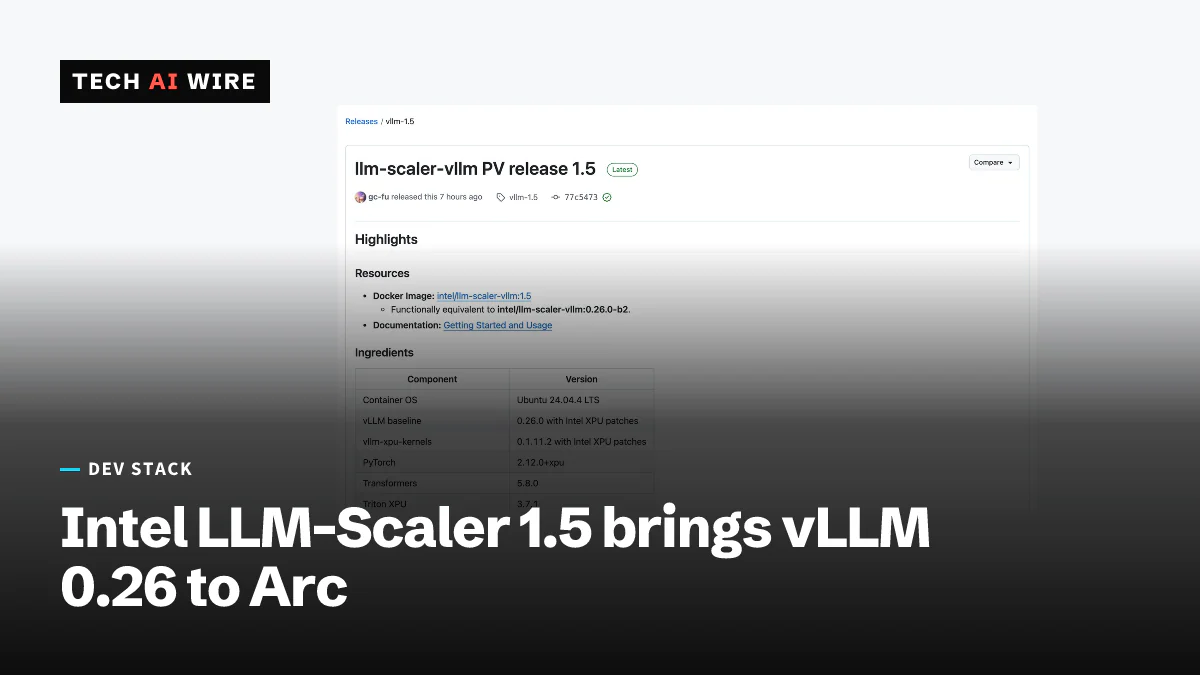
The release moves almost every layer of the stack forward, according to Intel's release notes on GitHub. The image runs on Ubuntu 24.04.4 LTS.
| Component | Before | In 1.5 |
|---|---|---|
| vLLM | 0.14.0 | 0.26.0, with Intel XPU patches |
| PyTorch | 2.10 | 2.12.0+xpu |
| Transformers | not listed | 5.8.0 |
| Triton XPU | not listed | 3.7.1 |
| vllm-xpu-kernels | not listed | 0.1.11.2 |
The jump is large, but it still trails the main project. Upstream vLLM is at 0.31, Phoronix notes. Intel builds the stack under Project Battlematrix, its effort to turn Arc cards into AI workstations. Phoronix describes the release as groundwork for Intel's coming Crescent Island data-center GPU.
The new Docker image is intel/llm-scaler-vllm:1.5. Intel says it is functionally the same as the 0.26.0-b2 beta it published on September 9.
New models and formats
Version 1.5 adds support for five models:
- Qwen3.6-27B
- Qwen3.8-27B
- Qwen3.6-35B-A3B
- gemma-4-26B-A4B-it
- gemma-4-31B-it
It also adds new ways to shrink models. Quantization stores a model's numbers at lower precision so it fits in less memory. The release supports online FP8 and symmetric INT4 quantization, plus checkpoints already saved in block-FP8. It can also keep the KV cache, the memory a model uses to hold the conversation so far, in FP8.
Other additions include LoRA serving and MTP. LoRA adapters are small add-on weights that tune a model for one task. MTP, or multi-token prediction, lets a model propose several tokens at a time. Intel also lists DFlash support, including for Muse-Glimmer-30B.
Intel reports a faster time to first token for Qwen and Gemma 4 models. That is how long a user waits before the answer starts. It also lists faster MTP decoding, LoRA serving and FP8 KV cache.
Bugs fixed and known issues
The release fixes three bugs that produced wrong results:
- Prefix caching did not work correctly with MTP. Prefix caching reuses work when many prompts start the same way.
- Models quantized to symmetric INT4 could return incorrect output.
- Block-FP8 models could corrupt their output when decoding several requests at once.
Intel lists two known issues. "XPU graph support is experimental," the notes say. Multimodal use of Muse-Glimmer also needs Transformers 5.15.0, while the image ships 5.8.0.
What this means for developers
If you serve models on Arc cards with an older LLM-Scaler image, upgrade. The INT4 and block-FP8 fixes alone matter, because both bugs returned wrong answers without crashing.
Check your launch settings against the newer vLLM. Twelve minor versions separate 0.14 and 0.26, and flags or defaults may have changed in between. Test on a staging box before you swap the production image.
If you want Muse-Glimmer with images, wait or build your own image. The bundled Transformers version is too old for it, by Intel's own notes. Keep XPU graph mode off in production while Intel calls it experimental.
The bigger signal is the pace. Intel now ships a vLLM only five versions behind upstream. That makes Arc a more realistic option for local and on-premises model serving.
Sources
- Intel LLM-Scaler-vLLM PV 1.5 Brings Big Improvements - Phoronix
- llm-scaler releases - GitHub (Intel)
Related articles
Qwen3.5-9B spends 32KB per token on KV cache
Qwen3.5-9B runs full attention on only 8 of its 32 layers, so its KV cache costs 32KB per token. That ratio decides whether it fits in 8GB.
AMD GAIA 0.25 folds its local AI agents into one
AMD's open-source local agent app now runs one agent, shrinks its Windows Python setup from 0.9GB to 0.1GB and stops crashing on 16GB laptops.
Strands Decider 2B makes agent choices in 115 ms
AWS's Strands Decider 2B is an open-source model that picks from a list instead of writing text. It answers in 115 ms on an RTX 3090 and scores 72.3% on JevBench.
The weekly digest
One email every Friday with the week's top stories from all six desks: AI, dev tools, coding, the tech industry, startups and what's next. Free, no spam.