Intel's Linux NPU driver 1.38 adds Ubuntu 26.04 support
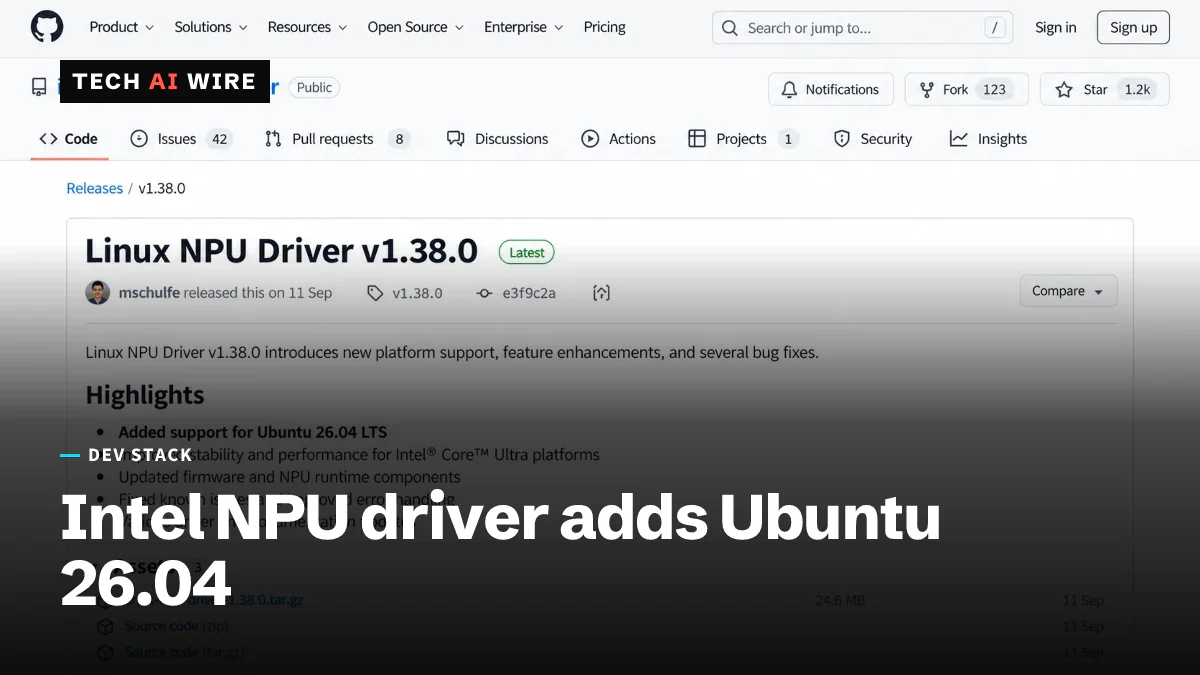
Intel's NPU driver 1.38 officially supports Ubuntu 26.04 LTS about five months late, with 322 tests passing across five processor generations.
3 min read
By the numbers
- tests passing, with zero failures, in Intel's own run
- 322
- processor generations validated on Ubuntu 26.04 LTS
- 5
- between the Ubuntu release and official support
- ~5 months
Intel has released version 1.38 of its Linux NPU driver, and the headline change is a support label rather than a feature. Ubuntu 26.04 LTS is now officially supported, roughly five months after that version of Ubuntu shipped. Intel published the release on GitHub on September 11, 2026, and Phoronix covered it the following day.
An NPU is a neural processing unit. It is a block on the chip built only for running trained AI models. It sits apart from the main processor and the graphics chip, so it can do that work using less power. Intel puts one in its Core Ultra laptop chips.
The important detail is that nothing was broken before this release. Phoronix notes the stack already worked on Ubuntu 26.04, and that the change is that it is "only now is officially recognized by Intel."
What is in the release
Intel's release notes and Phoronix together give the following picture.
| Item | Detail |
|---|---|
| Headline change | "Added support for Ubuntu 26.04 LTS" |
| Chips validated | Meteor Lake, Arrow Lake, Lunar Lake, Panther Lake, Wildcat Lake |
| Kernel tested against | Linux 7.0 |
| Bundled components | Level Zero v1.32.0, OpenVINO 2026.3.1 |
| Test results | 322 passing, zero failures |
| Licence | MIT |
Two of those names are worth knowing. Level Zero is Intel's low-level programming interface for talking to accelerator hardware directly. OpenVINO is the higher-level toolkit most people actually use to run a model on Intel hardware.
There is also a naming quirk to be ready for. The part of the driver that lives in the Linux kernel is still called IVPU, short for Versatile Processing Unit, which was the older name for this hardware. If you go looking for kernel messages about your NPU, search for the older name too.
What official support actually buys you
The driver splits in two, and only half of it is in this release. The kernel side ships with Linux itself. The user-space side is what Intel packages here, and it is the part your code loads when it asks the NPU to run a model.
"Official support" is mostly a testing claim. Intel says it ran 322 tests across five chip generations on Ubuntu 26.04 with Linux 7.0 and saw no failures. That is the difference between a stack that happens to work and one the vendor says it checked.
It also sets a boundary. Intel dropped Ubuntu 22.04 from this driver back in version 1.28. The supported list is a moving target, so the version of Ubuntu you standardize on has a shelf life inside this stack.
What this means for developers
If you already run the NPU on Ubuntu 26.04, the practical change is that you can now file a bug and be taken seriously. Upgrade for the support status, not for new speed. Nothing in this release claims a performance gain.
Check your bundled versions rather than just the driver number. This release pins Level Zero v1.32.0 and OpenVINO 2026.3.1. In a stack like this one, the version that breaks your model is usually the toolkit, not the driver. Pin all three in your setup scripts and record which combination you tested.
Treat the five validated chip generations as your compatibility list. Meteor Lake, Arrow Lake, Lunar Lake, Panther Lake and Wildcat Lake are the ones Intel says it tested here. If your target laptop uses something older, you are outside what this release covers, and Intel's own history of dropping Ubuntu 22.04 shows how that ends.
The wider pattern is worth noting if you plan hardware purchases. Official Linux support for AI accelerators keeps arriving months after the operating system does. Asahi Linux hit the same lag before it officially supported M3 Macs. Buyers weighing the newest Mac mini and Mac Studio for local AI face the same question. If you are choosing hardware to run models locally, check the driver's supported list before the spec sheet. The chip being capable and the vendor supporting your distribution are two different questions.
Sources
- Intel Linux NPU Driver Only Now Officially Supports Ubuntu 26.04 LTS - Phoronix
- linux-npu-driver v1.38.0 release - GitHub - intel/linux-npu-driver
Related articles
Open-source firmware boots on a consumer AMD desktop board
Coreboot and AMD's openSIL now run on the MSI B850P, a real desktop AM5 board. It cuts closed-source firmware code by 79.1%, but it ships as a paid product, not a free download.

Nouveau boots on Nvidia's DGX Spark GB10, unofficially
A Red Hat engineer got the open-source Nouveau driver and NVK running on Nvidia's DGX Spark GB10. It took about 100 patches, and upstreaming isn't settled yet.
Asahi Linux now officially supports M3 series Macs
Asahi Linux has merged M3, M3 Pro and M3 Max support into its installer. Wi-Fi, USB 3 and AV1 decoding work. Sleep, HDMI and fast 3D do not.
The daily brief
Three to five stories a day, and what each one means for the people who build software. Free, no spam.