New Mac mini and Mac Studio put more memory bandwidth behind local AI
Apple announced new Mac mini and Mac Studio models on August 25, 2026, shipping September 22. For local model work, the memory ceiling matters more than the AI multipliers.
4 min read
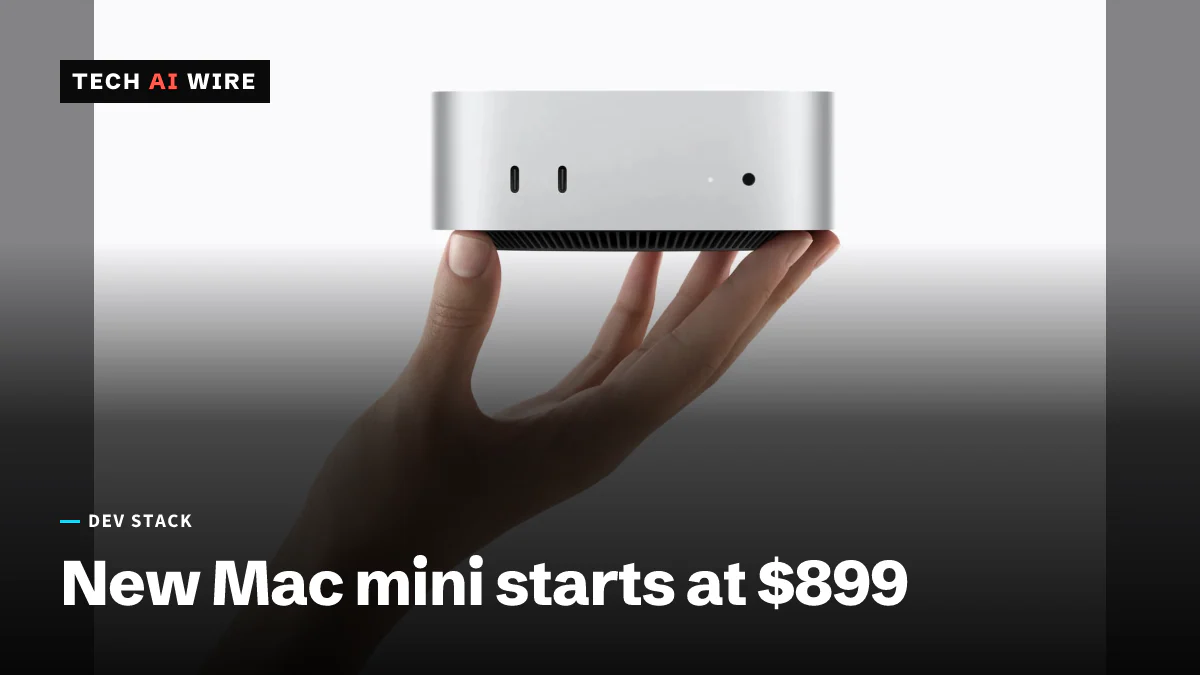
By the numbers
- starting price of the M6 Mac mini
- $899
- memory bandwidth on the M5 Pro
- 307GB/s
- unified memory in the base M5 Ultra Studio
- 96GB
- when the new models ship
- Sept 22
- M6
- 170GB/s
- M5 Pro
- 307GB/s
Apple announced new Mac mini and Mac Studio models on August 25, 2026, and both ship on September 22. Apple leads on AI speed multipliers, but for anyone running models on their own machine the numbers that decide things are the memory ceiling and the memory bandwidth.
The outside has not changed. Macworld reports the enclosure is the same as the 2024 redesign, and that the work went into the chips and the connections.
What is in each box
Four chips arrived at once. The Mac mini takes the M6 or the M5 Pro. The Mac Studio takes the M5 Max or the M5 Ultra.
| Model | Chip | CPU | GPU | Memory | Starting price |
|---|---|---|---|---|---|
| Mac mini | M6 | 12-core | 12-core | 16GB standard, 32GB max | $899 |
| Mac mini | M5 Pro | up to 18-core | up to 20-core | up to 64GB | $1,699 |
| Mac Studio | M5 Max | 18-core | up to 40-core | 36GB in the base build | $2,499 |
| Mac Studio | M5 Ultra | 36-core | up to 80-core | 96GB in the base build | $5,499 |
Apple's newsroom gives the M6 a dual 16-core Neural Engine. Forbes describes the M5 Ultra's graphics as the most powerful Apple silicon GPU ever built. Education pricing runs lower, at $799 for the M6 mini and $1,599 for the M5 Pro, per Apple.
Connectivity moved too. Apple lists Wi-Fi 7, Bluetooth 6 and 2.5Gb Ethernet as standard, plus Genlock over USB-C for syncing displays and cameras. The M5 Pro mini carries three Thunderbolt 5 ports where the M6 has three Thunderbolt 4.
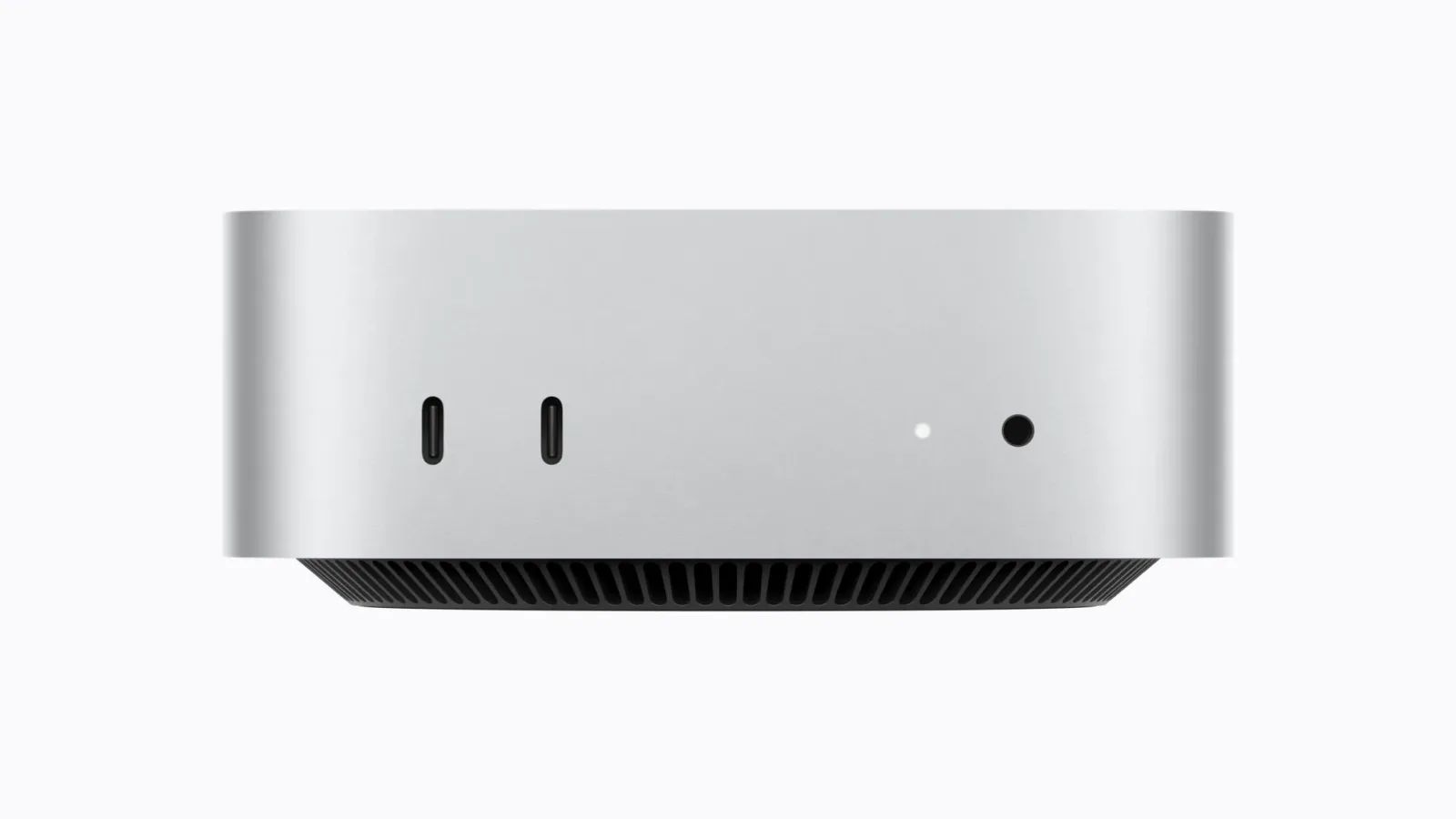
Image: Apple
The speed claims, and what they are measured against
Apple's figures are large, and each one has a baseline attached. Reading the baseline is the whole job.
Against the M4, Apple says the M6 delivers 4x faster AI performance, 40% faster CPU performance and 2x faster graphics. On language models specifically, Apple says the M5 Pro is 4x faster than the M4 Pro and 8.5x faster than the M2 Pro. Forbes reports the M5 Max at up to 50% faster than the M4 Max.
Johny Srouji, Apple's chief hardware officer, said the M6 mini "delivers a whole new level of AI performance."
Notice what shifts between those comparisons. The 8.5x figure reaches back to the M2 Pro, a chip from several generations ago. The like-for-like generational step is the 4x against the M4 Pro. Both are Apple's own numbers, measured by Apple, so treat them as vendor claims until independent benchmarks land.
Why bandwidth is the number to read
For local inference, the constraint is usually not raw compute. It is how fast weights move from memory into the chip.
Apple lists 170GB/s of memory bandwidth on the M6 and 307GB/s on the M5 Pro. That gap is close to double, and it lands directly on how many tokens per second a model produces. A token is roughly a word fragment.
The second constraint is capacity, because a model has to fit in memory before speed matters at all. On Apple silicon the memory is unified, meaning the CPU and GPU share one pool. So the maximum memory is effectively your maximum model size.
That reframes the price list. The M6 mini tops out at 32GB. The M5 Pro mini reaches 64GB. The base M5 Ultra Studio ships with 96GB, which is the real reason that machine costs $5,499.
What this means for developers
Buy for the memory ceiling, not the multiplier. Decide the largest model you need resident, add room for the operating system and your editor, and let that pick the machine. A 4x AI claim does not help if the weights do not fit.
Do the sizing arithmetic before you spend. A rough rule: a model quantized to 4 bits needs a little over half a gigabyte per billion parameters. On that basis a 32GB M6 mini handles small and mid-size models comfortably. At 64GB, considerably larger ones open up. At 96GB, the largest open-weight releases start to become practical. Confirm against the specific weights you plan to run.
If you are choosing between the two Mac minis, the honest split is bandwidth. The M5 Pro costs $800 more and roughly doubles memory throughput while doubling the memory ceiling. For a machine whose job is generating tokens, that is the upgrade that changes the experience. For compiling and ordinary development, the M6 at $899 is a lot of computer.
Two practical notes. Thunderbolt 5 on the M5 Pro matters if you attach fast external storage for datasets, since model files are large and slow disks show up quickly. And 2.5Gb Ethernet as standard is a quiet win for anyone pulling multi-gigabyte checkpoints over a local network.
Finally, wait for third-party benchmarks before committing budget. Every figure above is Apple's, the ship date is September 22, and tokens-per-second on the model you actually use is the only measurement that settles this.
Sources
Related articles
PyTorch 2.15 speeds MoE decoding on Macs up to 6.5x
PyTorch 2.15 adds FP8 tensors on Apple GPUs and new Metal kernels. Qwen3.6-35B-A3B decoding on an M3 Ultra jumps from 9.4 to 61.3 tokens a second.
Surface RTX Spark Dev Box opens for preorder at $5,999
Microsoft opened US preorders for the Surface RTX Spark Dev Box at $5,999 on October 7, 2026, with 128GB of unified memory for local AI models.
RemoveMacAI strips Apple Intelligence models from macOS 27
A new MIT-licensed command-line tool turns off Apple Intelligence on macOS 27, deletes its on-device models and stops macOS from downloading them again.
The weekly digest
One email every Friday with the week's top stories from all six desks: AI, dev tools, coding, the tech industry, startups and what's next. Free, no spam.