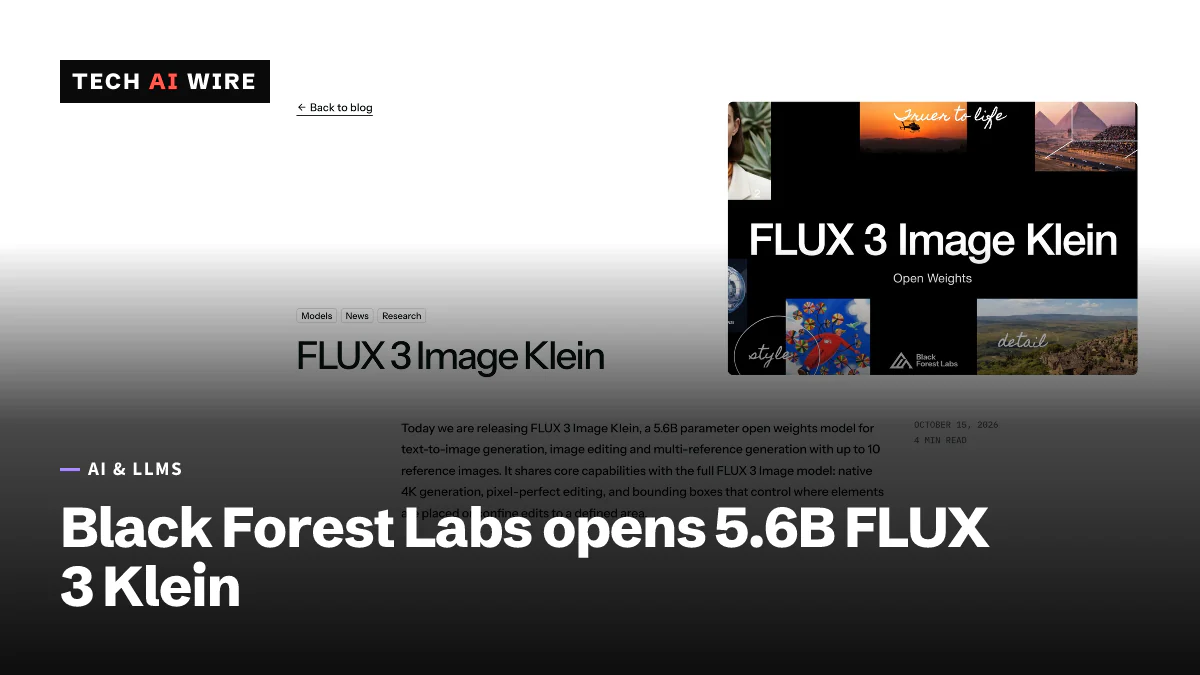
FLUX 3 Image Klein ships as a 5.6B open-weight model
Black Forest Labs released FLUX 3 Image Klein, a 5.6B open-weight image model that makes and edits pictures, with free commercial use under $5M revenue.
3 min read
By the numbers
- parameters, 38% fewer than FLUX.2 [klein] 9B
- 5.6B
- per 1024x1024 image on one H100, distilled model, per Hugging Face
- ~2 s
- reference images per request, at most
- 10
- annual revenue limit for free commercial use
- $5M
Black Forest Labs released FLUX 3 Image Klein on October 15, 2026. It is an open-weight AI model with 5.6 billion parameters that creates images from text and edits existing ones. The lab says it beats larger open models in its own tests, while staying small enough to run on a desktop graphics card. For developers, it means a recent image model they can download, fine-tune and host themselves.
Black Forest Labs makes the FLUX family of image models. "Open weight" means the trained model files are public. The license still limits who can use it for free, as explained below.
What Black Forest Labs released
The release has two main checkpoints, according to Black Forest Labs' announcement:
| Checkpoint | Steps per image | Best for |
|---|---|---|
| Klein (distilled) | 16 | Fast generation |
| Klein Base | 50 | Fine-tuning, LoRA training and research |
Both come in BF16, with FP8 and NVFP4 builds that use less memory. Black Forest Labs also lists an INT8 build. One model handles three jobs: making images from text, editing an image, and combining up to 10 reference images. It can also generate natively at 4K resolution.
Hugging Face added the model to Diffusers, its open-source library for image models, on launch day. Its blog post highlights a new feature: layout control. You draw boxes on a grid to suggest where objects should go. The boxes guide placement and size, but they are not hard masks, the model card says.
How fast it runs
Hugging Face measured about 2 seconds for a 1024x1024 image with the distilled model on an H100 GPU. Adding one reference image roughly doubles that time.
Black Forest Labs quotes speeds that Nvidia measured. The distilled model takes 0.55 seconds on a GB300 and 8.9 seconds on an RTX 4070. The INT8 build makes a 1-megapixel image in about 4 seconds on an RTX 5090. Black Forest Labs says it runs on GeForce RTX cards with as little as 8 GB of memory.
Memory needs depend on the setup. Hugging Face measured peak use of 20.72 GiB in BF16 on an H100, and 15.3 GiB with NVFP4 on an RTX 6000. With Black Forest Labs' own reference code on a B200, peak use was 31 GB in BF16 and 25 GB in NVFP4.
The catch: a required prompt upsampler
The model card carries a firm instruction: "Do not use the model without a prompt upsampler." A prompt upsampler is a second model that rewrites a short prompt into a detailed one. Black Forest Labs ships a 9-billion-parameter upsampler for this. It adds about 28 GB of GPU memory on an 80 GB card, the card says.
That matters for the small-GPU claims. The 8 GB figure covers the image model. Running the upsampler on the same machine needs far more memory, or a separate server.
What the license allows
FLUX 3 Image Klein uses the FLUX Kommunity License. Individuals and companies with less than $5 million in yearly revenue can use it commercially for free, according to Black Forest Labs. Larger organizations need a paid self-hosting license or must use the company's API.
The text encoder inside the package, Qwen3-VL-4B-Instruct, uses the Apache 2.0 license, the model card notes.
What this means for developers
If your company earns under $5 million a year, this is a capable image model you can ship for free. Check the license text yourself before you build a product on it. "Open weight" is not the same as an open-source license.
Plan for the upsampler from day one. Budget either a second GPU or a hosted model to rewrite prompts, and test quality with and without it.
For fine-tuning, start from Klein Base. Black Forest Labs says it supports LoRA training on day one through Diffusers and Ostris's AI Toolkit. A LoRA is a small add-on file that teaches the model a style or product. A LoRA adds around 5% to generation time, according to Black Forest Labs.
Finally, treat the "first place" rankings as a claim. They come from Black Forest Labs' internal tests, so compare it on your own prompts before switching.
Sources
- FLUX 3 Image Klein - Black Forest Labs
- Welcome FLUX.3 Image Klein in Diffusers: The latest open image generation model from Black Forest Labs - Hugging Face
- black-forest-labs/flux-3-image-klein - Hugging Face (Black Forest Labs)
Related articles
Holo4 open-weight agent models score 61.7% on OSWorld 2.0
H Company's Holo4-27B scores 61.7% on OSWorld 2.0 at $1.22 a task, but only its Apache 2.0 sibling, 35B-A3B, can be self-hosted commercially.
Qwen-Image-2.1 ships 7B weights under a research license
Qwen-Image-2.1 puts 7 billion parameters and native transparency in a downloadable image model. Its license bars commercial use without permission.

Reflection Beam open weights land under Apache 2.0
Reflection put Beam's 501B-parameter weights on Hugging Face on October 16, 2026 under Apache 2.0. The FP8 and 4-bit versions fit on one 8-GPU server.
The weekly digest
One email every Friday with the week's top stories from all six desks: AI, dev tools, coding, the tech industry, startups and what's next. Free, no spam.