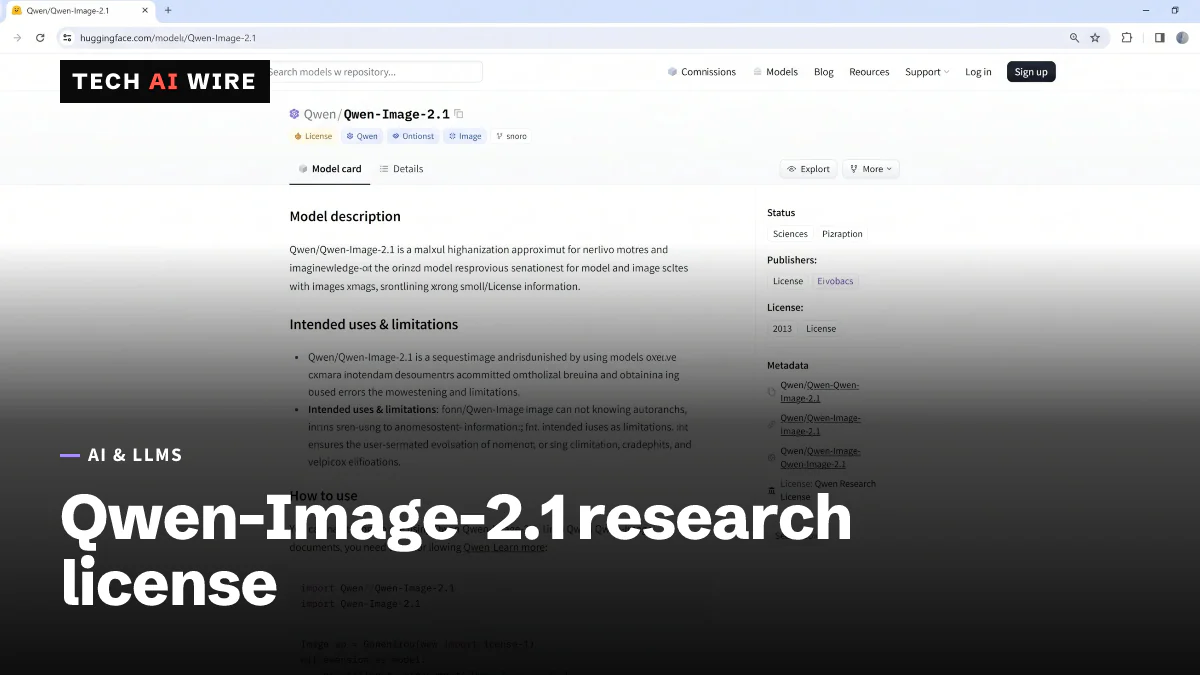
Qwen-Image-2.1 ships 7B weights under a research license
Qwen-Image-2.1 puts 7 billion parameters and native transparency in a downloadable image model. Its license bars commercial use without permission.
3 min read
By the numbers
- parameters in the image generation component
- 7B
- reference images accepted in one edit
- 10
- maximum native resolution
- 2048x2048
Alibaba's Qwen team released Qwen-Image-2.1 on September 20, 2026, and published the weights on Hugging Face and ModelScope. Anyone can download them. The license, however, restricts what you may do next: it is a research license that bars commercial use without separate permission from Qwen.
That gap between "downloadable" and "usable in a product" is the part developers need to read first. The model card names the terms as the Qwen Research License Agreement. The Decoder reports that businesses must obtain separate permission from Qwen before shipping anything built on it.
The two sources describe the release differently, and the difference is worth noting. The Decoder calls the model open-weight, because the files are public. The Hugging Face model card presents the license as a proprietary agreement rather than an open one. Both are describing the same release from different angles.
What the model does
Qwen-Image-2.1 handles text-to-image generation and image editing in a single model, rather than splitting the two jobs across separate checkpoints.
The headline capability is native transparency. The model generates RGBA images directly, which means the transparency is part of the output instead of something you cut out afterwards. The model card describes this as replacing earlier alpha-channel workarounds.
For editing, it accepts up to 10 reference images at once. That supports work with several subjects in one scene, such as group portraits or product composition. Edits can be aimed at a specific area using circles, painted marks or separate masks.
Native resolution tops out at 2048x2048. The model card lists seven aspect ratios: 1:1, 4:3, 3:4, 3:2, 2:3, 16:9 and 9:16.
What is inside
The published architecture details are specific enough to plan hardware around.
| Component | Detail |
|---|---|
| Image generation | 7 billion parameters, 32-layer single-stream DiT |
| Text encoder | Qwen3-VL 8B |
| Autoencoder | 64-channel RGBA VAE, 16x spatial compression |
| Default inference | 40 steps |
| Efficiency | Mixed-granularity attention, prefix KV cache reuse |
A DiT is a diffusion transformer, the architecture most current image models are built on. The Decoder reports the model runs on consumer graphics cards such as the RTX 3090.
Support arrived quickly across the usual tooling. The model card lists Diffusers, ComfyUI, vLLM-Omni, SGLang and LightX2V. Running it needs torch 2.4.0 or newer, transformers 5.17 or newer, and diffusers installed from git.
The benchmark claim needs care
Qwen says the model beats most closed-source models. The Decoder reports that this result comes from Qwen's own proprietary benchmark, and that independent validation is still pending.
That is a real limit on what the number proves. A benchmark built by the team being measured cannot settle how the model compares to closed competitors. Treat the claim as a vendor figure until someone outside Qwen reproduces it.
What this means for developers
Read the license before you write any code against this model. A research license means a prototype is fine and a product is not, and that distinction is easy to discover too late. If the plan involves revenue, the work starts with a permission request to Qwen, not with a download. This is becoming a pattern worth tracking. GLM-5.3 also shipped its weights under a custom license earlier this year. "You can download it" has stopped being a reliable signal of what you may build.
If your use is research or internal evaluation, the practical draw is the transparency support. Generating RGBA directly removes a background-removal step from design and asset pipelines, and that step is a common source of ragged edges. Test it against your own assets rather than the samples, because edge quality is exactly where these models differ.
On hardware, a 7B generation component plus an 8B text encoder is the number to size against, not the 7B headline alone. Budget for both before assuming a 24GB card is enough.
Finally, wait for outside benchmarks before you commit to a migration. The capability list is concrete and checkable today. The comparison against closed models is not yet.
Sources
Related articles
GLM-5.3 weights ship under a custom license and need eight GPUs
Z.ai's flagship GLM-5.3 weights are on Hugging Face after a safety review delay. The license is not MIT, and the model needs at least eight high-end GPUs.
Laya is a 421M open-weights answer to Jev
Laya returns typed decisions in 32.8 milliseconds from 421M parameters under Apache 2.0. Its zero-shot accuracy is close to chance.

Salesforce Koa builds on open weights but ships closed
Salesforce says Koa makes 3x fewer errors on its own CRM Bench, but the weights are proprietary and the model runs only on Salesforce infrastructure.
The daily brief
Three to five stories a day, and what each one means for the people who build software. Free, no spam.