US suspends Microsoft and Adobe from green card step
Officials said on October 8 that Microsoft, Adobe and six IT services firms are suspended from PERM, the first step of employer-sponsored green cards.
3 min read
By the numbers
- named companies, including Microsoft and Adobe
- 8
- universities the administration says it will investigate
- 9
- of approved H-1B visas go to workers from India, per AP via TechCrunch
- ~3/4
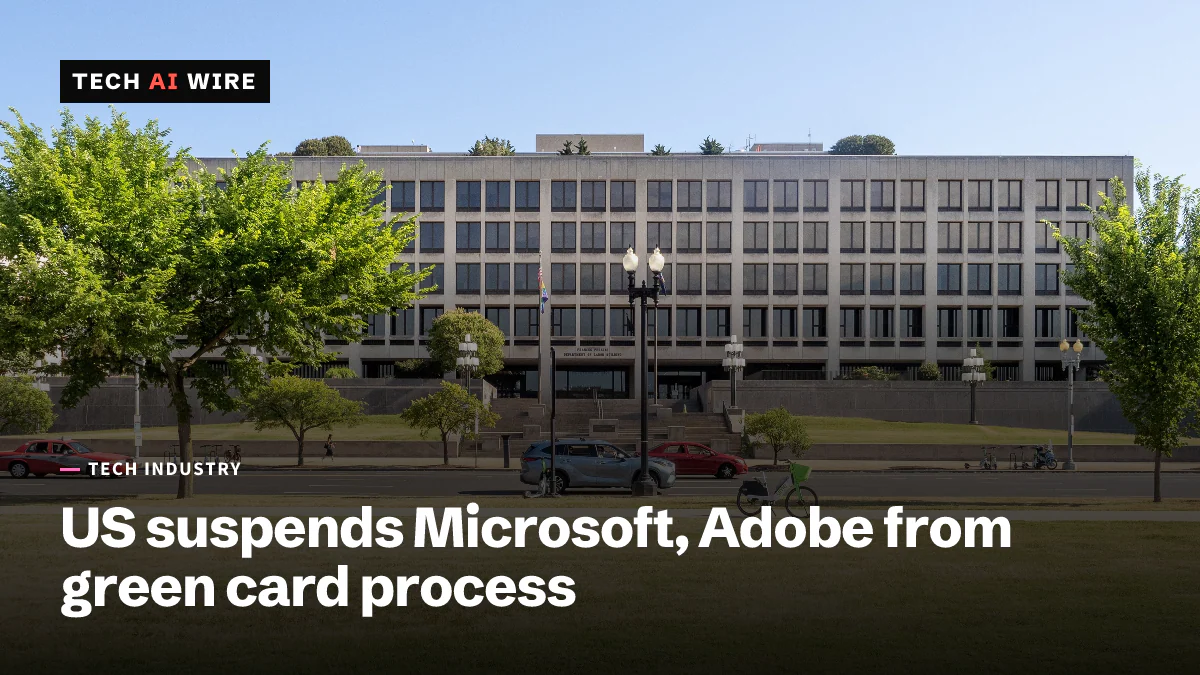
The US government said on October 8, 2026 that Microsoft, Adobe and six IT services firms are suspended from the first step toward an employer-sponsored green card. Labor Secretary Keith Sonderling said his department will not accept new applications from them or process pending ones, according to Reuters via BNN Bloomberg. Officials cited alleged fraud, which the companies have not answered. For workers sponsored by these companies, that first step has stopped.
What was announced
Vice President JD Vance and Sonderling announced the move at a news conference on Thursday, TechCrunch reports. The named companies are:
- Microsoft
- Adobe
- Capgemini
- Cognizant
- HCL
- Infosys
- Tata
- Wipro
"Our message to Microsoft is: You're a great American company, but you've got to hire great American workers," Vance said. Sonderling said: "We will not accept any new or process any pending permanent labor certification applications involving these companies."
Reuters says the officials framed the step as part of an effort to push companies to hire more Americans. TechCrunch says the administration accuses the companies of fraud. These are the administration's allegations. Neither report cites a court finding.
What PERM is
PERM is the Labor Department's permanent labor certification process. In it, an employer asks the department to certify that no qualified, willing and available US worker can fill a job. Reuters says this certification is required before an employer files most employment-based green card petitions.
So the suspension does not cancel any green card. It stops the first required step for the named companies. Neither report says whether the stop is permanent or when it takes effect. They also do not say what happens to workers already waiting.
TechCrunch notes that tech companies are among the largest users of H-1B visas, the temporary work visas many skilled workers hold before seeking a green card. It says, citing the Associated Press, that nearly three-quarters of approved H-1B visas go to workers from India.
Universities too
Vance also said the administration will investigate nine universities over claims that an international student program was abused to undercut American wages. Only Harvard, Yale and Stanford are named. Labor Inspector General Anthony D'Esposito said subpoenas have already been served, Reuters reports.
Company responses
Microsoft did not immediately respond to requests for comment, according to both reports. TechCrunch adds that Adobe also did not respond. No other company response appears in either report.
What this means for developers
If you work at one of these companies on a work visa, or hire people who do, the practical effects start now.
- Check where your case stands. Ask your employer's immigration counsel whether your PERM application is pending, planned or already approved. The reports only say that pending applications will not be processed.
- Expect questions the reports cannot answer. Neither source gives a start date, an end date or a path back. Do not assume an outcome until the Labor Department publishes details.
- Plan teams around the gap. Managers with visa-holding engineers should map which roles depend on a green card timeline. A delay can change hiring, relocation and promotion plans.
- Watch for legal challenges. The allegations are untested. A court filing or a company statement would show how the suspension may be contested.
- Do not generalize to other employers. The action names eight companies, and the reports do not extend it to others.
The next thing to watch is whether the Labor Department publishes the effective date and the conditions for ending the suspension.
Sources
Related articles
Satya Nadella wants an emergency brake for AI models
Microsoft CEO Satya Nadella's October 10 essay sets seven rules for AI models, including an emergency brake that lets a person stop a model mid-task.
Microsoft's AI code of conduct is a draft, not a rule yet
Microsoft published absolute constraints for its MAI models on September 14, 2026, then said its current models are not yet trained on the document.

FMCSA gives driverless trucks a 5-year beacon exemption
Driverless trucks may use cab-mounted beacons instead of roadside warning triangles until October 7, 2031, under a five-year FMCSA exemption.
The weekly digest
One email every Friday with the week's top stories from all six desks: AI, dev tools, coding, the tech industry, startups and what's next. Free, no spam.