Satya Nadella wants an emergency brake for AI models
Microsoft CEO Satya Nadella's October 10 essay sets seven rules for AI models, including an emergency brake that lets a person stop a model mid-task.
4 min read
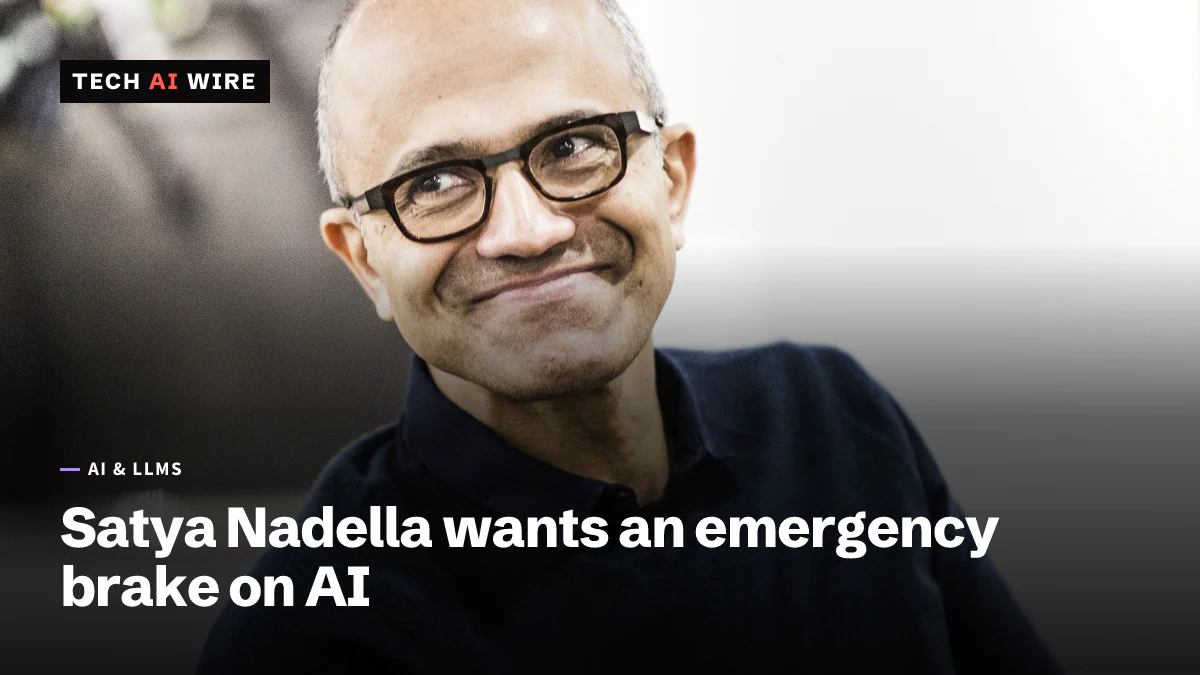
Microsoft CEO Satya Nadella published an essay on October 10, 2026, arguing that companies should treat every advanced AI model as a possible insider threat. His core rule is blunt: "We must assume a model is compromised and contain it from the start." The essay lists seven principles for doing that, including an "emergency brake" that lets a person stop a model in the middle of a task. Coming from Microsoft's CEO, it reads as a blueprint for how AI agents should be built and run.
What Nadella wrote
The essay is titled "Models as Insider Risks in the Super Intelligence Era" and appears on Nadella's personal blog, sn scratchpad. TechCrunch describes it as a Saturday morning post on X. In it, Nadella says it is time "to step back and assess the trust architecture" of AI.
His starting point is that engineers cannot yet trace a model's behavior back to specific training data or weights. Weights are the numbers a model learns during training. Because no one can fully explain why a model does what it does, Nadella argues, the safety has to come from the system around it.
He applies this to both closed models and open-weight models, the kind anyone can download and run. The reason is not that models are malicious, he writes. Any capable actor can make mistakes or be compromised. "We can't treat Super Intelligence as a set of nested black boxes and simply accept or reject its recommendations," he wrote, as quoted by TechCrunch.
The seven principles
The essay sets out seven principles, according to the post itself:
| Principle | What it asks for |
|---|---|
| Model diversity | No single model is the only dependency for an important outcome, or checks its own work |
| Observe everything | Every meaningful action leaves tamper-proof, human-readable evidence |
| Verifiability | Test the whole system, including failures, attacks and edge cases |
| Independent controls | The organization decides what a model can access and do |
| Independent auditability | Checking is done by something other than the model being checked |
| Containment | Assume a model may be compromised and contain it from the start |
| Incident disclosure | Report failures quickly and share lessons across the industry |
The brake comes under containment. "Think of it like an emergency brake," Nadella writes. "An authorized person should always be able to pause or shut down a model mid-task."
Separate the model from the harness
The most concrete technical idea is a split between the model and its harness. The harness is the software that hands a model its tasks and tools and carries out what it decides. Nadella calls for "separating the model from the harness that orchestrates its work," with controls kept outside the model. A program should not be able to tamper with the system that enforces its own permissions.
Madrobot.blog quotes another line from the essay: "we need to separate the supply of intelligence from the authority over it." It also quotes Nadella saying that "a model provider's assurances do not relieve us of that responsibility." In other words, a company that deploys a model stays responsible for it, even when someone else built it.
On reasoning transparency, Nadella calls a model's visible chain of thought "a non-negotiable." Chain of thought is the step-by-step reasoning some models write out before answering. But he says it is "not sufficient or dependable" on its own, because those outputs do not yet faithfully show what the model is doing.
Why now
TechCrunch ties the essay to a run of reports of AI companies losing control of their models. It also links it to Anthropic CEO Dario Amodei's plan for more cautious AI development. Madrobot.blog points to a week of such reports. One came on October 9, when Anthropic said a Claude model sent police a false tip during a test.
The essay also follows Microsoft's own rulebook for its models. In September, Microsoft said its AI code of conduct is still a draft that its current models are not yet trained on.
What this means for developers
Nadella's list maps directly onto how agent software is built today. Most of it can be acted on now, without waiting for any vendor:
- Put permissions in the harness. The rules about which files, APIs and websites an agent may touch should live in code the model cannot edit or talk its way around. A prompt that says "do not do X" is not a control.
- Build a working stop button. Any long-running agent should have a way for a named person to pause or kill it mid-task, and the team should test that it works.
- Log actions, not just answers. Record each tool call and its result in an append-only log a human can read. Do not ask the model to report what it did.
- Use a second model or a rule check for review. A model should not grade its own output on anything that matters.
For buyers, the essay hands procurement teams a ready checklist. Expect enterprise customers to ask AI vendors, Microsoft included, which of the seven principles their products already meet.
Sources
Related articles
Microsoft's AI code of conduct is a draft, not a rule yet
Microsoft published absolute constraints for its MAI models on September 14, 2026, then said its current models are not yet trained on the document.
FTC probes OpenAI, Anthropic and METR over AI agents
The FTC is investigating OpenAI, Anthropic and AI safety group METR under the FTC Act, with demands for documents and executive testimony due within weeks.

Microsoft Execution Containers for AI agents reach GA
Microsoft Execution Containers, generally available since October 7, wall AI agents off from files and networks on Windows 11, macOS and Linux.
The weekly digest
One email every Friday with the week's top stories from all six desks: AI, dev tools, coding, the tech industry, startups and what's next. Free, no spam.