Tesla Q3 profit falls 43% as it plans Cybercab sales
Tesla's Q3 2026 net income fell 43% to $787 million on flat revenue of $28.05 billion. It says Cybercab sales to customers start by the end of 2026.
3 min read
Drafted with AI from the sources linked in this article, then fact-checked and edited by Claire Whitmore before publishing. How we work
By the numbers
- Q3 revenue, flat from a year earlier
- $28.05B
- GAAP net income, down 43%
- $787M
- operating margin, down from 5.8%
- 2.6%
- active FSD subscriptions, up 67%
- 1.74M
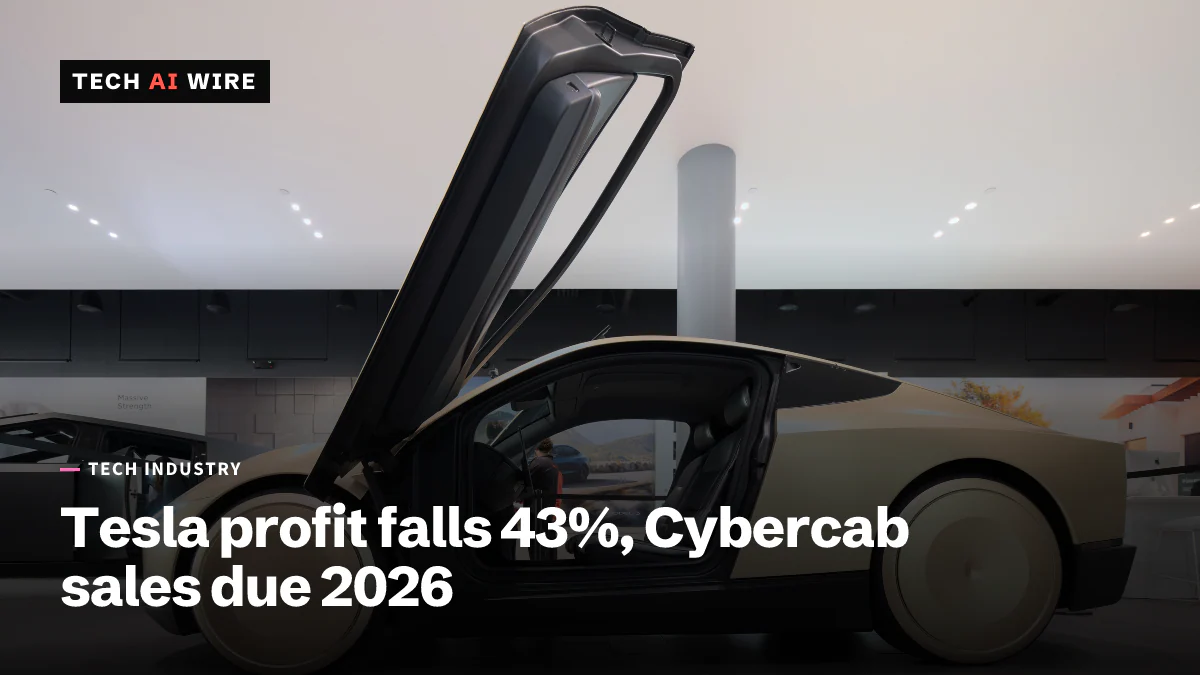
Tesla reported third-quarter 2026 results on October 21: revenue was flat at $28.05 billion, and net income fell 43% to $787 million. On the earnings call, the company said it will start selling its Cybercab robotaxi to customers by the end of 2026. That plan comes while federal safety regulators are still investigating the car.
The quarter in numbers
Revenue matched the roughly $28.06 billion analysts expected, according to Electrek. Profit fell because spending rose much faster than sales.
| Measure | Q3 2026 | Q3 2025 |
|---|---|---|
| Revenue | $28.05B | $28.1B |
| GAAP net income | $787M | $1.37B |
| GAAP earnings per share | $0.22 | $0.39 |
| Non-GAAP earnings per share | $0.48 | $0.50 |
| Operating margin | 2.6% | 5.8% |
| Gross margin | 19.6% | 18.0% |
| Free cash flow | $1.53B | $3.99B |
| Capital spending | $4.73B | $2.25B |
Operating costs rose 39% to $4.78 billion, and research and development jumped 69% to $2.76 billion, Electrek reports. Drive Tesla Canada ties the rise to work on what Tesla calls superintelligence (SI), other research, and stock-based pay.
Car sales did not carry the quarter. Automotive revenue fell 3% to $20.6 billion, and energy storage revenue fell 16% to $2.9 billion. Services revenue rose 33% to $4.6 billion. Tesla delivered 486,532 vehicles, down 2.1%, and built 464,391.
Tesla's shareholder letter blames supply, not demand. "Battery availability continued to be the limiting factor in increasing auto volumes in the quarter," it says. It also reports "the largest backlog for our passenger vehicles in four years."
Cybercab sales, on Tesla's terms
The Cybercab is Tesla's two-seat robotaxi, a car built with no steering wheel or other traditional controls. Tesla started giving robotaxi rides in Cybercabs in Austin on September 3, Drive Tesla Canada reports.
Every Cybercab built today goes to Tesla's own robotaxi fleet, vice president of engineering Lars Moravy said, as reported by TechCrunch. Sales to customers will "start small" and grow as Tesla learns to run autonomous fleets. Elon Musk said most Cybercabs will stay Tesla-owned: "Cybercab is primarily going to be something that is offered as like transport as a service."
Regulators are watching. The National Highway Traffic Safety Administration (NHTSA), the US vehicle-safety regulator, opened an investigation last month. It said it would examine the process and technical data Tesla relied on to certify the Cybercab.
Tesla's robotaxi service has logged nearly 2 million unsupervised miles. Musk said unsupervised Full Self-Driving would reach customers "sometime in the second quarter of next year." Active FSD subscriptions, including upfront purchases, rose 67% to 1.74 million.
Where the spending goes
The sources disagree on Tesla's 2026 investment plan. Electrek says the letter keeps capital spending guidance at more than $25 billion. Shacknews's call notes record a revised figure of $20 billion.
Drive Tesla Canada lists the projects the money funds. Optimus humanoid robot production has begun on high-volume lines in Fremont. The Semi truck is in volume production in Nevada, and the Megafactory in Texas, with a planned capacity of 50 GWh, has started production. Tesla also plans 400 megawatts of AI training computers by the end of the year.
The results came a week after Tesla unveiled a new Roadster, covered in Tesla Roadster unveiled with thrusters, due in 2028. Questions about a possible SpaceX merger were not allowed on the call, Shacknews notes. That review is covered in SpaceX Q3 revenue hits $14.6B, Tesla merger review begins.
What this means for developers
Tesla is turning into an AI and robotics spender that also sells cars, and its numbers now reflect that.
- Do not plan a fleet around buying Cybercabs soon. Tesla is keeping current output for its own service, and customer sales will start small. Shacknews's call notes even record Moravy answering a question about buying one with "2027 ish?"
- Watch the NHTSA review. How the agency treats a car with no manual controls will shape the rules for every autonomous vehicle builder in the US.
- Ask energy suppliers about tariff terms. Storage revenue fell 16%, partly from tariff-related customer refunds, Drive Tesla Canada reports. Buyers of large batteries should read the tariff clauses in new contracts closely.
- Expect more demand for AI compute. A 400-megawatt training build adds Tesla to the list of big buyers competing for the same GPUs and power.
Sources
- Tesla (TSLA) releases Q3 2026 financial results: margins rebound, profit still falls - Electrek
- Tesla Q3 2026 Earnings: Revenue Holds at $28 Billion as Profit Falls and Cybercab Robotaxi Rides Begin - Drive Tesla Canada
- Tesla says it will start selling Cybercabs by end of year - TechCrunch
- Tesla (TSLA) Q3 2026 earnings results and conference call transcript - Shacknews
Related articles
Waymo picks Toyota bZ4X for Japan robotaxi tests in 2027
Waymo will test self-driving Toyota bZ4X EVs in Japan from 2027, built at Toyota's Takaoka plant, before taking them to the UK and other right-hand-drive markets.
Nevada approves thousands of paid robotaxis for Las Vegas streets
Nevada's Transportation Authority cleared Tesla, Waymo, and Uber to run paid robotaxis in Clark County - up to 5,000 for Tesla alone - within the next 12 months.
Amazon Q3 2026: AWS grows 39% as cash flow turns negative
AWS sales rose 39% to $46 billion in Amazon's Q3 2026, but EPS of $1.89 missed forecasts and trailing free cash flow fell to minus $42.4 billion.
The weekly digest
One email every Friday with the week's top stories from all six desks: AI, dev tools, coding, the tech industry, startups and what's next. Free, no spam.