SpaceX Q3 revenue hits $14.6B, Tesla merger review begins
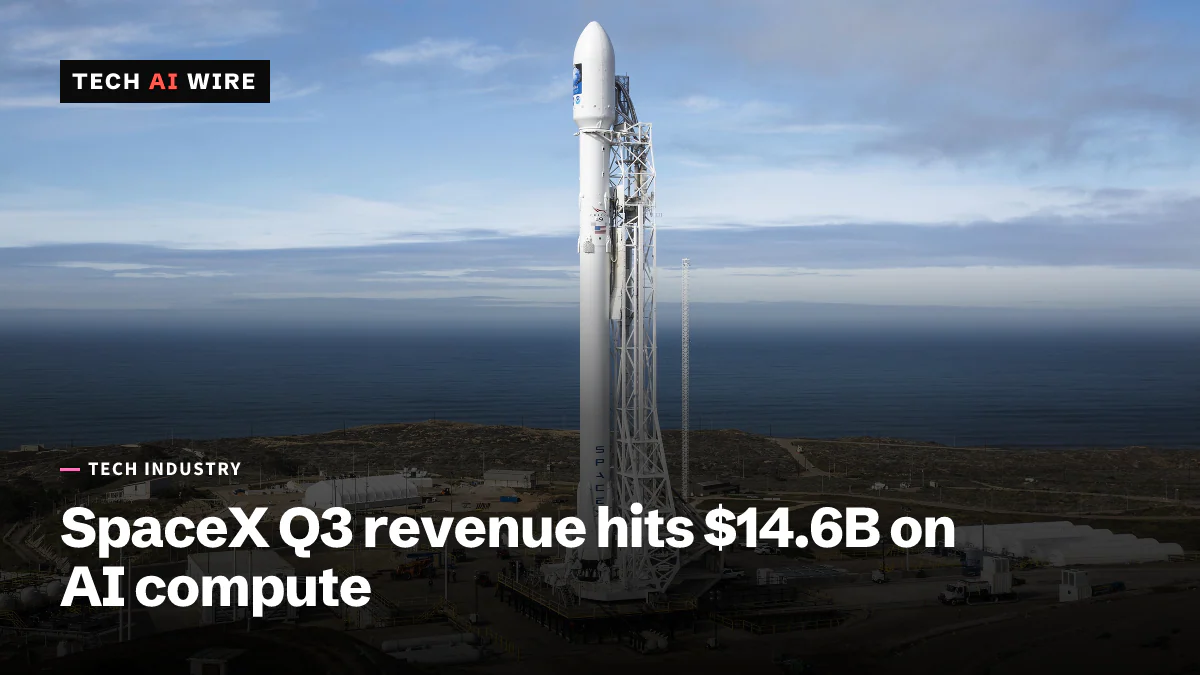
SpaceX's Q3 revenue rose 161% to $14.6 billion, led by $7.56 billion from AI compute. SpaceX and Tesla have formed committees to weigh a merger.
3 min read
By the numbers
- Q3 revenue, up 161% from a year earlier
- $14.6B
- Q3 net income, or 35 cents a share
- $4.4B
- Q3 capital spending
- $19.6B
- Super Intelligence (AI)
- 7.56B
- Connectivity (Starlink)
- 5.25B
- Space
- 1.77B
SpaceX reported third-quarter revenue of $14.6 billion on October 20, 2026, up 161% from a year earlier. Most of it now comes from renting out AI computing power, not from rockets or Starlink internet. On the same call, Elon Musk said SpaceX and Tesla have each formed committees of independent directors to weigh a merger.
The Q3 numbers
SpaceX beat Wall Street's forecasts on almost every line, Fortune reports. Analysts had expected revenue of about $12.86 billion, by the Visible Alpha estimate Fortune cites. Yahoo Finance cites a Bloomberg estimate of $12.7 billion.
| Measure | Q3 2026 | What was expected |
|---|---|---|
| Revenue | $14.6 billion (+161%) | $12.86 billion (Visible Alpha) |
| Net income | $4.4 billion, 35 cents a share | 15 cents a share (Yahoo Finance) |
| Operating income | $2.79 billion | $2.33 billion |
| Adjusted EBITDA | $8.81 billion | $6.59 billion (Yahoo Finance) |
| Capital spending | $19.6 billion | No full-year forecast given |
Operating income is profit from the business before interest and taxes. This was SpaceX's first operating profit since it went public, after a $143 million operating loss in the second quarter, Fortune says.
AI compute is now the biggest business
The segment SpaceX calls Super Intelligence brought in $7.56 billion, up from $2.56 billion in the second quarter. That beat the $6.47 billion analysts expected, and it is now larger than Starlink.
Fortune says the growth came from computing capacity leased to Anthropic, Google, Grok and X. According to Yahoo Finance's live coverage, the company credits cloud services deals, the Cursor acquisition and growth in its own AI models and apps. Cursor, the AI coding tool SpaceX bought in August, added $608 million. "There are many customers asking for compute," chief financial officer Bret Johnsen said.
Starlink, inside the Connectivity segment, grew revenue 69% to $5.25 billion. But it added 1.6 million consumer subscribers in the quarter, short of the 2.29 million analysts expected. It now has 13.6 million consumer subscribers in 174 markets, Yahoo Finance reports. The Space segment, which covers launches, grew 6% to $1.77 billion.
Almost all of the spending went to AI. Of the $19.6 billion in capital spending, $16.44 billion was for AI, according to Yahoo Finance. Fortune cites Visible Alpha's Melissa Otto, who expects capital spending of about $70 billion this year, rising to $197.4 billion in fiscal 2028. She expects debt to grow from $50.7 billion in 2025 to $350 billion in 2029.
The Tesla merger committees
SpaceX and Tesla have both set up special committees of independent directors to study combining the two companies. Musk said they were "created at the request of shareholders," TechCrunch reports.
"Because I'm a conflicted party, I can't actually be in the discussions of the special committees," Musk said. He runs both companies and is the largest shareholder in each. Asked if a merger would be a good idea, he answered: "Do I think it would be a good idea? Yes."
He also warned that it is not a certainty. "At the end of the day, the shareholders have to be supportive of this," he said. At Tesla, approval would need 50% of all shareholders, not just those who vote. At SpaceX, Musk holds more than 50% of the voting power, which makes approval easier there.
Musk named AI software, robotics, a planned orbital AI data center called Starmind and the Terafab chip project as reasons to combine. Tesla has seven independent directors and SpaceX has six, TechCrunch says. Neither company has said who sits on the committees or when they will decide.
What this means for developers
SpaceX is now one of the larger suppliers of rented AI computing power. That matters even to teams that never buy a launch.
- Know whose chips you rent. Anthropic and Google both lease capacity from SpaceX, per Fortune. If your work depends on their models, SpaceX's build-out is now part of their capacity.
- Watch Cursor's direction. SpaceX owns Cursor, and OpenAI is cutting Cursor off from its models on November 12. Teams on Cursor should track which models it offers after that date.
- Read the merger as a supplier question. A combined company would hold Grok, Starlink, Cursor and Tesla under one owner. If you buy more than one of these, check what your contracts say about a change of control.
- Track the debt. Analysts expect SpaceX's debt to reach $350 billion by 2029. Long compute contracts carry more risk if the build-out stalls, so prefer terms you can exit.
Sources
Related articles
Meta Q3 revenue rises 26% as free cash flow turns negative
Meta's Q3 2026 revenue rose 26% to $64.6 billion, but $34.9 billion of capex and a $9.9 billion legal charge pushed free cash flow negative.
DayOne files for a Nasdaq IPO with 962 MW in service
Data center operator DayOne filed for a Nasdaq IPO as DODC. It has 962 MW in service and needs about $11.4B to build the 2,281 MW it has already booked.
Micron sees tighter memory supply in 2027 and 2028
Micron posted $54.23 billion in fiscal Q4 revenue and guided to $61.5 billion, then warned memory supply will be tighter in 2027 and 2028 than in 2026.
The weekly digest
One email every Friday with the week's top stories from all six desks: AI, dev tools, coding, the tech industry, startups and what's next. Free, no spam.