Science Corp implants PRIMA in first Stargardt patient
Science Corporation says its PRIMA retinal implant let its first Stargardt disease patient read a word by his second rehab session, after surgery in May.
3 min read
By the numbers
- square size of the PRIMA chip, per TechCrunch
- 2 mm
- of assessed AMD trial patients could read letters, numbers and words
- 84%
- length of the implant procedure
- ~1 hour
Science Corporation said on October 13, 2026 that its PRIMA retinal implant has been placed in its first patient with Stargardt disease. The patient, a man, saw a letter in his first rehabilitation session and read a word in his second. Stargardt is an inherited condition that destroys central vision and is currently considered incurable, so the result tests whether PRIMA can work beyond the disease it was built for.
What happened
The implant was placed in May at Sydney Eye Hospital in Australia, the company's update says. It is part of a clinical trial called PRIMAlia, supervised by Dr. Matthew Simunovic. The company has not given the patient's name or age.
Stargardt damages the light-sensing cells of the retina, called photoreceptors, while other retinal cells survive. That is the pattern PRIMA was designed for. Science says the approach may suit other diseases where photoreceptors are lost but the inner retina still works.
How PRIMA works
PRIMA is a small chip placed under the retina, at the back of the eye. TechCrunch puts it at 2 mm by 2 mm and says the procedure takes about an hour.
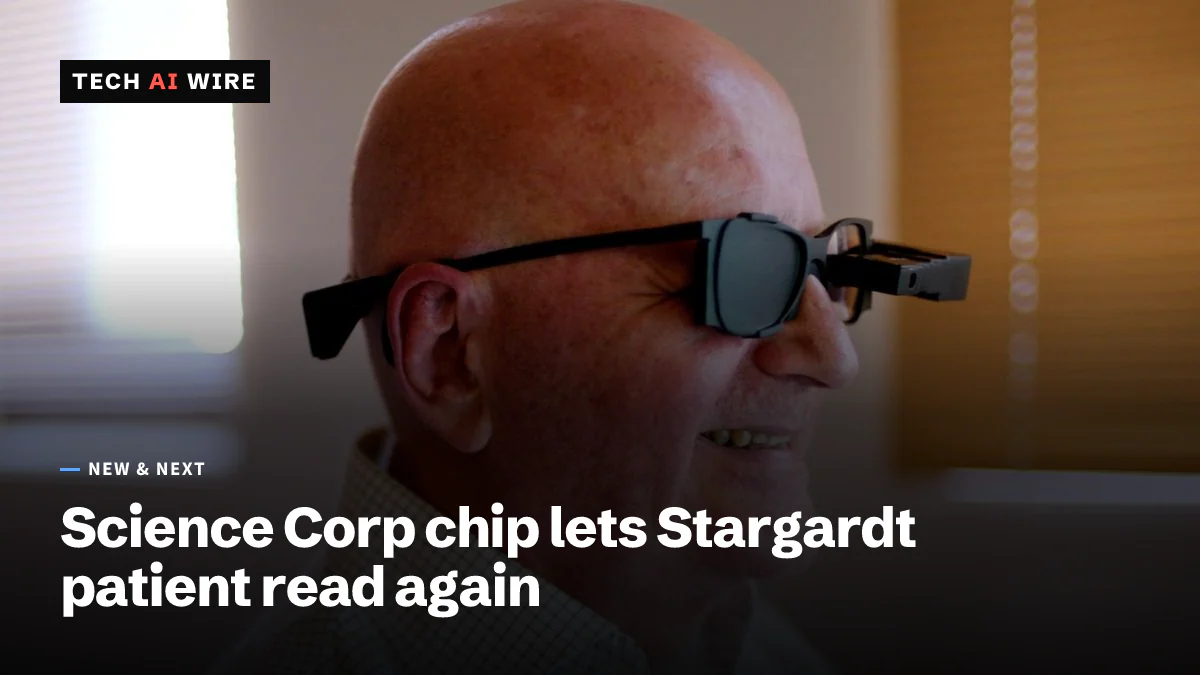
The patient wears glasses with a camera. Science says the glasses send the scene to the implant as infrared light. The chip's tiny solar-cell pixels turn that light into electrical signals. The remaining retinal cells pass those signals on to the brain's visual cortex.
"The retina is part of the central nervous system," Science chief executive Max Hodak told TechCrunch. He described the resulting image as high contrast and sharp: "they can see a couple letters at a time."
Hodak co-founded Neuralink, the brain-implant company, and started Science in 2021 after leaving it, TechCrunch reports.
Where PRIMA stands
PRIMA was first developed for geographic atrophy, an advanced form of age-related macular degeneration (AMD). Science lists its status by market:
| Market | Status |
|---|---|
| European Union | CE marked and commercially available for geographic atrophy |
| United Kingdom | Registered for supply |
| United States | Not approved; Humanitarian Use Device designations for geographic atrophy and Stargardt, spring 2026 |
| Australia | Investigational only |
A Humanitarian Use Device designation is a first step, not an approval. Science says a US approval would still need a Humanitarian Device Exemption.
In a study of 38 geographic atrophy patients published in the New England Journal of Medicine, 32 were assessed at 12 months. Of those, 84% could read letters, numbers and words, the company says.
TechCrunch reports that Science is building a next-generation device for human testing within the next year. The goal is to approach normal visual sharpness over five years.
What this means for developers
For people who build or buy medical technology, a few points stand out:
- Expect slow, staged approvals. PRIMA is on sale in Europe but has only designations in the US. Teams building on brain-computer interfaces should plan for years between a first patient and a first sale in each market.
- The software matters as much as the chip. The camera glasses turn the scene into a pattern the implant can use. Image processing and rehabilitation training shape what a patient can actually read.
- Watch the second disease. A device approved for one condition is now being tested on another. If PRIMAlia succeeds, it shows how one implant can reach more patients through new trials.
- Treat the early results as early. One patient reading a word is a milestone, not a trial outcome. Wait for PRIMAlia's results before drawing conclusions about Stargardt.
Sources
Related articles
Sony sells a Japan-only black PS5 for 55,000 yen
Sony announced a Midnight Black PS5 Digital Edition for Japan on October 13: 55,000 yen with tax, out November 19, and usable only in Japanese.

Apple TV 4K with A19 costs $299; HomePod mini 2 is $149
Apple announced a $299 Apple TV 4K with an A19 chip and a $149 HomePod mini 2 on October 13. Siri AI comes to the TV at launch, the speaker later.
Apple HomeView is a $299 smart display with Siri AI
Apple unveiled HomeView on October 13, a $299 smart home display with a 7-inch screen and Siri AI. It ships November 13, but not in the European Union.
The weekly digest
One email every Friday with the week's top stories from all six desks: AI, dev tools, coding, the tech industry, startups and what's next. Free, no spam.