Ling-3.1-flash: Ant Group opens 560B model under MIT
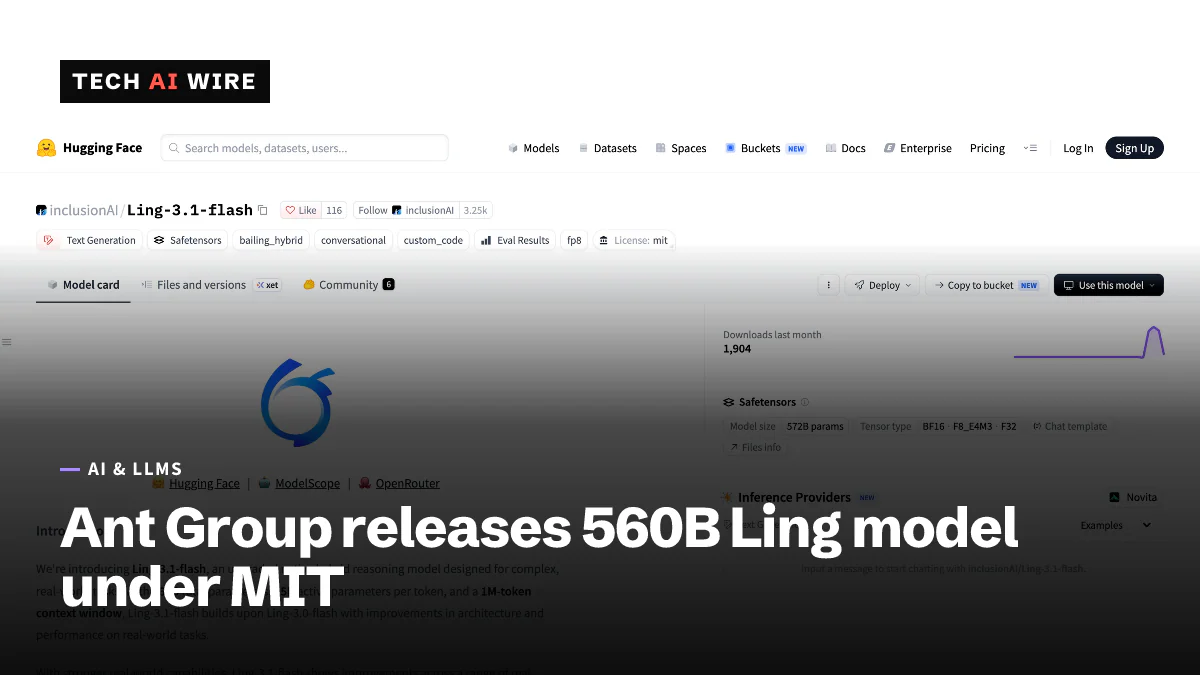
Ant Group's inclusionAI published Ling-3.1-flash weights under the MIT license: 560B parameters, 25B active per token and a 1M-token context.
3 min read
By the numbers
- total parameters
- 560B
- parameters active for each token
- 25B
- tokens of context
- 1M
- H200 GPUs in the recommended serving setup
- 8
Ant Group's AI research team, inclusionAI, has published the weights of Ling-3.1-flash on Hugging Face under the MIT license. The model has 560 billion parameters, uses 25 billion for each token, and reads up to 1 million tokens at once. The MIT license means companies can build products on it with very few conditions.
What inclusionAI released
The model card on Hugging Face describes a "hybrid-linear" mixture-of-experts model. A mixture-of-experts model splits its work across many small expert networks and switches on only a few for each token, the word piece a model reads or writes. Ling-3.1-flash has 512 routed experts and turns on 8 of them per token, plus 1 shared expert.
"Hybrid-linear" refers to its attention layers, the part of a model that relates each word to the others. Most of its 72 attention layers use a cheaper linear design, and 9 use a fuller design called Gated MLA.
The repository's first commit is dated October 13, and the model card was last updated on October 15. Tech360 reports that Ant first offered the model as a two-week free API trial capped at 256,000 tokens of context. It promised the full window and the weights after the trial, and published them when the trial closed.
How it scores
The model card lists these results. They are inclusionAI's own figures, and the card does not name the models it compares against.
| Benchmark | Ling-3.1-flash |
|---|---|
| SWE-bench Multilingual | 88.5 |
| Terminal-Bench 2.1 | 81.18 |
| SWE-bench Pro | 68.74 |
| SkillsBench v1.1 | 68.7 |
| Deep SWE | 59.7 |
| Terminal-Bench 4 | 46.03 |
| Humanity's Last Exam | 37.44 |
An outside view comes from Artificial Analysis, an independent benchmarking firm. AlphaSignal reported on October 6 that it gave the hosted model 41 on its Intelligence Index, up from 20 for Ling 3.0 Flash. Agent tasks gained most: AutomationBench-AA went from 3% to 62%.
What it takes to run
The weights are big. AlphaSignal put the memory at 1.12 TB in full BF16 precision, 560 GB at 8 bits and 280 GB at 4 bits.
The model card recommends SGLang, a serving engine, on 8 Nvidia H200 GPUs or 4 GB300 GPUs. It also gives a recipe for vLLM, another engine. Both use multi-token prediction, a trick where the model drafts several tokens ahead to speed up output. The card also points to quantized versions for llama.cpp, Ollama and LM Studio, which shrink the model to run on smaller machines.
| Where to get it | Detail |
|---|---|
| Hugging Face | Weights, MIT license |
| ModelScope | Weights |
| OpenRouter | Hosted API |
| Novita | Hosted API, also listed on Hugging Face |
On October 6, AlphaSignal listed Novita's price at $0.30 per million input tokens and $0.90 per million output tokens. Tech360 adds that Ant built LingCode, a coding harness on top of the open-source agent Pi, and may open-source it later.
How it compares on cost
Per-token price is not the whole cost for agents, which run for many steps. AlphaSignal cited Artificial Analysis figures for the cost of one benchmark task. Ling 3.1 Flash came in at $0.99, against $0.32 for DeepSeek V4.1 Flash in its Max mode and $1.24 for Gemini 3.8 Flash on its High setting. DeepSeek shipped an updated V4.1 Flash checkpoint today, so that gap may have moved.
Ling-3.1-flash joins a busy week for large open models. Meta released Muse Spark Open with 816 billion parameters on October 15.
What this means for developers
The MIT license is the headline for most teams. It allows commercial use and changes with few conditions, so legal review should be short. Meta's model, by contrast, uses a custom license.
Self-hosting is still a data-center job. Eight H200s is the recommended starting point, so most teams will begin on OpenRouter or Novita. Compare their prices with the trial figure, since none of the sources gives a post-trial price.
Test it on your own long-context work. A 1-million-token window only helps if quality holds near the end of a long input, and the scores on inclusionAI's card do not include a long-context test.
Check benchmark harnesses before you compare. Vendors run Terminal-Bench and SWE-bench in different setups, so a few points between two model cards may not mean much.
Sources
Related articles
Xiaomi MiMo-V2.6-Pro ships 1T open weights under MIT
Xiaomi's MiMo-V2.6-Pro has 1.02 trillion parameters, 42 billion active, a 1M-token context and MIT-licensed weights, but needs about 680 GB of GPU memory.
StepFun Step 5 Preview: 600B open-weight agent model
StepFun's Step 5 Preview, a 600B-parameter model with 27B active and a 1M-token context, is on Hugging Face after an API-only month at $1/$2.70 per M.
Meta Muse Spark Open ships 816B open weights
Meta released Muse Spark Open, an open-weight model with 816B parameters, 42B active and a 1M-token context, on Hugging Face and three cloud platforms.
The weekly digest
One email every Friday with the week's top stories from all six desks: AI, dev tools, coding, the tech industry, startups and what's next. Free, no spam.