Torvalds' page cache patch reworked: 4.5x faster on ext4
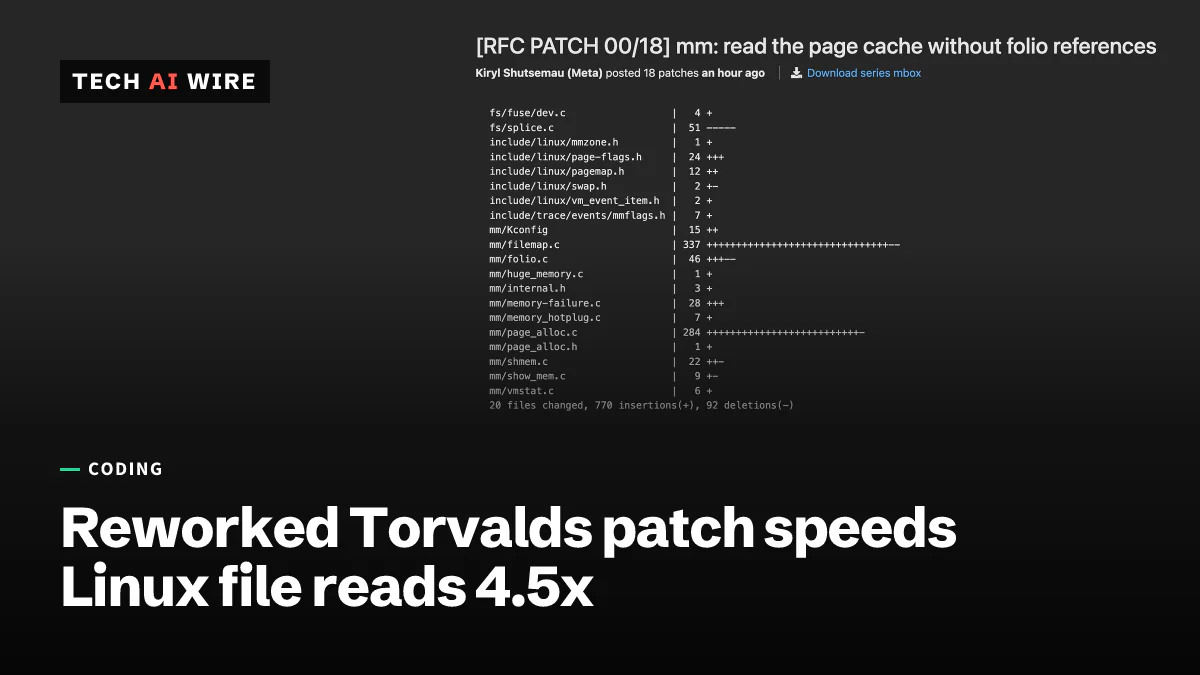
Meta's Kiryl Shutsemau turned Torvalds' page cache patch into an 18-patch RFC. 64 threads on ext4 rose from about 15M to 70M small reads a second.
4 min read
- Before, mitigations on
- 15.7M
- After, mitigations on
- 70.1M
- Before, mitigations off
- 17.2M
- After, mitigations off
- 220M
Meta engineer Kiryl Shutsemau posted a reworked version of Linus Torvalds' Linux page cache patch on October 19, 2026. The new series has 18 patches. In a 64-thread test on the ext4 file system, small reads of one file rose from about 15 million to about 70 million a second. It also adds fixes for memory problems Torvalds had left open, though the code is still a draft for review.
What changed since Torvalds' version
A week ago, Torvalds published a set of page cache patches he wrote with Claude Code, Anthropic's AI coding assistant. Shutsemau has now taken that work further. His series is titled "mm: read the page cache without folio references."
The cover letter, as archived on Patchew, credits Torvalds' earlier draft. Shutsemau wrote 11 of the 18 patches and Torvalds wrote 7. Together they touch 20 files, adding 770 lines and removing 92. The series builds on Linux 7.3-rc7, a test release.
It is marked RFC, short for "request for comments." That label means the author wants feedback before anyone merges it. Phoronix, which covers Linux performance, called the results a "Fabulous improvement."
The problem: one counter, many processors
Linux keeps recently used file data in memory, in an area called the page cache. The kernel tracks that memory in units called folios. Each folio has a reference count, a counter that says how many readers are using it.
Every read briefly raises that counter and then lowers it. When many processor cores read the same small file, they all fight over one counter. "Small reads of one file from many CPUs all take and drop a reference on the same folio," Shutsemau writes.
How the series fixes it
The series lets ordinary file reads copy data without touching the counter. It covers filemap_read(), the kernel function behind normal file reads. It also covers shmem, the code behind tmpfs, a file system that lives entirely in memory.
To make that safe, a folio such a reader may copy from is freed only after an RCU grace period. RCU is a kernel method that lets readers work without locks. A grace period is a short wait after which every earlier reader is known to be done.
Only busy folios get this treatment. They carry a new flag called PG_rcu_free, which works on 64-bit systems only.
Four patches deal with the memory left waiting during that delay. They add a counter for it and speed up grace periods when memory runs low. Waiting pages are also freed before the out-of-memory killer, large contiguous allocations or memory removal give up. Torvalds had listed the first two as unsolved problems. A final patch adds a switch to turn the new fast path off.
The numbers
Shutsemau tested on a virtual machine with 64 virtual CPUs and 2 GB of memory, running on an AMD Threadripper 7975WX. Each thread read 16 bytes from the start of one file. Results are millions of reads per second.
| Test | Before | After |
|---|---|---|
| ext4, 64 threads | 15.0-15.7 | 68.9-70.1 |
| tmpfs, 64 threads | 1.6-1.7 | 71-72 |
| XFS, 64 threads | 11.3-11.4 | 20.4-20.5 |
| Raw block device, 64 threads | 14.7 | 28.8-28.9 |
| Any of these, 1 thread | 1.6-1.9 | 1.7-2.0 |
Those runs used the default CPU security mitigations, which are protections against flaws in the processor itself. Shutsemau says they add about 400 nanoseconds to every read as it crosses into the kernel. With them turned off, the ext4 gain grows from 4.5x to 13x, reaching 217-220 million reads a second. Those figures come from an earlier version with the same small-read path.
There are costs. A workload that keeps re-reading pages the kernel already dropped loses 4% to 6%.
What is still open
The cover letter lists several open questions:
- One patch relies on a check that no file holds the inode open. An inode is the kernel's record of a file. The f2fs file system broke that rule for atomic writes, and a fix is on its way.
- A patch drops a lock from tmpfs reads. Shutsemau thinks it is safe but asks another developer, Hugh, to double-check.
- During a grace period, a waiting folio counts toward no cgroup, the Linux feature that limits memory per container.
- The effect on memory compaction, which gathers free memory into large blocks, has not been measured.
- On some architectures, files mapped for writing still take the slow path.
What this means for developers
- Nothing ships yet. This is an RFC, and no target release is named. Memory-management reviewers will decide its shape.
- Busy shared reads gain most. The big wins come when many threads read the same small cached file. Single-thread reads barely move.
- tmpfs users should watch closely. It went from about 1.6 million to 71 million reads a second at 64 threads, the largest jump in the table.
- Benchmark with your real security settings. Mitigations cost about 400 nanoseconds per read here. Results with them off will not match a hardened production server.
- AI-assisted drafts still go through review. Torvalds' Claude Code draft became a reworked series from another engineer within a week. The normal kernel review path did the rest.
Sources
- [RFC PATCH 00/18] mm: read the page cache without folio references - Patchew (Linux kernel mailing list archive)
- Linus Torvalds' AI Code Improved: Huge Performance Wins With Reworked Code - Phoronix
Related articles

BeamFS RFC: a Reed-Solomon file system for Linux
BeamFS, an 18-patch Linux RFC, stores every block as Reed-Solomon codewords so it can repair flipped bits on a single disk, at a cost of 7% of the space.
MeshXFS: an AI-written clustered file system built on XFS
MeshXFS 0.90.130 turns XFS into a clustered file system, released for up to 16 nodes. AI agents wrote its clustering code, with no line-by-line human review.
Linux 7.3 released with fchroot, failfs and faster Btrfs
Linus Torvalds released Linux 7.3 on October 18, 2026: 18,765 commits from 3,021 developers, new sandboxing tools and Btrfs fsync up to 5x faster.
The weekly digest
One email every Friday with the week's top stories from all six desks: AI, dev tools, coding, the tech industry, startups and what's next. Free, no spam.