Linux 7.3 released with fchroot, failfs and faster Btrfs
Linus Torvalds released Linux 7.3 on October 18, 2026: 18,765 commits from 3,021 developers, new sandboxing tools and Btrfs fsync up to 5x faster.
4 min read
By the numbers
- non-merge commits in Linux 7.3, per LWN
- 18,765
- developers contributed to the release
- 3,021
- of them were first-time kernel contributors
- 807
- faster Btrfs fsync with no-holes in a sample test
- 5x
Linus Torvalds released Linux 7.3 on October 18, 2026, right on schedule. LWN calls it a record-breaker "on all fronts", with 18,765 non-merge commits from 3,021 developers. The release adds new sandboxing tools, per-group CPU schedulers and faster file systems. Container, database and desktop users will feel those changes once their distributions ship the new kernel.
Torvalds' own announcement was short. He wrote that "nothing very special seems to have happened this last week," LWN reports. He also said the merge window for Linux 7.4 opens the next day. The merge window is the stretch when new features land for the next release.
What's new in Linux 7.3
The KernelNewbies changelog and LWN list these headline changes. Two terms come up often. BPF lets small, checked programs run inside the kernel. A cgroup is a group of processes the kernel manages together, and it is the building block of containers.
| Area | Change in Linux 7.3 |
|---|---|
| Sandboxing | A new fchroot() system call and failfs, a file system where every operation fails |
| CPU scheduling | sched_ext supports cgroup sub-schedulers, each running its own BPF scheduler |
| Starting programs | binfmt_misc can use BPF to pick an interpreter each time a program starts |
| File systems | Btrfs and ext4 speedups; NTFS can read files with Windows System Compression |
| File sharing | The kernel's SMB server gains opt-in Apple Time Machine support |
| Virtual machines | userfaultfd can track which guest memory a VM is actively using |
| Graphics | Low-end GPUs evict less important buffers instead of moving straight to system RAM |
| User-space file systems | FUSE gains io_uring buffer pools and zero-copy transfers |
The VRAM change targets gaming on low-end graphics cards, KernelNewbies says. The sched_ext feature lets a BPF program act as the CPU scheduler. With sub-schedulers, each container group can now run a different one.
New sandboxing tools: fchroot and failfs
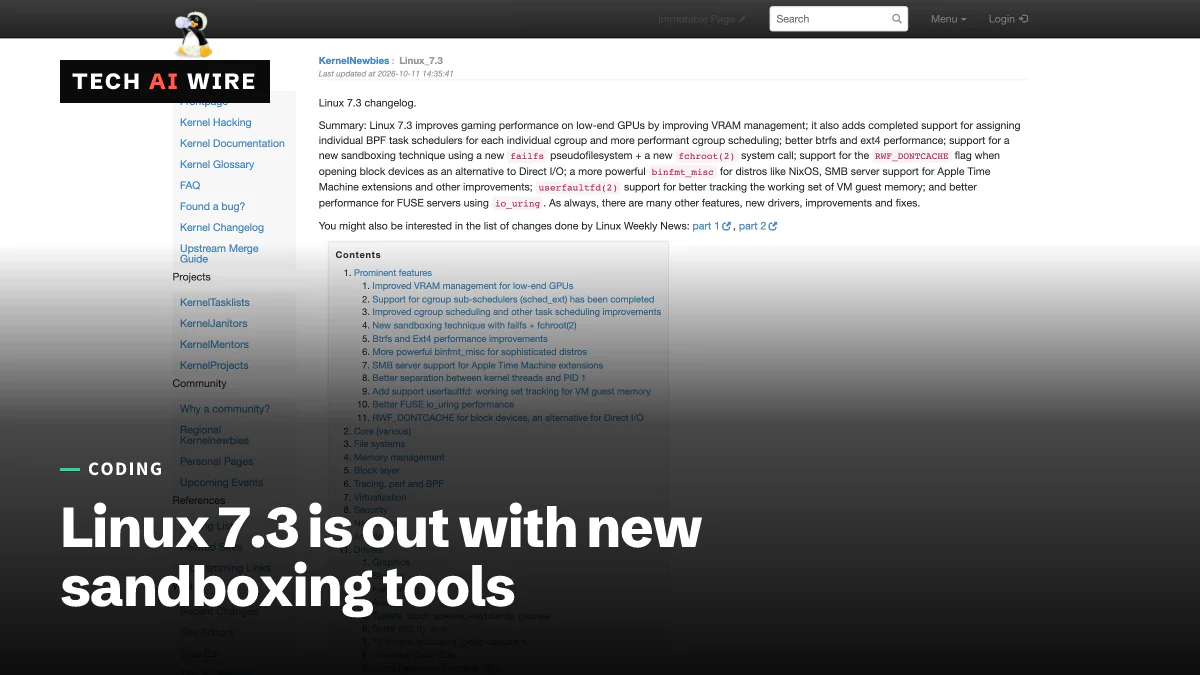
Sandboxing means locking a program in so it can touch only what it is allowed to. KernelNewbies describes fchroot() and failfs together as a new sandboxing technique. The fchroot() call is a new relative of chroot(), the old call that changes which directory a process sees as the top of the file system. The failfs pseudo-file system fails every operation, LWN says. A sandboxed program pointed at it finds nothing it can use.
The release also tightens how the kernel runs its own background threads. Kernel threads now live in nullfs, an empty file system, which keeps them apart from PID 1, the first user-space process.
Faster file systems and memory
KernelNewbies gives figures from developers' sample workloads:
- ext4 small direct I/O: from about 1.92 million to 2.19 million operations per second.
- Btrfs direct I/O: from about 50% to about 95% of the theoretical maximum.
- Btrfs fsync with no-holes: about 5x faster. Databases call fsync to force data onto the disk.
- KSM locking: the worst-case lock hold fell from over 500 milliseconds to under 2 milliseconds. KSM merges identical memory pages, mostly on virtual machine hosts.
- Memory reclaim: time spent waiting on the LRU lock dropped by over 60%.
Block devices also gain RWF_DONTCACHE, a flag that asks the kernel not to keep the data in its cache. KernelNewbies presents it as an alternative to direct I/O. These are sample tests, so real gains depend on the workload.
Hardware support and late fixes
Phoronix's Michael Larabel highlights faster I/O on modern systems and more AMD Zen 6 preparation. The release adds a driver for the 2026 Steam Controller and improves support for older AMD graphics cards.
Late in the cycle, developers fixed rare boot hangs on multi-processor systems that dated back to 2024. They also added workarounds for Samsung 990 PRO and 990 EVO Plus SSDs. On some firmware versions, those drives report their capabilities wrongly. Phoronix also reports that Darrick Wong is stepping down after 23 years of kernel work.
The cycle drew attention for other reasons too. Linux 7.3-rc4 carried error-path fixes that LLM tools helped find, and Ubuntu 26.10 shipped on October 15 with a kernel built from release candidate 7.3-rc6.
What comes next: Linux 7.4
The Linux 7.4 merge window opened on October 19. Torvalds warned that his merge schedule may be "a bit unusual for a while," because he is on his annual family vacation. Phoronix says 7.4 has a chance of release before the end of December.
Some 7.4 changes are already queued, such as a patch that removes BFS, the old UnixWare boot file system. Phoronix also speculates that 7.4 could be this year's long-term support (LTS) kernel, or that Greg Kroah-Hartman may pick 7.3 instead.
What this means for developers
Most developers will get Linux 7.3 from their distribution, not from kernel.org. Run uname -r to see what you have, and watch your distribution's kernel updates over the coming weeks.
If you build containers or sandboxes, fchroot() and failfs are new tools worth testing. They exist only on 7.3 and later, so a tool that uses them must detect support and fall back on older kernels.
If you run databases on Btrfs or ext4, benchmark 7.3 with your own workload before you upgrade. The headline figures come from sample tests, and fsync-heavy or direct-I/O work is where you should look first. If your Samsung 990 PRO or 990 EVO Plus drives have misbehaved, 7.3 is worth trying.
Teams that run mixed workloads should look at the sched_ext sub-schedulers. A latency-tuned scheduler for one container group and a throughput-tuned one for batch jobs can now share a machine. Teams that standardize on LTS kernels should watch which version Kroah-Hartman names.
Kernel security work does not pause for a release. Two days before 7.3 shipped, a researcher disclosed six kernel bugs called Infinity Core with public exploits.
Sources
- The 7.3 kernel has been released - LWN.net
- Linux 7.3 Released With Faster I/O Performance, AMD Zen 6 Preparations & More - Phoronix
- Linux 7.3 changelog - KernelNewbies
Related articles
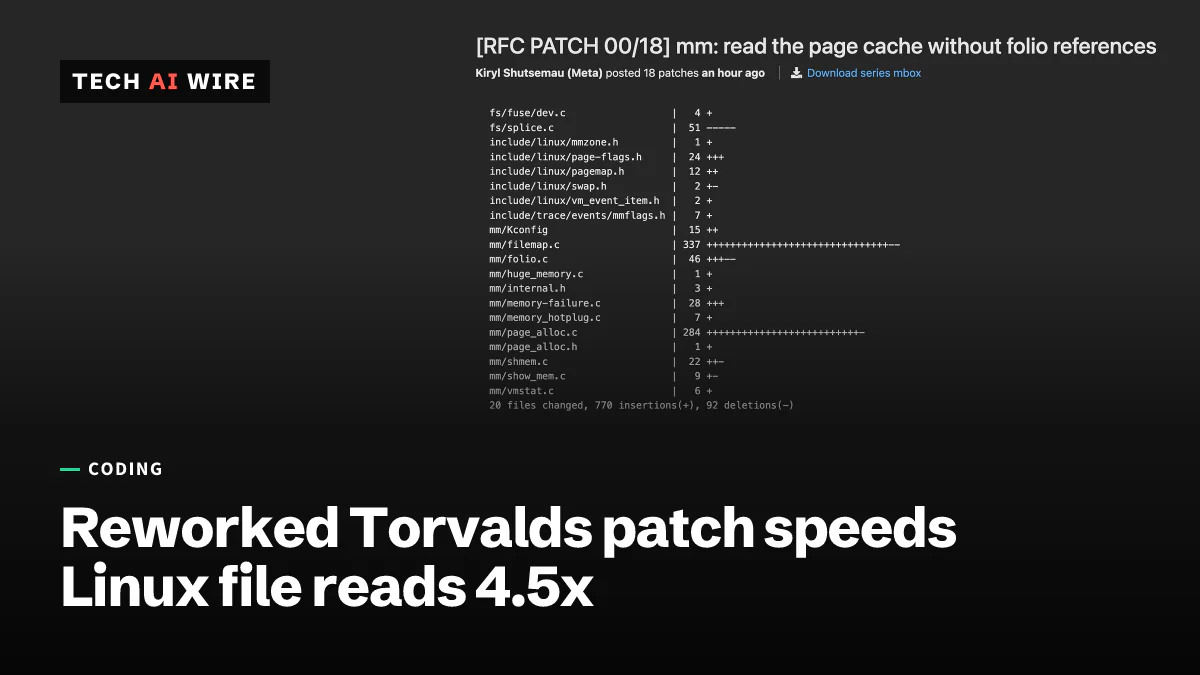
Torvalds' page cache patch reworked: 4.5x faster on ext4
Meta's Kiryl Shutsemau turned Torvalds' page cache patch into an 18-patch RFC. 64 threads on ext4 rose from about 15M to 70M small reads a second.

BeamFS RFC: a Reed-Solomon file system for Linux
BeamFS, an 18-patch Linux RFC, stores every block as Reed-Solomon codewords so it can repair flipped bits on a single disk, at a cost of 7% of the space.
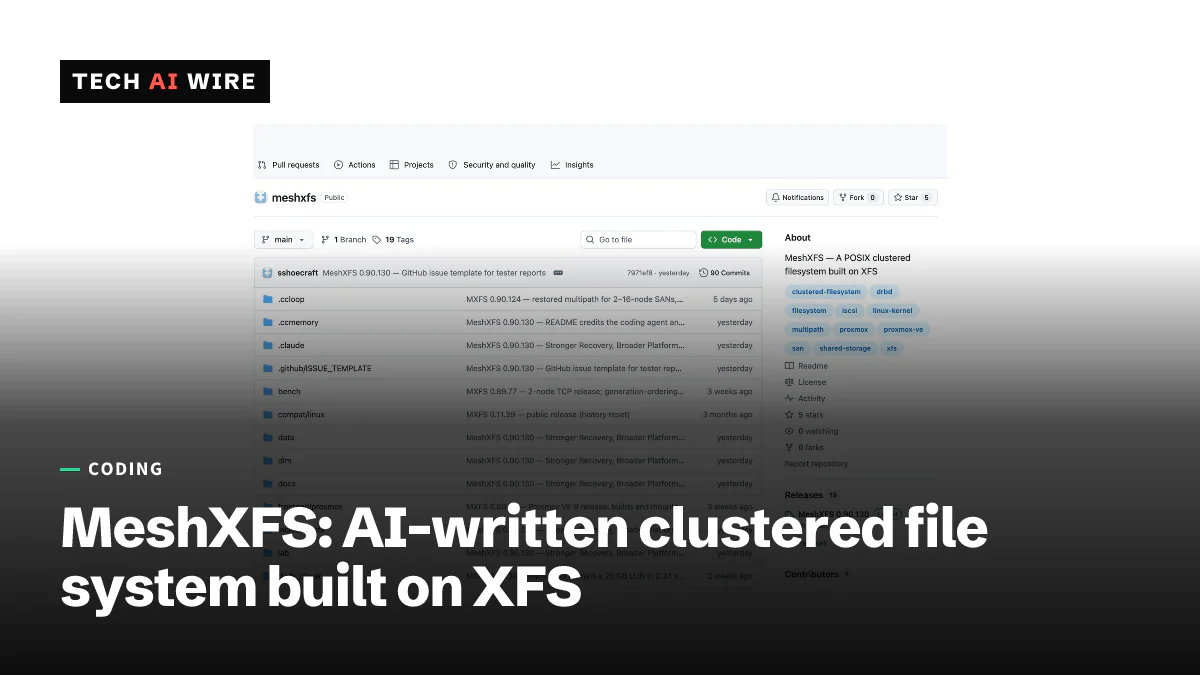
MeshXFS: an AI-written clustered file system built on XFS
MeshXFS 0.90.130 turns XFS into a clustered file system, released for up to 16 nodes. AI agents wrote its clustering code, with no line-by-line human review.
The weekly digest
One email every Friday with the week's top stories from all six desks: AI, dev tools, coding, the tech industry, startups and what's next. Free, no spam.