FTC says Amazon quietly turned its ad auction into a first-price one
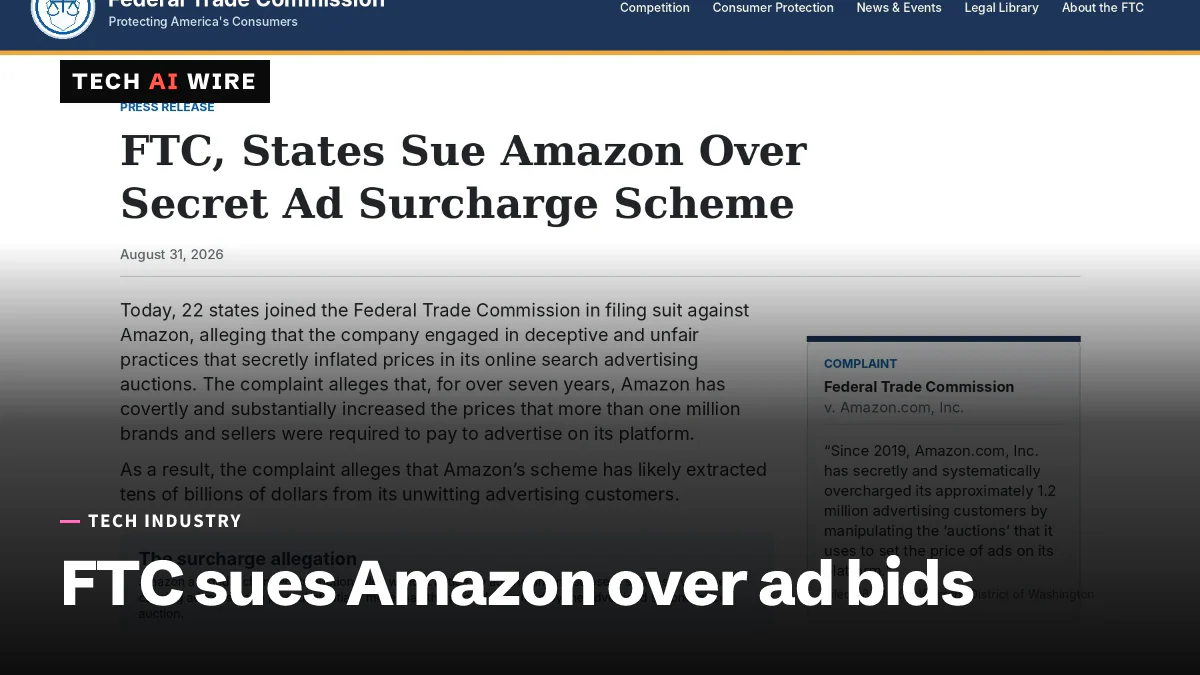
The FTC and 22 states sued Amazon on August 31, 2026. The complaint says Amazon charged advertisers their own maximum bid about 80% of the time by 2024.
4 min read
By the numbers
- of the time advertisers paid their max bid by 2024
- 80%
- states joining the FTC complaint
- 22
- the conduct allegedly ran, starting in 2019
- 7 years
- 2021
- 35%
- 2022
- 70%
- 2024
- 80%
The Federal Trade Commission and 22 states sued Amazon on August 31, 2026, alleging it secretly converted its advertising auction from a second-price auction into a first-price one. The FTC says advertisers were charged their own maximum bid about 80% of the time by 2024. If you have ever built or bid into an ad auction, the mechanism described in this complaint is worth reading closely.
The complaint was filed in the U.S. District Court for the Western District of Washington. NPR notes it is the third major federal case against Amazon, after a $2.5 billion Prime settlement and an ongoing monopoly suit.
How the auction was supposed to work
Amazon ran what advertisers understood to be a Generalized Second Price auction, or GSP. The FTC's filing says advertisers operated "under the assumption that Amazon uses a GSP auction."
In a second-price auction, you submit the most you are willing to pay. If you win, you do not pay that amount. You pay one cent more than the next highest bid. That design is deliberate: it makes bidding your true maximum the safe strategy, because you are protected from overpaying when rivals bid low.
That protection is the whole reason advertisers bid high.
What the FTC says actually happened
According to the complaint, Amazon added undisclosed surcharges that ate the gap between the second price and the bidder's maximum. The agency reports Amazon called this internally a "soft reserve price."
Two other mechanisms are named. The FTC describes Amazon using an "invented auction participant" and a "proxy 2nd price" calculation, and says these functioned as shill bids. A shill bid is a fake competing bid that exists only to push the price up.
The effect grew over time. The FTC's figures track the escalation year by year. Advertisers paid their own maximum bid 30 to 40 percent of the time in 2021, about 70 percent in 2022, and roughly 80 percent by 2024.
| Year | Share of the time the advertiser paid their own max bid |
|---|---|
| 2021 | 30 to 40 percent |
| 2022 | About 70 percent |
| 2024 | About 80 percent |
At 80 percent, the auction is a second-price auction in name only.
Who was affected, and what Amazon says
The scale figures differ slightly between sources. The FTC says more than one million brands and sellers, including more than 500,000 small and medium-sized businesses. NPR puts the figure at 1.2 million brands and sellers. The FTC says the conduct spans more than seven years, beginning in 2019, and extracted tens of billions of dollars.
The complaint quotes Amazon's own people. A senior executive in 2024 called it an "incredibly effective way to drive revenue." Internal discussion cited by the FTC also weighed the risk of "irrevocable damage to advertiser trust" and a "downward spiral."
Amazon rejects the case. Per NPR, the company said the FTC "misrepresented the reality" of its ad auctions and "cherry-picked findings," and argued that ad quality improved while cost-per-click stayed flat adjusted for inflation. NPR reports Amazon's advertising revenue at $69 billion in 2025.
The FTC and the state attorneys general are asking the court to stop the practices and to order monetary relief.
What this means for developers
If you build an auction, the lesson is about the contract your pricing rule makes with your users. A second-price auction is a promise: bid your true value and we will not exploit it. Adding a hidden reserve that captures the surplus breaks the promise while keeping the vocabulary. The FTC's word for that is deception, and it is now a legal theory.
So document your pricing logic where bidders can see it. If you apply a reserve price, say so and say how it is set. If your effective clearing price differs from the textbook rule your docs imply, either change the docs or change the rule. "Technically we charge less than or equal to your bid" is not a defense if your interface taught people to expect second-price behavior.
If you spend money on Amazon Ads, there is something concrete to do this week. Pull your Sponsored Products reports and compare your actual cost-per-click against your bid caps. A distribution clustered at your maximum rather than below it is the pattern the FTC describes. That does not prove anything on its own, but it tells you whether your bid ceilings have been functioning as prices.
And revisit your bidding strategy on that basis. Second-price auctions reward bidding your true value; first-price auctions punish it, because any amount above the clearing price is money lost. If a platform behaves like the second kind, bid shading becomes rational and your existing automation may be systematically overpaying.
One caution on all of it. These are allegations in a complaint, not findings by a court, and Amazon disputes both the characterization and the numbers. The mechanism is instructive either way.
Sources
- FTC, States Sue Amazon Over Secret Ad Surcharge Scheme - Federal Trade Commission
- The U.S. sues Amazon again - NPR
Related articles

OpenAI tests Sponsored Agents inside ChatGPT ads
ChatGPT Ads runs in 40+ countries, but OpenAI's new Sponsored Agents pilot is US-only: a brand's own chatbot, one click away from an ad.
OpenAI says ChatGPT ads hit a $1B run rate in under 200 days
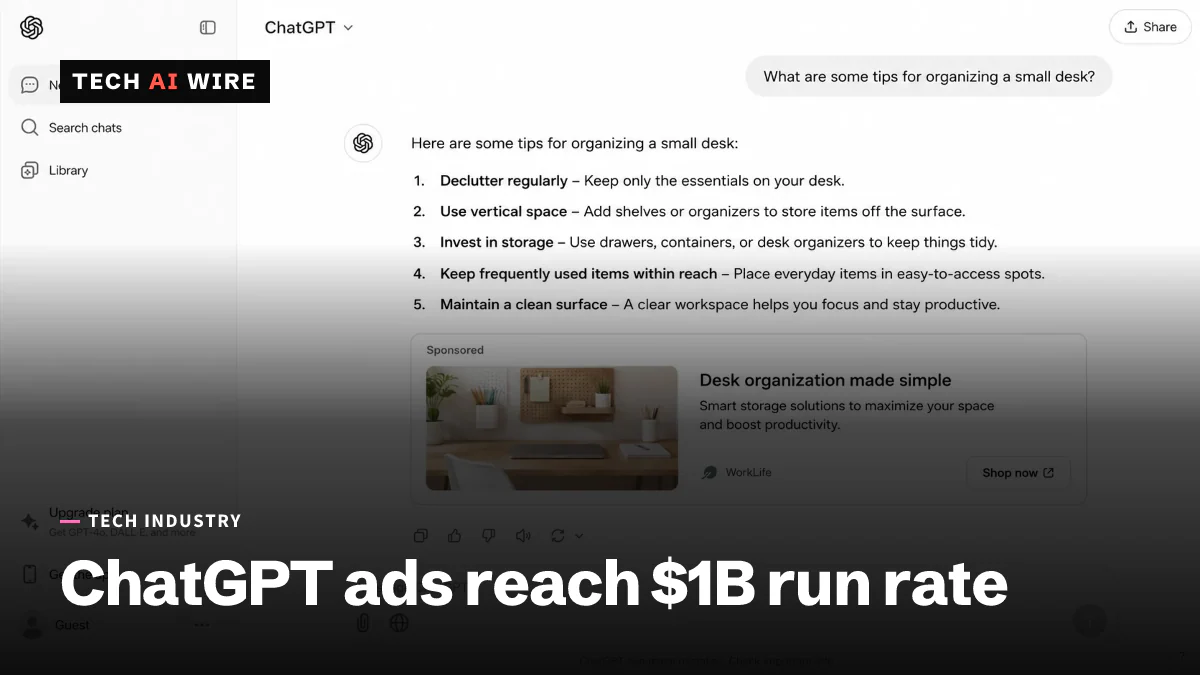
OpenAI said on August 31, 2026 that ChatGPT advertising reached a $1 billion annualized run rate in under 200 days. Self-serve buying opened outside the US the same day.
iOS 27.2 gives EU apps an alternative tracking prompt
The new prompt is mandatory in 5 EU countries and optional elsewhere. It drops the word track, and developers may ask again after a year.
The daily brief
Three to five stories a day, and what each one means for the people who build software. Free, no spam.