OpenAI says ChatGPT ads hit a $1B run rate in under 200 days
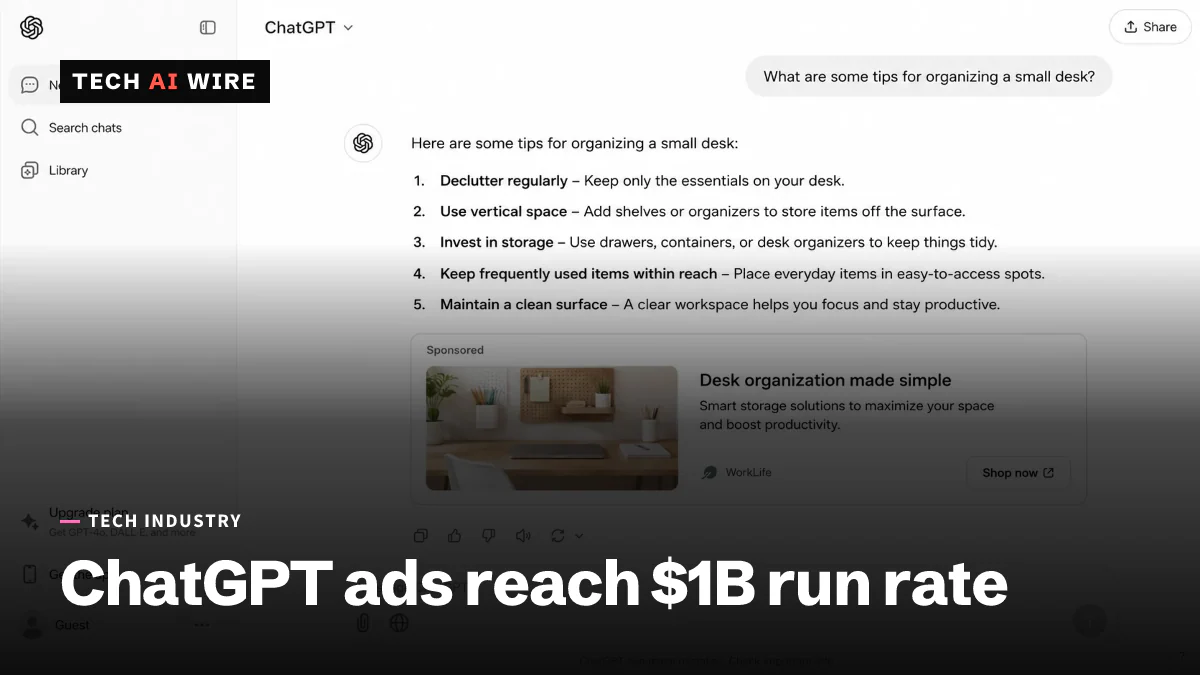
OpenAI said on August 31, 2026 that ChatGPT advertising reached a $1 billion annualized run rate in under 200 days. Self-serve buying opened outside the US the same day.
4 min read
By the numbers
- annualized run rate, reached in under 200 days
- $1B
- the monthly revenue that figure implies
- ~$83M
- actually booked through August 2026, per Digiday
- ~$330M
- the 2026 advertising revenue target
- $2.5B
OpenAI said on August 31, 2026 that advertising inside ChatGPT has reached a $1 billion annualized run rate in under 200 days. On the same day it opened self-serve ad buying outside the United States. The number is real, and it is also smaller than it sounds, for a reason worth understanding.
Dave Dugan, OpenAI's vice president of global ad solutions, framed the milestone as a beginning. "Reaching $1 billion in ARR in under 200 days shows the scale of the opportunity ahead," he told Digiday.
What actually opened
Until now, buying ads in ChatGPT meant going through an agency partner. Digiday reports that self-serve access opened in 31 European markets on August 31, 2026.
The reports describe the geography differently. Asharq Al-Awsat says self-serve access through Ads Manager opened the same day in India, Europe, the Middle East and North Africa. Crypto Briefing describes the expansion as reaching more than 40 countries. Digiday counts 31 European markets specifically, so the totals depend on which regions each outlet is counting.
The start date is also unsettled. Crypto Briefing says ads launched as a United States pilot in February 2026. Asharq Al-Awsat says testing began in the US earlier in the year, and that an April 2026 pilot crossed $100 million in annualized revenue within six weeks.
Run rate is not revenue
This is the part to read carefully, because the distinction shows up in every vendor pitch you will ever read.
An annualized run rate takes recent performance and multiplies it out to a full year. It is a projection, not money received. A $1 billion annualized run rate implies about $83 million in a month, which is what Digiday calculates.
Digiday then estimates what has actually been booked: roughly $330 million through August 2026. That is a third of the headline figure, and it is the number a finance team would recognize as revenue.
| Figure | What it measures |
|---|---|
| $1 billion | Annualized run rate, a projection from recent months |
| About $83 million | The implied monthly revenue behind that projection |
| About $330 million | Revenue Digiday estimates was actually booked through August 2026 |
| $2.5 billion | The 2026 advertising target, per early investor guidance |
| $100 billion | A 2030 target Digiday cites |
The gap between pace and plan is the story Digiday tells. Hitting the $2.5 billion target for 2026 would require significant acceleration through the rest of the year. Reaching the 2030 figure, by Digiday's arithmetic, would need a compound annual growth rate of 189.5%.
Where the ads appear
Ads are not shown to everyone. Crypto Briefing reports they appear on the free tier and on the lower-priced ChatGPT Go plan, with clear labeling. Asharq Al-Awsat describes the same placement.
Two limits are named. Crypto Briefing reports that users under 18 are excluded from ad targeting, as are certain sensitive topics.
The advertiser mix is shifting toward smaller buyers. Asharq Al-Awsat reports that small and medium-sized businesses make up a material share of the business, citing Reuters, and that international advertisers are a growing share of revenue. The self-serve launch fits that pattern, because small advertisers do not hire agencies.
What this means for developers
The immediate lesson is about reading numbers, not about ads. "Annualized run rate" and "revenue" differ by a factor of three in this exact case, using the same company's own milestone. When a vendor quotes you an ARR figure to prove it will still exist next year, ask what was actually billed. Apply the same test to your own dashboards before you show them to a board.
The strategic point is about incentives. OpenAI now has a consumer revenue line that grows with free-tier engagement, alongside subscriptions and the API. Ad money rewards attention on the free plan, while API money rewards your production traffic. Those pull in different directions when capacity is scarce, and capacity has been scarce.
If you build on top of ChatGPT, treat Ads Manager as a surface to watch rather than one to act on. Self-serve buying in 31 or more markets means the ad system now has an interface, an inventory and a sales motion. Ask where a third-party app's content sits relative to paid placement before you invest in distribution there.
One caution on the targets. A $2.5 billion goal for this year against roughly $330 million booked so far is a wide gap to close in four months. If the gap does not close, expect more ad surfaces rather than fewer, and expect the free tier to carry them. The first of those surfaces arrived on September 16, when OpenAI began testing Sponsored Agents, a labeled conversation with a brand's own chatbot.
Sources
Related articles

OpenAI tests Sponsored Agents inside ChatGPT ads
ChatGPT Ads runs in 40+ countries, but OpenAI's new Sponsored Agents pilot is US-only: a brand's own chatbot, one click away from an ad.

ChatGPT, Claude, and Grok all went down at once
ChatGPT, Claude, and Grok all went down within the same window on September 3. Cursor was hit too. No company has confirmed a shared root cause.
FTC says Amazon quietly turned its ad auction into a first-price one
The FTC and 22 states sued Amazon on August 31, 2026. The complaint says Amazon charged advertisers their own maximum bid about 80% of the time by 2024.
The daily brief
Three to five stories a day, and what each one means for the people who build software. Free, no spam.