iOS 27.2 gives EU apps an alternative tracking prompt
The new prompt is mandatory in 5 EU countries and optional elsewhere. It drops the word track, and developers may ask again after a year.
3 min read
Drafted with AI from the sources linked in this article, then fact-checked and edited by Claire Whitmore before publishing. How we work

By the numbers
- EU countries where the new prompt is mandatory
- 5
- how soon a developer may ask for tracking again
- 1 year
- agreed changes to the framework, per 9to5Mac
- 8
Apple is replacing the wording of its tracking permission screen for apps in the European Union. Apple's developer note says iOS 27.2 and iPadOS 27.2 introduce an alternative version of the App Tracking Transparency prompt. It is mandatory in Germany, France, Italy, Poland and Romania, and optional elsewhere in the EU.
iOS 27.2 has since shipped to everyone, so the new prompt is now live.
App Tracking Transparency, usually shortened to ATT, is the system prompt an iOS app must show before it tracks a user across other companies' apps and sites. The words in that prompt decide how many people say yes, which is why a rewrite is a business change rather than a cosmetic one.
What the new prompt looks like
The format changes first. TechCrunch reports the alternative appears as a full-page screen rather than a pop-up.
Then the language. TechCrunch reports the word "track" is gone, and the buttons change from "Allow" and "Ask App Not to Track" to plain "Allow" and "Reject." The old phrasing put a discouraging verb and an asymmetric pair of buttons in front of every request.
There is also a new place for your own explanation. 9to5Mac reports a text button labeled "Additional Information", where a developer can describe how data is linked for targeted advertising or shared with data brokers.
Where it applies, and what does not change
The geography is specific, and so are the limits.
| Item | Detail |
|---|---|
| Releases | iOS 27.2 and iPadOS 27.2 |
| Mandatory | Germany, France, Italy, Poland, Romania |
| Optional | The rest of the European Union |
| Re-prompting | A developer may ask again one year after a previous choice, per 9to5Mac, whether the user accepted or declined |
| Unchanged | Apple says "the requirements for when you must seek permission to track users will remain the same" |
That last row is the one to read twice. The prompt is different, but the rule about when you are obliged to show it is not, so this changes your conversion rate rather than your compliance obligations.
The cause is regulatory. TechCrunch reports Germany's Bundeskartellamt led the antitrust investigation behind the change, and 9to5Mac reports the Federal Cartel Office's years-long inquiry ended in eight agreed changes to the framework. Apple's own note attributes the update to agreements with select European competition authorities. The complaint regulators pressed was that ATT disadvantaged third-party apps, because Apple's own apps use customer data without showing the same screen.
What this means for developers
Treat this as an opt-in you have to decide about, not a migration. Outside the five named countries the alternative prompt is optional, so you now have two versions of the same consent flow and a choice to make per market. Running the old prompt in Spain and the new one in Italy is a supported configuration, and also a reporting headache.
Rebuild your opt-in baselines before you judge anything. A full-page screen with "Allow" and "Reject" will not convert like a pop-up with "Ask App Not to Track". Any attribution model tuned on the old rates is now measuring a different question. Plan to re-measure rather than assume the direction of the change.
The "Additional Information" button is the piece worth drafting carefully. It is space to explain data linking and broker sharing in your own words, inside Apple's screen, which means legal review of copy that users will actually read. Write it before the release, not after.
Note what nobody has published yet. None of these reports names an API, an entitlement or a plist key for choosing the alternative prompt, so the mechanics of adopting it are still down to Apple's documentation. Apple shipped iOS 27 itself only on September 14. That puts 27.2 close enough to belong on the current quarter's plan.
Sources
Related articles
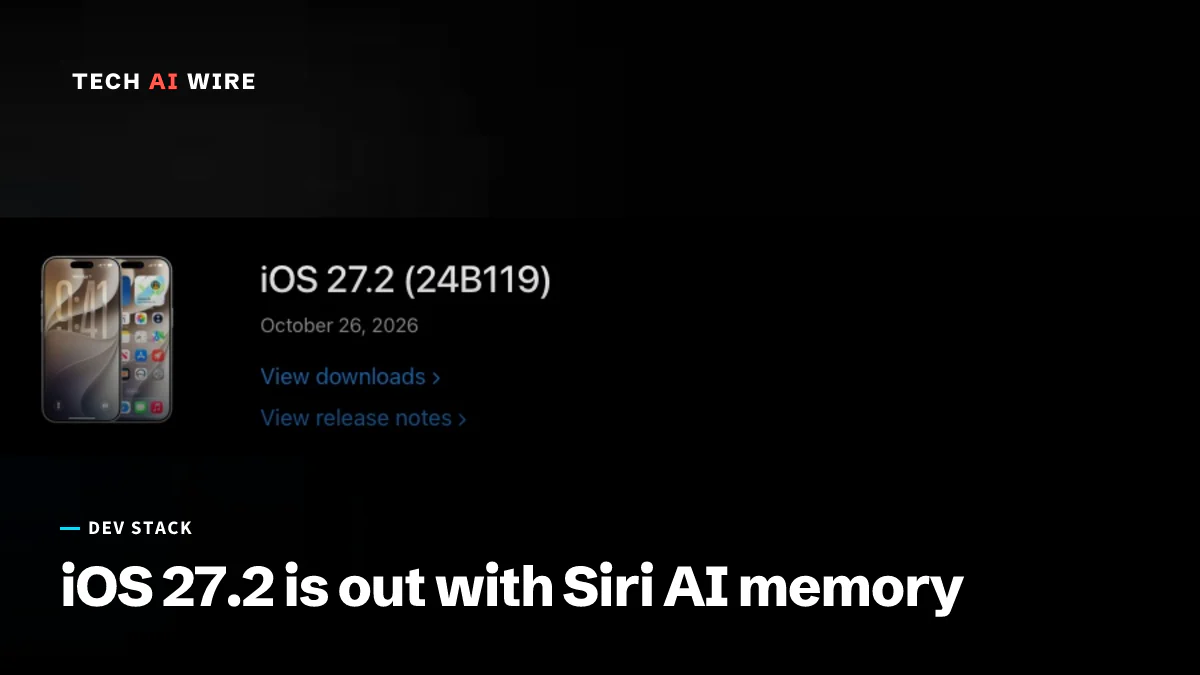
iOS 27.2 is out with Siri AI memory and 163 fixes
Apple released iOS 27.2 on October 26 with Siri AI memory, an Excluded Apps privacy setting, five new Siri languages and fixes for 163 vulnerabilities.

CodeQL can't trace Xcode 27 builds or scan Swift 6.4
GitHub says CodeQL cannot trace builds on Xcode 27 or analyze Swift 6.4 after Apple dropped Intel code it relied on. Its advice: stay on Xcode 26 for now.

AdFection: Citizen Lab finds spyware delivered via ads
Citizen Lab says Israeli firm Discover-Tech used targeted ads to deliver Candiru spyware with no click. At least 45 Al Jazeera devices were targeted.
The weekly digest
One email every Friday with the week's top stories from all six desks: AI, dev tools, coding, the tech industry, startups and what's next. Free, no spam.