Federal judge rules a Flock plate search unconstitutional
A federal judge ruled a warrantless Flock license plate search broke the Fourth Amendment and threw out 91 pounds of seized meth. It is not binding precedent.
3 min read
By the numbers
- warrantless Flock searches a month, per 404 Media's audit logs
- 100,000+
- of methamphetamine suppressed as evidence
- 91 lbs
- location records pulled on one driver
- 50+
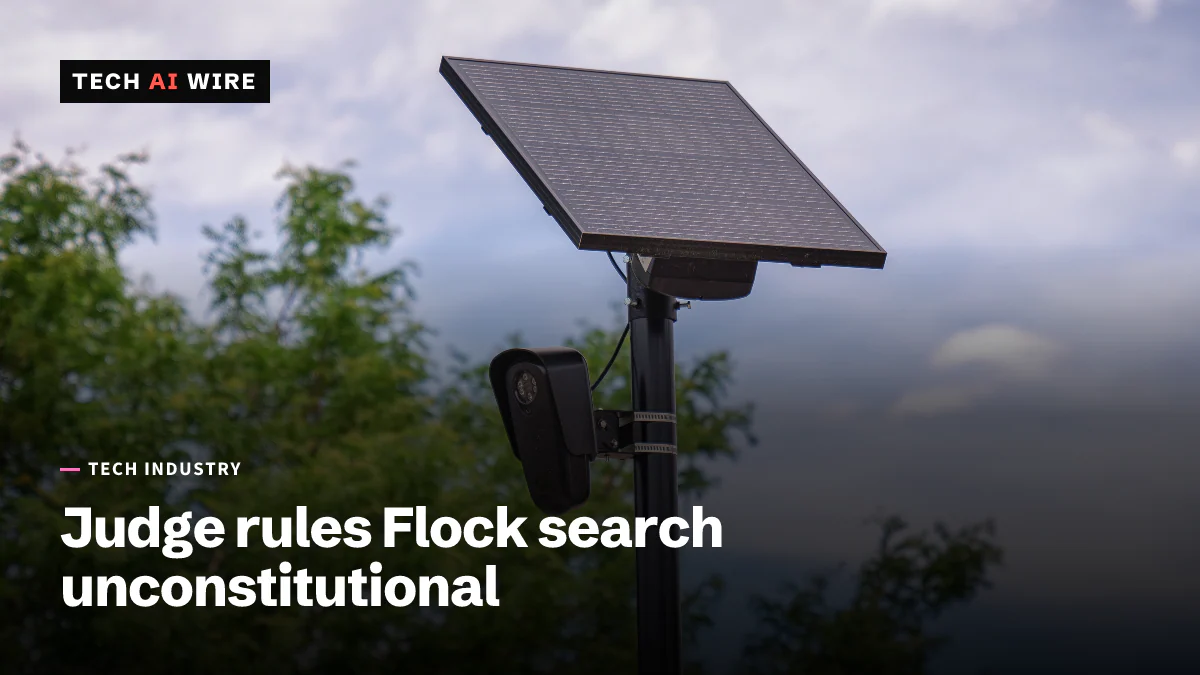
A federal judge in Oklahoma has ruled that a police search of Flock's license plate camera network broke the Fourth Amendment. Judge Sara Hill called the system "a type of indiscriminate mass surveillance," 404 Media reports. Any team that builds or buys camera data tools should note that a court has now questioned the legal basis of searching such data without a warrant.
What happened in the case
In May, a Tulsa County deputy sheriff parked beside a highway and saw a car with a California plate. According to 404 Media, he followed it only because the plate was from out of state.
He ran the plate through Flock's nationwide database. He then stopped the car for a lane change without a signal. During the stop, he reviewed more than 50 times the system had spotted the driver's car across the country. He used that travel history as part of his reason to search the car, and the search found methamphetamine.
Judge Hill found "no apparent reason" for the database search "other than the fact that [the woman's vehicle] had a California license plate," TechCrunch reports.
What the judge decided
Judge Hill ruled the deputy's use of the system was a warrantless search with no probable cause. TechSpot reports that she suppressed the 91 pounds of methamphetamine found in the car. She said the evidence must be thrown out as "the fruit of a poisonous tree," a legal rule that bars evidence gained through an illegal search.
The ruling breaks from earlier cases on license plate readers. Those cases said drivers have no expectation of privacy on public roads. TechSpot reports that Hill treated Flock's linked network as a different kind of tool, because it can track nearly any traveler between states.
404 Media notes that earlier rulings leaned on old precedent, such as the 1983 Supreme Court decision in United States v. Knotts. That case dealt with a single beeper on a single car, not a nationwide network.
Michael Soyfer of the Institute for Justice told 404 Media the opinion "recognizes one thing that courts ignore which is the sheer breadth of these systems."
How big the system is
404 Media says audit logs it viewed show more than 100,000 warrantless searches of the Flock system every month. That scale is why the judge's wording matters. A search that is routine for thousands of officers is now described in a federal opinion as a possible dragnet.
Limits of the ruling
This is one district court decision. TechCrunch and 404 Media both stress that it does not set binding precedent. Other courts around the country are still deciding whether warrantless Flock searches are legal.
Politics is moving too. TechSpot reports that Representatives Alexandria Ocasio-Cortez and Senators Bernie Sanders and Jeff Merkley introduced the Ban Flock Act after the ruling. In August, Texas halted state funding for Flock cameras, as we reported.
What this means for developers
If you build or integrate license plate, camera or location search tools, treat query logs as evidence. A court may one day ask why each search was run. Record who searched, what they typed and the stated reason. Make the reason a required field, not an optional note.
Check how your product handles broad searches. The deputy here searched by plate with no suspect and no case. Tools that let a user run open-ended lookups invite the same challenge. Consider requiring a case number or a warrant reference before a search runs.
Buyers should ask vendors three things. Can we export full audit logs? Can we limit searches by case type? What is our retention period for location history? A city that cannot answer may face suppressed evidence and public pressure at once.
Watch for appeals and for the next district court to rule. One decision is a signal. Several that agree would change what these systems can legally do.
Sources
- Federal Judge Rules a Flock Search Was 'Indiscriminate Mass Surveillance' and Unconstitutional - 404 Media
- Federal judge calls Flock search unconstitutional, as AOC and Bernie Sanders introduce bill to ban license plate readers - TechSpot
- Federal judge calls Flock 'indiscriminate mass surveillance' - TechCrunch
Related articles
Texas halts state funding for Flock's AI license plate cameras
Governor Greg Abbott ordered Texas agencies to stop funding Flock cameras on August 27, 2026, after officers were charged with using the network to stalk people.
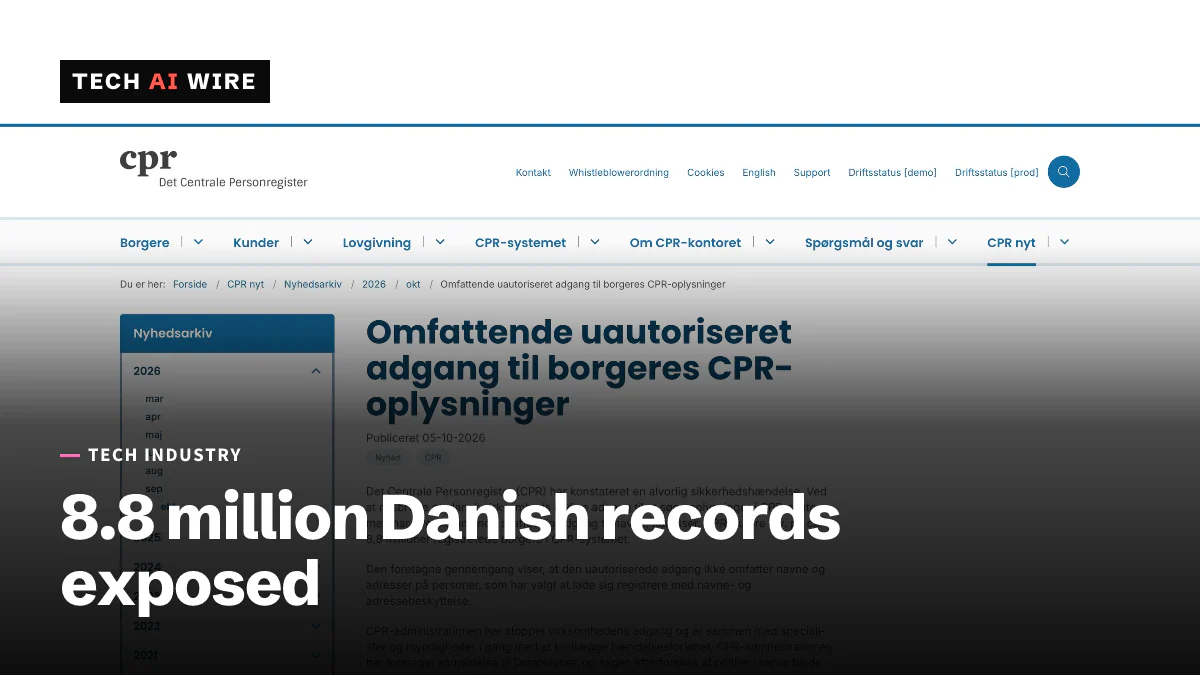
Denmark CPR breach exposes 8.8 million personal records
Attackers misused a Danish company's legal access to the CPR register and pulled names, addresses and ID numbers of 8.8 million people in September.

Bitchat pulled from India's App Store and Google Play
India ordered Jack Dorsey's offline messenger Bitchat off Apple's and Google's stores under Section 69A, months after GitHub was told to remove its code.
The daily brief
Three to five stories a day, and what each one means for the people who build software. Free, no spam.