Bitchat pulled from India's App Store and Google Play
India ordered Jack Dorsey's offline messenger Bitchat off Apple's and Google's stores under Section 69A, months after GitHub was told to remove its code.
2 min read
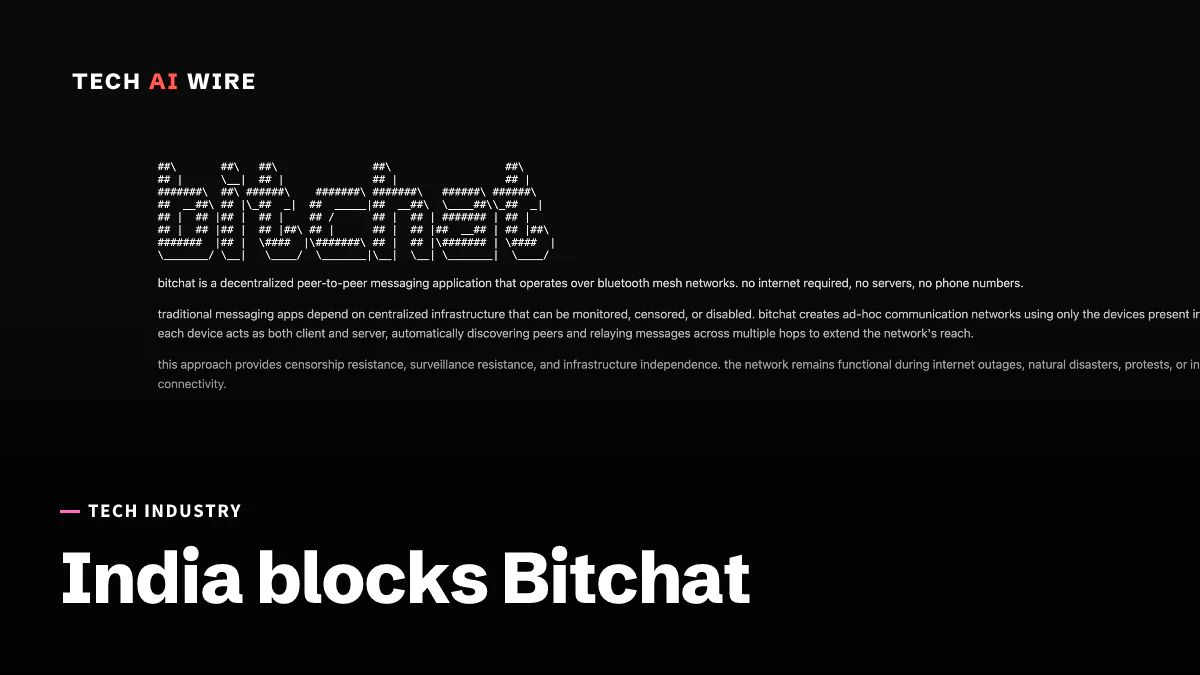
Bitchat, the offline messaging app backed by Twitter co-founder Jack Dorsey, has been removed from Apple's App Store and Google Play in India after a government order. India's Ministry of Electronics and Information Technology issued the order under Section 69A of the Information Technology Act, TechCrunch reports. The app's website is also blocked by Indian internet providers. It is the second action against Bitchat in India, after GitHub was told to take down its code in July.
What Bitchat is
Bitchat lets phones send encrypted messages to each other over Bluetooth, with no internet, mobile network or central server. Each phone passes messages along to others nearby, forming what is called a mesh network. That design means it can keep working during an internet shutdown, TechCrunch notes.
What happened
Dorsey announced the removal on X. "government of India officially removes bitchat from the App Store," he wrote, as quoted by the news agency IANS.
The removal goes beyond the main app stores. TechCrunch and IANS both report that Apple's TestFlight beta program was blocked in India too, so public test links stopped working. Bitchat's website became unreachable across Indian internet providers, according to TechCrunch. The app is still available outside India.
Apple, Google and the IT ministry declined to comment to TechCrunch.
Why the government acted
Section 69A is the part of India's IT Act that lets the government order online content blocked. The reports give two versions of the reason.
TechCrunch says the order concerns the app's design, which makes it hard for law enforcement to intercept messages or trace users. According to IANS, Apple's notice to the developers said the app contained "content considered illegal under Indian law."
The earlier GitHub takedown
This is not the first order. In July 2026, Indian authorities ordered GitHub to remove repositories hosting Bitchat's code, TechCrunch reports. IANS says the government was concerned the platform could "be exploited to evade lawful surveillance and facilitate unlawful activities."
Together, the two orders reach every layer of how the app spreads: the source code host, the app stores, the beta channel and the website.
What this means for developers
If you build encrypted or peer-to-peer apps, note how far a Section 69A order reaches. It does not stop at one store. In Bitchat's case, it covered the code on GitHub, both major app stores, TestFlight and the project website. Plan for each of those channels being blocked in a market at once.
Open-source maintainers should think about where their code lives. A repository blocked in one country is hard for contributors there to reach. Mirrors on other hosts can keep a project available, but they may face the same orders.
For companies that ship messaging or privacy features in India, review how your product handles lawful interception. TechCrunch's account suggests the design itself, not specific messages, drew the order. Apps that cannot hand over data by design may face the same scrutiny.
Watch for more cases. Two orders in about three months against one app show the government is willing to act on how a tool is built. Other offline or mesh messaging apps could be next.
Sources
Related articles

Hans Anders pulls Ray-Ban Meta glasses over privacy
Hans Anders stopped selling Ray-Ban Meta glasses in the Netherlands and Belgium on October 2, a day after Wehkamp, as Dutch pressure on them grows.

Newsom vetoes SB-1130, California's smart glasses bill
California Gov. Gavin Newsom vetoed SB-1130, which would have required recording lights on smart glasses and fined secret recording up to $1,500.

Texas halts state funding for Flock's AI license plate cameras
Governor Greg Abbott ordered Texas agencies to stop funding Flock cameras on August 27, 2026, after officers were charged with using the network to stalk people.
The daily brief
Three to five stories a day, and what each one means for the people who build software. Free, no spam.