Texas halts state funding for Flock's AI license plate cameras
Governor Greg Abbott ordered Texas agencies to stop funding Flock cameras on August 27, 2026, after officers were charged with using the network to stalk people.
3 min read
By the numbers
- in state grants spent on Flock cameras
- $30M
- cameras installed in Texas since 2023
- 3,200
- counts against one indicted officer
- 100
Texas Governor Greg Abbott ordered state agencies to stop paying for Flock cameras on the night of Thursday, August 27, 2026. His spokesman confirmed the order the next day. The reversal follows criminal charges against police officers accused of using the camera network to track people they knew.
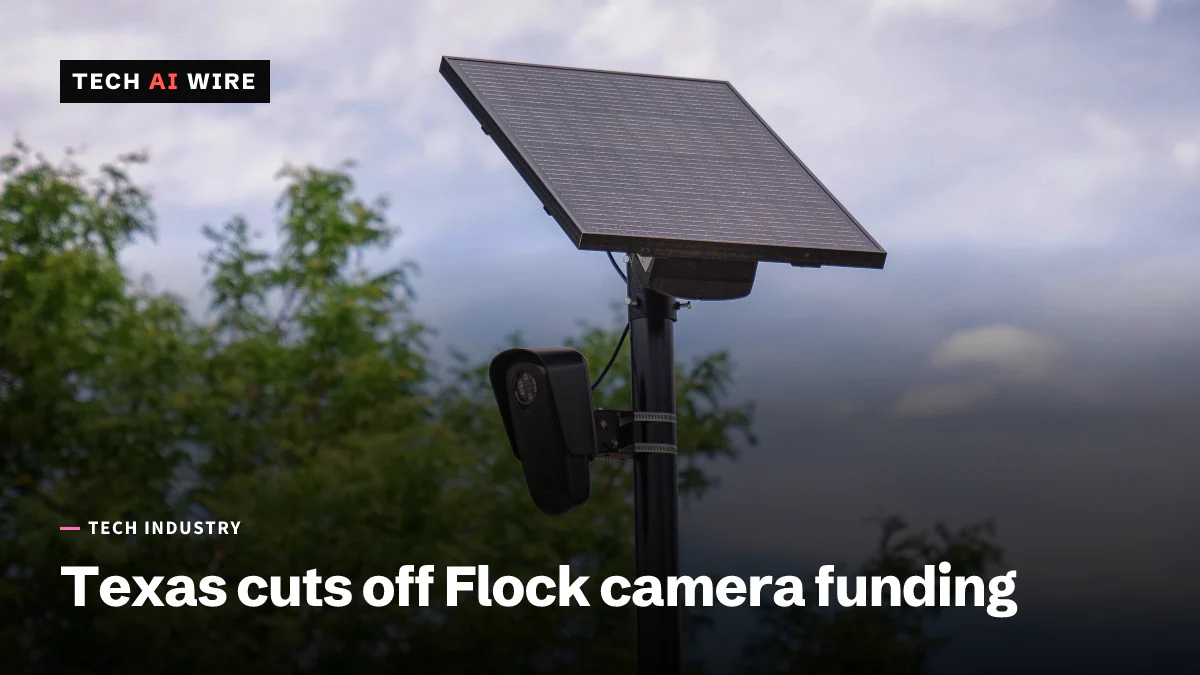
Flock Safety sells automated license plate readers. The cameras sit beside roads, photograph passing vehicles, and use computer vision to read and log every plate. Police can then search that log for where a car has been.
Where the money came from
Texas built the network with a fee almost nobody noticed. The Texas Tribune reports that the Legislature unanimously approved a $1 annual charge on every auto insurance policy in 2023. The stated purpose was fighting catalytic converter theft, and the fee raised an estimated $81 million.
The money was handed out by the Motor Vehicle Crime Prevention Authority, a state board created in 1991 to fight car theft. Abbott appoints six of its seven members. According to the Tribune, at least $30 million of that fund went to Flock:
| Grant | Amount | Cameras |
|---|---|---|
| Department of Public Safety, three-year contract | $15.9 million | 1,183 |
| At least 95 local police grants | About $14 million | Roughly 2,000 |
| Approved in August 2026 | $3 million | 583 |
At least 3,200 cameras have gone up across the state since 2023. The board's chair, Miguel Rodriguez, said he hoped to "cover the entire state" with them.
The misuse cases that changed the politics
The charges are about officers searching the system for personal reasons. A Lufkin police officer was indicted on August 24, 2026 on 100 counts of misusing official information. Prosecutors say the officer used Flock to watch 11 people over about a year.
That case is not isolated. The Texas Tribune reports that officers in Baytown, Harris County, Fort Bend County, Temple, and Pasadena have been arrested, disciplined, or investigated. Several cases involve tracking former partners or co-workers. ABC13 reports that a Katy officer was fired for using the cameras to follow his ex-wife. In all, at least six Texas departments had officers placed on leave, investigated, or charged within a single month.
Abbott's spokesman, Andrew Mahaleris, framed the order narrowly. "To the extent any funding comes from Texas agencies, those agencies are clarifying that those funds cannot be used for Flock cameras," he said. He also noted that most city funding for the cameras comes from the federal government, which the order does not touch.
Flock called its system "an important public safety tool." The company said it supports "thoughtful legislation" that adds privacy guardrails while keeping officer access.
What this means for developers
The failure here was not the model. The cameras read plates correctly. Authorized users then queried the database for reasons nobody checked. If you build anything that stores where people have been, that is the threat you are actually designing against.
Make the access log a product feature, not a compliance artifact. A log that exists but is never read stops nothing. The controls that would have caught these cases are ordinary engineering. Alert on repeated lookups of the same plate by one account. Require a case number on every search. Show each user a monthly summary of what they queried.
Set retention as short as the stated purpose allows. Every extra month of plate history widens the blast radius of a single misused account and adds nothing to the catalytic converter theft the fee was sold to fight.
There is a business lesson too. Flock's Texas revenue came from one grant program, and a state agency can close it in an evening. Funding attached to a political story is not recurring revenue. A product whose main risk is abuse by its own users will be judged on how well it prevented that abuse.
Sources
- Gov. Abbott blocks state agencies from spending money on Flock cameras - The Texas Tribune
- How a $1 Texas insurance fee funded thousands of Flock cameras - The Texas Tribune
- Gov. Greg Abbott blocks state agencies from spending money on Flock cameras - ABC13 Houston
Related articles

Meta settles state addiction claims for up to $17.1 billion
Meta will pay about $12 billion over 10 years, rising to $17.1 billion if rival platforms settle too. Teen accounts get a 2-hour default cap and a nightly lockout.
Section 232 chip tariffs, explained
A 25% US tariff on imported chips took effect on January 15, 2026. Here is what it covers, what it exempts, and what it costs.
OpenAI's __obi cookie ties ad pixels to ChatGPT accounts
OpenAI's ad pixel sets a one-year __obi cookie linking other sites to a ChatGPT account; scraped identity beat advertiser data 685 to 255.
The daily brief
Three to five stories a day, and what each one means for the people who build software. Free, no spam.