DRAM and NAND prices climb again as AI takes capacity
DRAM contract prices rise 13-18% in Q3 2026 after an 80-90% jump in Q1, as memory makers move capacity to AI servers.
4 min read
By the numbers
- DDR5 price in December 2025, from $6.84 in September
- $27.20
- NAND rise from early 2025 to December 2025
- 246%
- capacity HBM consumes against DDR5
- 3-to-1
- September 2025
- 6.84
- December 2025
- 27.2
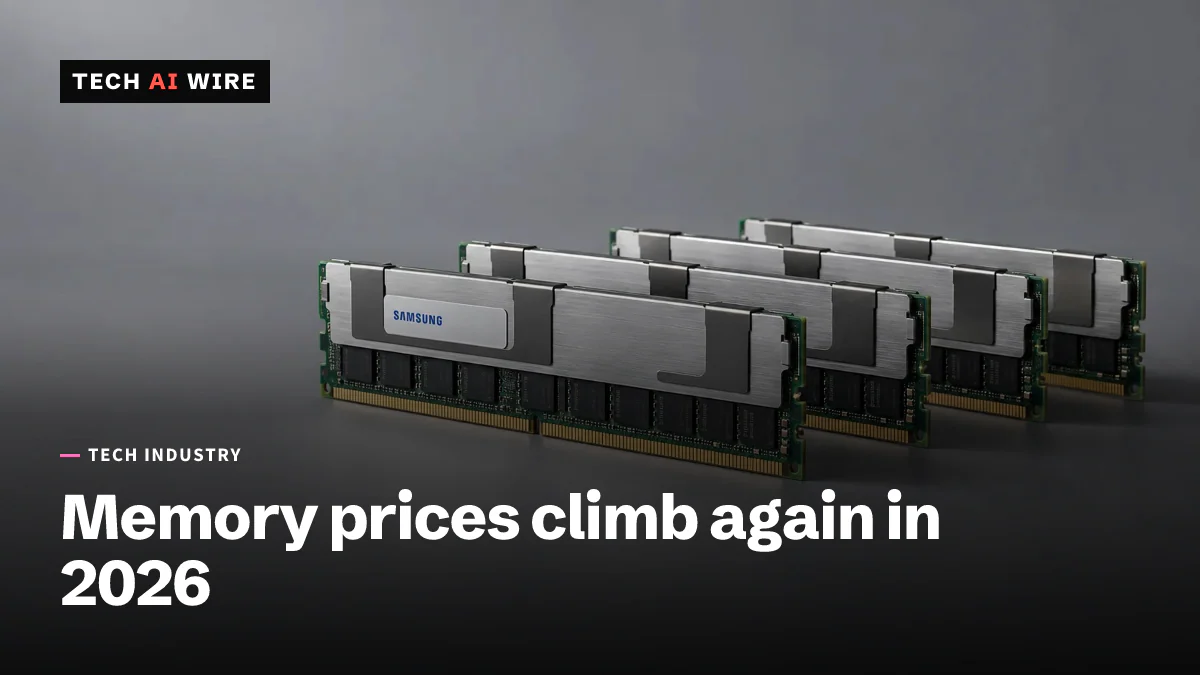
Memory prices are still rising, and the reason is that AI data centers are buying the capacity that used to make ordinary RAM. TrendForce projected on July 3, 2026 that DRAM contract prices would rise another 13% to 18% in the third quarter, with NAND flash up 10% to 15%. For developers that is not a market curiosity. It is the reason a build machine, a cloud instance and a test phone all cost more than they did a year ago.
DRAM is the working memory a computer uses while it runs. NAND flash is the storage in an SSD or a phone. Contract prices are what large buyers pay, so they set what laptops and servers cost months later.
How far prices have moved
The third-quarter rise looks small only against what came before it. Sourceability, a components distributor that tracks these contracts, put the earlier jumps far higher.
| Period | DRAM | NAND |
|---|---|---|
| Q4 2025 to Q1 2026 | Up 80-90% | Sharp spikes on delivery gaps |
| Early 2025 to December 2025 | - | Up 246% cumulative |
| Q3 2026 (TrendForce projection) | Up 13-18% | Up 10-15% |
One line makes the scale concrete. Sourceability records DDR5 moving from $6.84 in September 2025 to $27.20 in December 2025. That is roughly four times the price in three months.
NAND moved in bursts rather than a steady climb. About 70% of its 2025 increase landed in the final 60 days of that year, when delivery disruptions pushed weekly prices up by 50% to 100%.
Why AI took the capacity
The cause is not a factory fire or a shipping crisis. It is a deliberate choice by three companies about what to build.
Samsung and SK Hynix together hold about 70% of the DRAM market, and Sourceability reports neither has signaled aggressive plans to expand capacity. Micron can fill only 55% to 60% of what its core customers ask for, and its new Idaho plant does not come online until 2027.
The mechanism inside the fab is the part worth understanding. High-bandwidth memory, the stacked DRAM that sits beside an AI accelerator, eats about three times the capacity of the same amount of DDR5. Every wafer moved to HBM removes roughly three wafers of ordinary memory from the market.
Demand keeps pulling in that direction. Sourceability puts 2026 capital spending by the top eight cloud providers above $600 billion, up 40% year over year.
TrendForce adds a detail that explains why this is not only a GPU story. Agentic AI workloads run on general-purpose x86 servers with RDIMM memory, not only on accelerators. So the same wave raises demand for plain server memory too.
What it does to the price of a device
Memory used to be a modest line on a bill of materials. It is now one of the largest.
HP's chief financial officer said memory moved from 15% to 18% of a PC's parts cost to around 35% in 2026. At the ISSCC conference in February 2026, MediaTek chief executive Rick Tsai put it more bluntly: "Memory now accounts for roughly 50% of the total BOM."
Kingston's data center SSD business manager said in December 2025 that "NAND prices had surged 246% since the start of 2025."
TrendForce expects the rally to run past 2028.
What this means for developers
Treat memory as a budget line that now moves, not a constant. If you size cloud instances or CI runners by habit, re-check them. RAM-heavy instance families are where provider price changes land first. An over-provisioned runner fleet costs more than it did last year.
Buy hardware earlier than you otherwise would. That is unusual advice, and it follows from the forecasts rather than from panic. When the analyst who called the last four quarters expects the rally past 2028, waiting for a better price is a bet against the only published view.
Local AI work is hit hardest. Running models on your own machine is mostly a question of how much memory you can afford, and that is exactly the component being rationed. Apple's recent Mac mini and Mac Studio refresh put more memory bandwidth behind local AI, and machines like those get more expensive as the same shortage works through.
There is a software response too. Memory efficiency has been an unfashionable thing to optimize for a decade of cheap RAM. Profiling a service's actual working set, and fitting it into a smaller instance, now pays back in real money rather than in tidiness.
Watch DDR4 specifically if you maintain older fleets. TrendForce notes Taiwanese suppliers are expanding DDR4 output, but not by enough to offset cuts elsewhere. Legacy parts can get scarce faster than current ones, because nobody is investing in them.
Sources
Related articles
Xeon and EPYC lead times stretch to six months
Server CPU lead times have gone from two weeks to about six months, and AI systems now need more CPUs per rack, not fewer.
Australian RAM and SSD prices climb as stock tightens
A 4TB Samsung SSD that sold near A$500 now lists at A$1,149, and Australian resellers say quotes are valid for days, not weeks.
Section 232 chip tariffs, explained
A 25% US tariff on imported chips took effect on January 15, 2026. Here is what it covers, what it exempts, and what it costs.
The daily brief
Three to five stories a day, and what each one means for the people who build software. Free, no spam.