Section 232 chip tariffs, explained
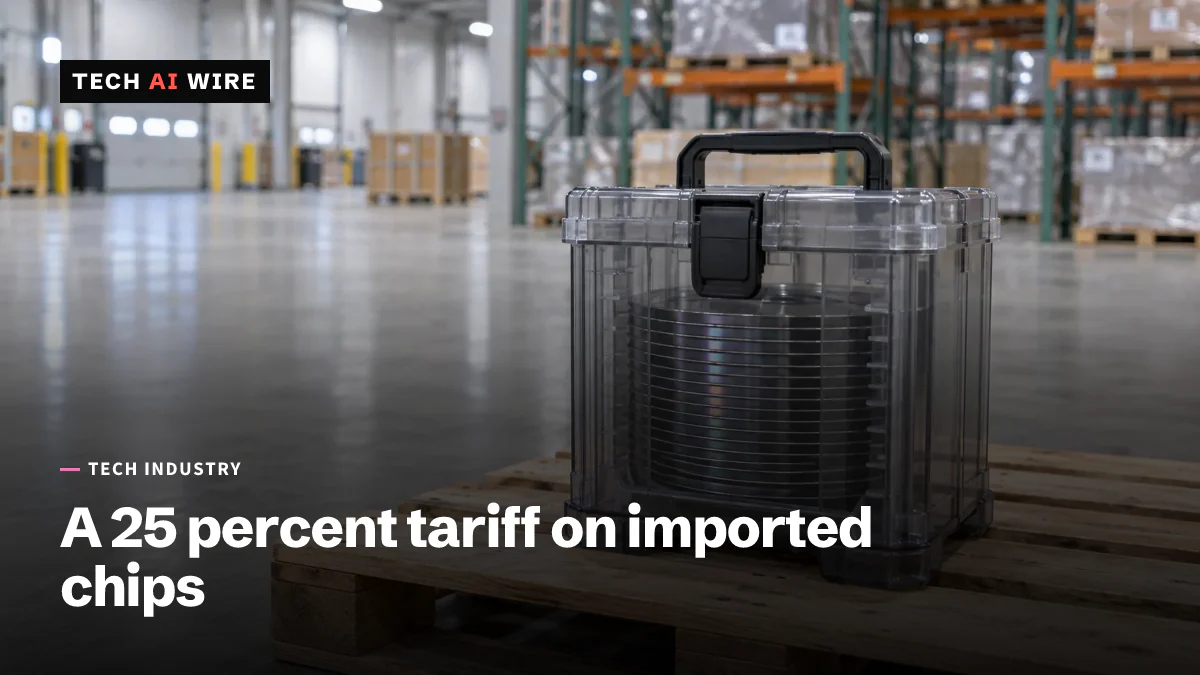
A 25% US tariff on imported chips took effect on January 15, 2026. Here is what it covers, what it exempts, and what it costs.
4 min read
By the numbers
- tariff rate on covered semiconductor imports
- 25%
- first-year GDP cost ITIF estimates
- $58B
- Q1 2026 RAM price rise, before any tariff effect
- 90%
- 25% tariff, in force
- 58
- 50% tariff, modeled
- 122
A 25% United States tariff on imported semiconductors has been in force since January 15, 2026. It is a Section 232 measure, meaning it was imposed on national security grounds rather than as an ordinary trade duty. If you buy servers, laptops or development hardware in the US, it is one of two forces raising your costs, and the smaller of the two.
Section 232 is a part of US trade law that lets the president restrict imports that a Commerce Department investigation finds threaten national security. It does not need new legislation. That is why it moves faster than most trade policy, and why it can change again without warning.
How the tariff works
The rate is 25% ad valorem, which means 25% of the declared value of the goods rather than a fixed fee per unit.
According to EY, it applies to logic integrated circuits and to articles that contain them. Logic chips are the processors that compute, as opposed to memory chips that store. The tariff reaches finished products too, not just bare components, which is how a laptop can be covered by a chip tariff.
EY lists the covered categories under tariff codes 8471.50, 8471.80 and 8473.30. Sandler, Travis & Rosenberg adds that semiconductor manufacturing equipment and derivative products are covered as well.
Two mechanical details matter to anyone actually importing. Duty drawback is not available, so a company cannot reclaim the tariff by re-exporting the goods. Goods placed in a foreign-trade zone after January 15 must enter under privileged foreign status, which locks in the duty treatment at that date.
What is exempt
The exemptions are broad, and they are the reason the measure has not hit every buyer equally.
EY reports that chips for US data center use are exempt. So are those for repair, research and development, startup use, public sector work, and consumer or civil industrial applications outside data centers.
There is also a layering rule. Covered semiconductors are exempt from other Section 232 actions and from most tariffs imposed under the International Emergency Economic Powers Act. The IEEPA fentanyl tariffs on China still apply on top.
What changed and when
The timeline is short for a measure of this size.
| Date | Step |
|---|---|
| April 16, 2025 | Commerce opens the Section 232 investigation |
| December 22, 2025 | Investigation concludes |
| January 14, 2026 | Proclamation signed |
| January 15, 2026 | Tariff takes effect at 12:01 a.m. EST |
| July 1, 2026 | Commerce market update on data center chips due |
The July report was the trigger for deciding whether the rate should move. A second phase has been discussed that would raise the rate sharply and add an offset program rewarding companies that invest in US semiconductor production. ITIF notes the eligibility rules and implementation of that offset remain unclear.
What it costs
The Information Technology and Innovation Foundation, a technology policy think tank, published estimates on June 4, 2026.
For the 25% tariff now in force, it puts the cost at $58 billion of US GDP in the first year and $1.6 trillion over ten years. For a hypothetical 50% second phase, the figures roughly double to $122 billion in year one and $4.4 trillion over a decade. Per person, ITIF estimates about $170 in the first year, rising toward $5,000 by year ten.
These are model outputs, not measurements, and they come from an organization that opposes the policy. Read them as one considered estimate rather than a settled number.
Why memory still matters more
Here is the part worth holding onto. ITIF notes RAM prices had already surged 90% in the first quarter of 2026, before tariffs did much of anything.
That is the larger force. Memory is being rationed because AI data centers are buying the manufacturing capacity, and DRAM and NAND contract prices have climbed through 2026 as a result. The tariff adds to hardware costs at the margin. The memory shortage is setting them.
What this means for developers
Check whether your purchases are actually covered before you assume a 25% markup. The exemptions are wide, and data center, R&D and repair uses are named. A team buying servers for a US data center is in a different position from one buying laptops, and your finance team may not have made that distinction.
Ask your vendors where the price change came from. A quote that rose this year may reflect the memory shortage, the tariff, or both, and the two behave differently. Memory is a supply problem that forecasters expect to persist past 2028. A tariff is a policy that can be changed by a signature.
Plan for the rate to move rather than assuming it holds. The same authority that set 25% can raise it, and a second phase has been openly discussed. If you are signing a multi-year hardware agreement, ask who carries the tariff risk if the rate changes mid-contract.
Do not read the exemptions as permanent either. They were set alongside a Commerce review specifically covering data center chips, which is the category most likely to be revisited.
Sources
- US Section 232 proclamation imposes 25% tariff on certain semiconductors - EY Global Tax News
- Section 232 Semiconductor Tariffs Could Undermine US Economic Growth - ITIF
- Section 232 Investigation: Semiconductors - Sandler, Travis & Rosenberg
Related articles
Australian RAM and SSD prices climb as stock tightens
A 4TB Samsung SSD that sold near A$500 now lists at A$1,149, and Australian resellers say quotes are valid for days, not weeks.
Xeon and EPYC lead times stretch to six months
Server CPU lead times have gone from two weeks to about six months, and AI systems now need more CPUs per rack, not fewer.
DRAM and NAND prices climb again as AI takes capacity
DRAM contract prices rise 13-18% in Q3 2026 after an 80-90% jump in Q1, as memory makers move capacity to AI servers.
The daily brief
Three to five stories a day, and what each one means for the people who build software. Free, no spam.