Xeon and EPYC lead times stretch to six months
Server CPU lead times have gone from two weeks to about six months, and AI systems now need more CPUs per rack, not fewer.
3 min read
By the numbers
- server CPU lead time, up from two weeks
- 6 months
- of Intel revenue now from AI-driven business
- 60%
- Xeon Scalable CPUs shipped in the five years before ChatGPT
- 100M+
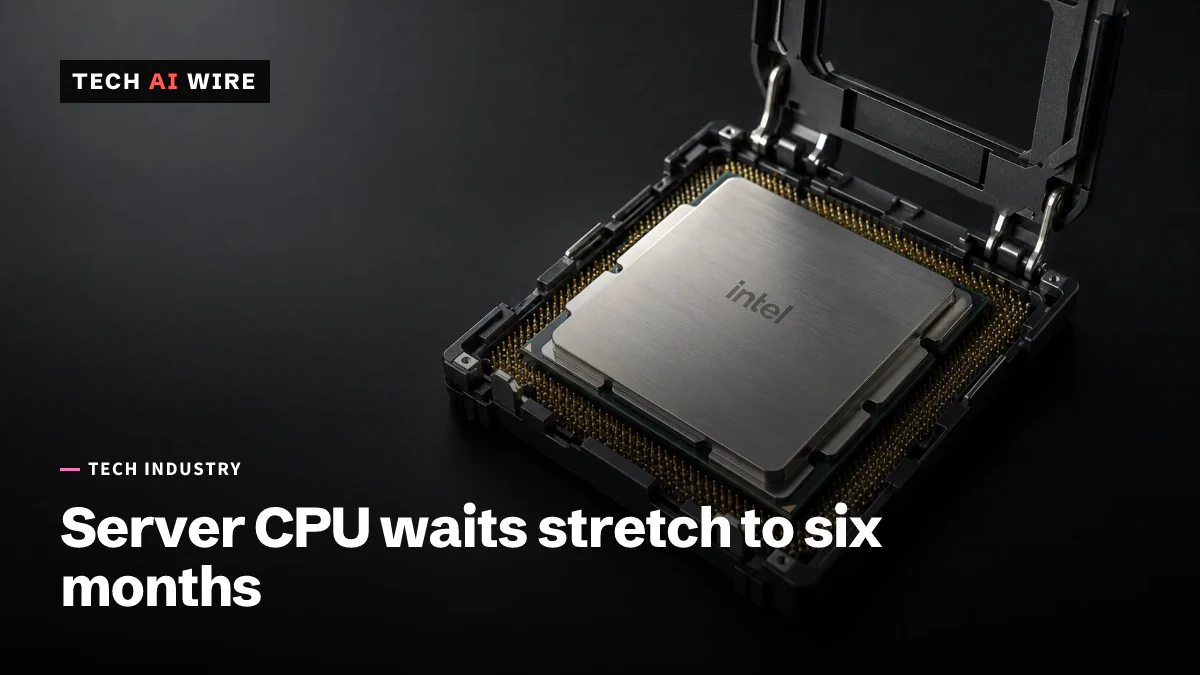
Ordering a server processor now takes about six months, against roughly two weeks before the shortage, Tom's Hardware reports. Both Intel and AMD parts are affected. If you plan capacity by assuming hardware arrives when you order it, that assumption no longer holds.
The surprise is the cause. The AI build-out was supposed to be about GPUs, and CPUs were the boring part of the rack. It turns out AI systems need a lot of both.
Why AI needs more CPUs, not fewer
Every AI server pairs accelerators with general-purpose processors that feed them work. The ratio between the two is what changed.
The Next Platform reported in April 2026 that GPU-to-CPU ratios have fallen from about 8 to 1 toward 4 to 1 and even 2 to 1. Fewer GPUs per CPU means more CPUs per system. The same number of accelerators now pulls several times the processors it used to.
That shift shows up directly in Intel's results. Its Data Center and AI group brought in $5.05 billion in the first quarter of 2026, up 22.4% from a year earlier. AI-driven businesses now make up 60% of Intel revenue and grew 40% year over year.
Intel's Dave Zinsner described the scale of the company's undercapacity in Xeon production by saying it "starts with a B. So it's meaningful."
How tight supply actually is
SemiAnalysis traced the turn to an unexpected jump in data center CPU demand in late 2025. Intel has since widened its 2026 capital spending on foundry tools and started putting server wafers ahead of PC wafers.
Prices are following supply. SemiAnalysis reports Intel "facing the unexpected depletion of their CPU inventory, is looking to raise prices across their Xeon line." AMD expects data center CPU demand to grow in "strong double digits" during 2026.
For scale, SemiAnalysis notes more than 100 million Xeon Scalable chips shipped in the five years before ChatGPT launched in November 2022. This is a market that was considered mature.
The parts both vendors are racing to ship
The roadmaps explain why relief is slow. These are large, complex chips, several using stacked dies.
| Chip | Vendor | Cores | Note |
|---|---|---|---|
| Granite Rapids | Intel | 128 | Shipping |
| Diamond Rapids | Intel | 192 | 40% faster than Granite Rapids |
| Clearwater Forest | Intel | 288 | Slipped from H2 2025 to H1 2026 |
| EPYC 9755 | AMD | 128 | Shipping |
| Turin dense | AMD | 192 | Shipping |
| Venice | AMD | 256 | 1.7x better performance per watt than Turin |
The manufacturing detail matters for the timing. Diamond Rapids puts Intel 18A-P compute cores on Intel 3-PT base dies using hybrid bonding. Clearwater Forest stacks Intel 18A core dies on an Intel 3 base. AMD builds Venice's core chiplets on TSMC's N2 process.
Intel also cancelled the 8-channel version of Diamond Rapids-SP, and SemiAnalysis describes limited adoption for Sierra Forest.
What this means for developers
Stop treating compute as available on demand for anything on-premises. A six-month lead time means next year's capacity is being ordered now. If your roadmap assumes a cluster expansion in the second quarter, the purchase order belongs in this quarter.
In the cloud, the risk shows up as price and availability rather than delivery dates. Reserved instances and committed-use discounts look different when the underlying parts are scarce and vendors are raising list prices. Locking in a term is a hedge now, not just a discount.
Right-size before you scale out. The cheapest processor is the one you do not buy. CPU-bound services often have easy wins left: a profiler run, a chattier serialization format replaced, a synchronous call made parallel. That work was hard to justify when a bigger instance was a click away.
Look seriously at non-x86 options if your workload allows it. Arm server parts come from different fabs and different queues, which is exactly the diversification a shortage rewards. Fujitsu's MONAKA packs 144 Armv9 cores and ships in November, and cloud Arm instances are already general-purpose.
Watch Intel 18A yields as the real signal. Two of the three Intel parts above depend on it, and the schedule for everyone else moves with it. Intel says yields on its 7, 4 and 3 processes are ahead of plan, which is encouraging but is not the same claim.
Sources
- PC makers face shortages of Intel and AMD CPUs that stretch up to six months - Tom's Hardware
- AI-Driven CPU Shortage Saves Intel's Financial Cookies - The Next Platform
- CPUs are Back: The Datacenter CPU Landscape in 2026 - SemiAnalysis
Related articles
DRAM and NAND prices climb again as AI takes capacity
DRAM contract prices rise 13-18% in Q3 2026 after an 80-90% jump in Q1, as memory makers move capacity to AI servers.
Australian RAM and SSD prices climb as stock tightens
A 4TB Samsung SSD that sold near A$500 now lists at A$1,149, and Australian resellers say quotes are valid for days, not weeks.
Section 232 chip tariffs, explained
A 25% US tariff on imported chips took effect on January 15, 2026. Here is what it covers, what it exempts, and what it costs.
The daily brief
Three to five stories a day, and what each one means for the people who build software. Free, no spam.