AI decision models, explained
A decision model picks from fixed answers and returns a probability for each, instead of writing text. Hosted prices start at $0.02 per million tokens.
5 min read
By the numbers
- lowest hosted price per million input tokens (Perplexity)
- $0.02
- for output tokens at TypeSafe, OpenAI, Perplexity and Microsoft
- $0
- one d1-3B decision on an RTX 4090, per Liquid AI
- 8 ms
- gap between the cheapest and dearest hosted price
- 12x
- pplx-decider
- 2¢
- Clef-flash
- 3.8¢
- Jev
- 4.2¢
- Microsoft-Decision-1
- 4.2¢
- OpenAI gpt-6-luna
- 10¢
- Clef-omni
- 15¢
- Clef
- 24¢
A decision model is an AI model that picks from a fixed set of answers and returns a probability for each one, instead of writing text. At least eight companies have shipped one since mid-September 2026, from TypeSafe's Jev to models by Cloudflare, AWS, Perplexity, Liquid AI, OpenAI and Microsoft. They matter because AI agents make many small yes-or-no and pick-one calls, and a decision model makes them faster and cheaper than a chatbot can.
How a decision model works
A chatbot model writes its answer one word piece, or token, at a time. A decision model does not write at all. An app sends it some input, called the state, plus a list of questions with fixed answers. The model returns a probability for every allowed answer.
TypeSafe, which started the category with Jev, describes it as a function call. "Unstructured state in, typed probabilistic decisions out," said Diogo Almeida, TypeSafe's founder. "Typed" means the answer always has the expected shape. A yes-or-no question can only come back as yes or no.
Most vendors offer the same three kinds of question, though the names differ:
| Question type | What it returns | Names used |
|---|---|---|
| Yes or no | The probability that the answer is yes | noul (Cloudflare, Perplexity, Laya), predicate (OpenAI) |
| Pick one | A probability for each option | choice |
| Rate | A level on a scale, weighted by probability | score |
The speed comes from skipping text generation. The Strands team at AWS says it removed the part of the model that produces words, so Decider "always produce[s] an answer from the selected options." Cloudflare says Clef reads the input once and then scores all the valid choices in parallel. Liquid AI puts it simply: its d1 models "don't produce tokens but answer in a single forward pass."
The probabilities are meant to be calibrated. That means an answer marked 80% sure should be right about 80% of the time. An app can use that number to act, ask a human or hand the question to a bigger model.
The models so far
| Model | Maker | Weights | Built on | Hosted input price per million tokens |
|---|---|---|---|---|
| Jev | TypeSafe | Hosted service | Not stated | $0.042 |
| Laya | Convai Innovations | Open, Apache 2.0 | ModernBERT-large, 421M | None (self-hosted) |
| Clef | Cloudflare | Open, Apache 2.0 | Qwen3.8-27B | $0.24 |
| Clef-flash | Cloudflare | Open, Apache 2.0 | Qwen3.5-9B | $0.038 |
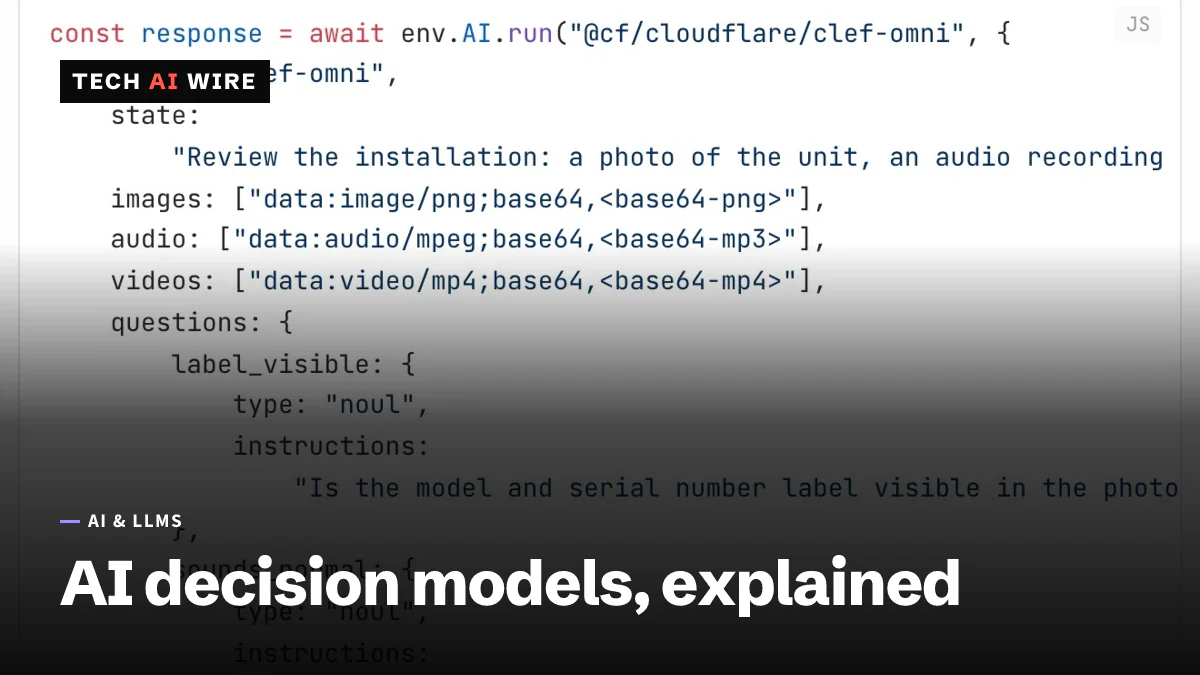
| Clef-omni | Cloudflare | Open | 30B mixture of experts, 3B active | $0.15 |
| Strands Decider 2B | AWS Strands team | Open source | Qwen3.5-2B | Not stated |
| pplx-decider | Perplexity | Open, Apache 2.0 | Qwen3.8-27B | $0.02 |
| d1-3B, d1-omni-600M | Liquid AI | Open | Liquid's LFM2.5 models | Not stated |
| Decisions API | OpenAI | Hosted service | gpt-6-luna | $0.10 |
| Microsoft-Decision-1 | Microsoft | Hosted service | Qwen3.5-9B | $0.042 |
TypeSafe, OpenAI, Perplexity and Microsoft all say output tokens are free, so only the input is billed. Perplexity's documentation lists $0.02 per million input tokens for pplx-decider. AlphaSignal's report from the October 1 launch gave $0.04, so check the current price before you budget.
What changed and when
The field went from one model to ten in a month:
| Date | Release |
|---|---|
| September 15, 2026 | TypeSafe launches Jev |
| September 2026 | Convai Innovations releases Laya with open weights |
| October 1, 2026 | Cloudflare Clef, Strands Decider 2B and Perplexity's pplx-decider |
| October 7, 2026 | Liquid AI releases d1-3B and d1-omni-600M |
| October 9, 2026 | Cloudflare adds Clef-omni and cuts Clef-flash from $0.090 to $0.038 |
| October 2026 | OpenAI's Decisions API in public beta; Microsoft-Decision-1 in Foundry |
Inputs widened along the way. Laya reads text only, and Clef took images from its launch. Clef-omni now also accepts audio and video, according to Cloudflare's changelog. Liquid AI's d1-omni-600M takes text with either images or audio. OpenAI says it expects its API to leave beta "in the coming weeks."
How fast they are
Speed is the main selling point, and every figure comes from the vendor that built the model. Liquid AI says d1-3B answers one question in 8 ms on an Nvidia RTX 4090 graphics card. Laya's makers report 32.8 ms on an Nvidia T4. The Strands team measured a median of about 115 ms on an RTX 3090. TypeSafe gives Jev a range of 70 to 500 ms.
Cost per decision is tiny. InfoWorld works through Microsoft's numbers: $1 covers more than 275,000 similar short decisions. InfoWorld notes that these figures are Microsoft's own claims.
Benchmarks are harder to compare. Each maker publishes its own tables. AlphaSignal reports that pplx-decider scored 85.71% across 11 benchmarks, against 84.51% for Jev, but does not say who ran the tests.
Where they fall short
A decision model cannot explain itself or write anything. The Strands team says Decider is significantly worse than reasoning models on complex problems and does not suit coding, chatbots or summaries. Laya's makers recommend fewer than 20 options per question, because accuracy drops as the list grows. Their tests also found that Laya scored 0% on Khmer text while reporting 95.2% average confidence.
Analysts quoted by InfoWorld raise the same worry. "A precise-looking probability can give an uncertain decision more authority than it deserves," said Amit Kumar Jena, development manager for AI at Kanerika.
What this means for developers
Use a decision model for the routine choices inside an agent: routing a support ticket, picking a tool, checking a guardrail or grading an output. Keep a full language model for the cases that need reasoning or text. The Strands team suggests this kind of hybrid agent.
Test calibration on your own data before trusting the numbers. Run a few hundred past cases with known answers and check that 80% confidence really means 80% right. Start with decisions you can reverse, as the analysts in InfoWorld advise.
Compare prices on your real traffic. A request's cost depends on how many input tokens it sends, and hosted prices differ by twelve times, from $0.02 to $0.24 per million. Clef also follows Jev's API, so trying it can be close to a change of web address.
If data must stay in-house, the open models are the route. Laya, Clef, Decider, pplx-decider and Liquid AI's d1 can all run on your own hardware.
Sources
- Introducing System One Models & Jev - TypeSafe AI
- Clef: open-weight decision models - Cloudflare Blog
- Clef-omni adds audio and video input, Clef-flash is now cheaper, and Clef is faster - Cloudflare Changelog
- Introducing Strands Decider - Strands Agents
- Decisions API guide - OpenAI
- Decisions API quickstart - Perplexity
- Multimodal open d1 decision models for the edge - Liquid AI on Hugging Face
- Perplexity Releases pplx-decider, a 27B Open Model That Replaces Label Parsing - AlphaSignal
- Microsoft separates decision-making from generative AI with a new model - InfoWorld
- Laya - System 1 decision engine with calibrated probabilities - Convai Innovations
Related articles

Meta Muse Wonder launches as its first frontier model
Meta released Muse Wonder on October 12 at $4 per million input tokens and $20 per million output, with a larger Wonder Full kept for Muse Code.
Mistral Large 4 launches with 1.05T parameters
Mistral Large 4 is a 1.05T-parameter open-weight MoE model with a 1M-token context, in API preview at $1.36 per million input tokens. Weights follow in October.
Xiaomi MiMo-V2.6-Pro ships 1T open weights under MIT
Xiaomi's MiMo-V2.6-Pro has 1.02 trillion parameters, 42 billion active, a 1M-token context and MIT-licensed weights, but needs about 680 GB of GPU memory.
The weekly digest
One email every Friday with the week's top stories from all six desks: AI, dev tools, coding, the tech industry, startups and what's next. Free, no spam.