Tools This Week: October 10, 2026 - Python 3.15, Mold 3.0
Seven developer tools this week, led by Python 3.15.0 and the Rust rewrite of the Mold linker, with what each one changes and what it costs.
4 min read
By the numbers
- tools in this week's list
- 7
- speedup from Python 3.15's experimental JIT on x86-64 Linux
- 7-8%
- SQLite 3.54.0 speedup over the previous release
- ~4%
This week's Tools This Week list has seven developer tools, led by a major Python release and a Rust rewrite of the Mold linker. Four are open source, VS Code is free to use, and SQLite is in the public domain. GitHub's stacked pull requests come with every github.com plan. This edition covers the week to Friday, October 9.
This week's tools at a glance
| Tool | What it does | Price |
|---|---|---|
| Python 3.15.0 | New major Python release with lazy imports and frozendict | Free, open source (PSF License) |
| Mold 3.0 | Fast Unix linker, now written in Rust | Free, open source (MIT) |
| Zig 0.17.0 | Systems language with a rebuilt build system | Open source (MIT) |
| VS Code 1.141 | Editor that now sandboxes AI agents' terminal commands | Free for private or commercial use |
| SQLite 3.54.0 | Embedded database, about 4% faster | Public domain, no license needed |
| GitHub stacked pull requests | Small dependent pull requests that merge together | Included in all github.com plans |
| RemoveMacAI | Turns off Apple Intelligence on macOS 27 and deletes its models | Free, open source (MIT) |
Languages
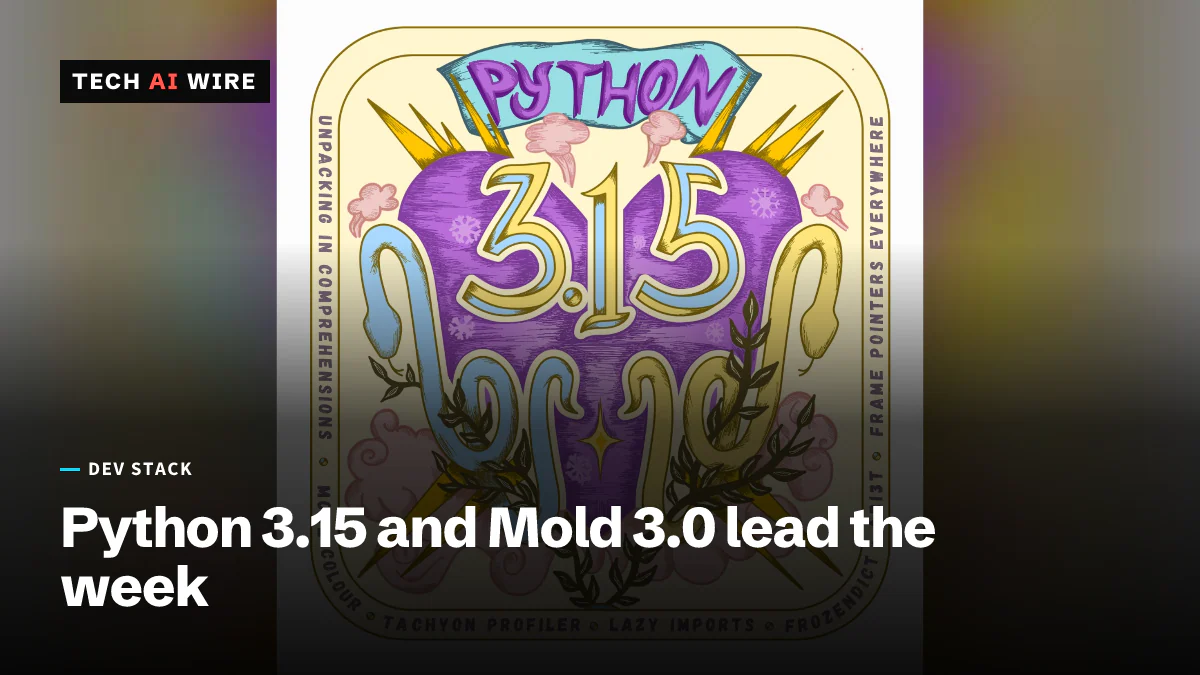
Python 3.15.0 shipped on October 9, 2026, from 5,643 commits by 1,012 contributors, the release page says. Explicit lazy imports load a module only when code first uses it, which speeds up startup. A new built-in frozendict type is a dictionary that cannot be changed after it is made. UTF-8 is now the default text encoding. An experimental JIT compiler, which turns Python into machine code while it runs, is 7-8% faster than the standard interpreter on x86-64 Linux. Read our Python 3.15 story for the full list.
Zig 0.17.0 came out on October 2, after five months of work by 206 contributors across 925 commits. Zig is a systems programming language often used in place of C. Its build system now splits setup from execution. Incremental compilation, which rebuilds only what changed, now works for most projects on x86_64 Linux. Our Zig 0.17.0 story covers the breaking changes.
Build and data tools
Mold is a linker, the tool that joins compiled pieces into one program. Version 3.0, released October 5, is a rewrite in Rust. It accepts the same command-line options and targets as before, and the release notes say linking speed is on par with 2.42.1, the last C++ release. It now builds with Cargo and needs Rust 1.95 or later. Out-of-bounds memory reads are now checked, so Mold stops with a panic at the faulty read instead of a segmentation fault. More in our Mold 3.0 story.
SQLite 3.54.0 arrived on October 9. It runs about 4% faster than the previous release, and about 7.5% faster than version 3.51.0 a year ago. A new diskused() extension reports how a database uses disk space and replaces the deprecated sqlite3_analyzer. See our SQLite 3.54.0 story for the command-line changes.
Editors and code review
VS Code 1.141 shipped on October 7. Terminal sandboxing now limits which files and network resources an AI agent can reach, on Windows, macOS and Linux. A new cleanup editor shows the disk space used by old agent session worktrees, separate working copies of a repository, and removes them. Agent sessions can also sit side by side. Our VS Code 1.141 story has the details.
GitHub made stacked pull requests generally available on October 6. A stack splits one large change into a series of small pull requests that build on each other. Each is reviewed separately, and the whole stack moves through the merge queue as one group. Rebasing keeps approvals on code that did not change, and auto-merge for stacks rolls out over the following weeks. The feature is on all github.com plans and is coming to GitHub Enterprise Server. More in our stacked pull requests story.
For your own machine
RemoveMacAI turns off Apple Intelligence on Macs running macOS 27 and deletes the AI models stored on the machine. It also stops analytics and personalized ads, and switches off other apps' background updaters. It is tested on macOS 27.0; macOS 27.0.1 needs version 0.2.3 or later, and macOS 26 and earlier are not supported. Read our RemoveMacAI story before you run it.
What this means for developers
- Test Python 3.15 on a branch. The UTF-8 default can change how existing code reads and writes files. Run your test suite on 3.15 before you move production, then try lazy imports where startup time matters.
- Try Mold 3.0 as a drop-in. It keeps the same options, so swapping it into a build should need no flag changes. Check that your toolchain has Rust 1.95 or later if you build Mold yourself.
- Plan the Zig upgrade. The build system change touches every project. Upgrade a small project first and note what breaks.
- Turn on agent sandboxing. If AI agents run commands in your VS Code terminal, the new sandbox limits what they can touch.
- Split big pull requests. Stacked pull requests are now on every github.com plan, so a large change can go out as small, reviewable pieces.
- Check licenses before shipping. MIT and the PSF License allow commercial use, and SQLite needs no license at all. VS Code is free to use under a Microsoft license, while its source code is MIT.
The previous edition is Tools This Week: October 2, 2026. The current list always lives on the Tools This Week page.
Sources
- Python 3.15.0 - Python.org
- mold 3.0.0 release - GitHub
- 0.17.0 Released - Zig
- Visual Studio Code 1.141 - Visual Studio Code
- SQLite Release 3.54.0 - SQLite
- Stacked pull requests are now generally available - GitHub Changelog
- RemoveMacAI - GitHub
Related articles

Python Language Summit 2026 debates Rust and a new GC
The Python Language Summit 2026 reports are out: 47 core developers weighed Rust in CPython, a new garbage collector, a std namespace and faster startup.
YSERVER 1.7 adds Vulkan 1.2 and cuts 4K VRAM use
YSERVER 1.7 cuts 4K VRAM use from 2-4GB to about 1.2GB, near X.Org's 0.9GB, and adds Vulkan 1.2 support for older Intel graphics.
Mold 3.0 ships its Rust rewrite as a drop-in linker
Mold 3.0 is the first release written in Rust. It needs Rust 1.95, drops Intel's oneTBB and links as fast as 2.42.1, the last C++ version.
The weekly digest
One email every Friday with the week's top stories from all six desks: AI, dev tools, coding, the tech industry, startups and what's next. Free, no spam.