SK hynix Q3 revenue tops 100 trillion won for first time
SK hynix's third-quarter revenue hit 104.62 trillion won, its first quarter above 100 trillion, with an 80% margin. It sees memory short through 2030.
4 min read
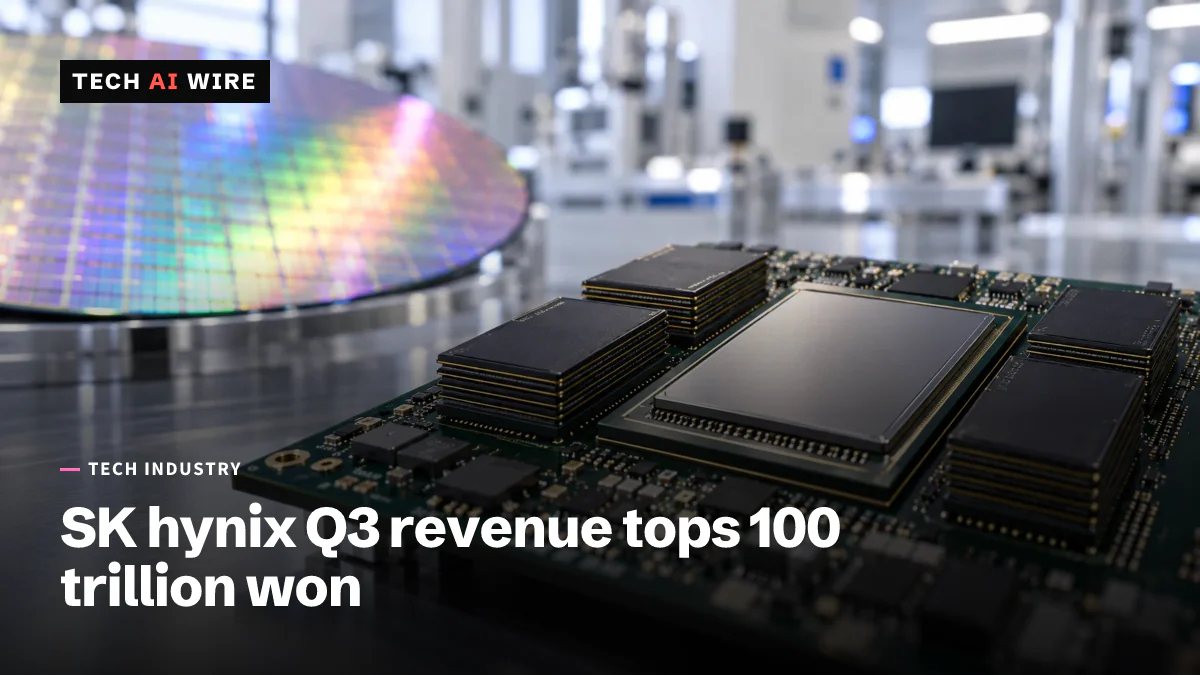
By the numbers
- third-quarter revenue, up 328% from a year earlier
- 104.62T won
- operating profit, about $62.8 billion
- 83.33T won
- operating margin, up from 76% in the second quarter
- 80%
- of 2027-2028 capacity under long-term deals
- 50%+
- Q3 2025
- 24.45T
- Q2 2026
- 79.32T
- Q3 2026
- 104.62T
SK hynix reported record third-quarter results on October 28, 2026, with revenue of 104.62 trillion won. It is the first time the South Korean memory maker has passed 100 trillion won in a quarter. The company also said it expects memory supply to trail demand through 2030, a signal that the chips inside AI servers will stay scarce for years.
SK hynix makes DRAM, the working memory in computers, and NAND flash, the storage inside SSDs. It also makes HBM, or high-bandwidth memory. HBM is stacked DRAM that sits right beside the processor on AI accelerator chips.
The third-quarter numbers
The figures below come from SK hynix's results announcement. They are preliminary and still subject to an independent audit review.
| Measure | Q3 2026 | Change from Q2 2026 | Change from Q3 2025 |
|---|---|---|---|
| Revenue | 104.62 trillion won | +32% | +328% |
| Operating profit | 83.33 trillion won | +38% | +632% |
| Operating margin | 80% | up from 76% | up from 47% |
| Net income | 39.78 trillion won | -58% | +216% |
Operating profit and revenue both beat forecasts. Korea JoongAng Daily reports that the FnGuide consensus expected 76.96 trillion won in operating profit and 98.23 trillion won in revenue. It puts the operating profit at about $62.8 billion.
Net income was the weak spot. The paper says forecasters expected 61.29 trillion won, well above the 39.78 trillion won reported. The company's release does not explain the 58% drop from the second quarter, when net income was 93.92 trillion won.
What drove the quarter
AI demand did most of the work, according to Korea JoongAng Daily. DRAM sales rose as shipments of HBM4, the newest generation of HBM, ramped up and demand for server memory grew. NAND sales also rose, led by SSDs for data centers.
SK hynix expects HBM4 to pass the older HBM3E in both shipments and revenue in the fourth quarter. The company did not give unit or revenue figures for HBM4.
Shortages through 2030 and five-year contracts
The bigger news may be the outlook. SK hynix expects supply to lag demand through 2030. It blames two things: leading-edge chipmaking is hard, and new factories take a long time to build.
Customers are locking in supply. The company says long-term agreements with 14 major customers now cover more than half of its 2027 and 2028 capacity. A typical deal runs five years, with prices that move with the market inside agreed bands.
"The customer trust built through our technological competitiveness is leading to long-term contracts," CEO Kwak Noh-Jung said in the release.
New capacity is on the way. The M15X factory should reach full capacity by the end of 2026, and the first phase of the Yongin site should run at full scale in 2027.
Cash for shareholders
SK hynix plans to return about 100 trillion won to shareholders for 2026. That includes at least 30 trillion won in cash dividends and at least 60 trillion won in share buybacks and cancellations.
| Item | Amount |
|---|---|
| Third-quarter dividend | 14 trillion won, or 20,000 won per share |
| Of which, special dividend | 10,000 won per share, tied to gains on Kioxia |
| New share buyback | 20 trillion won (half to be cancelled, about half for employee pay) |
| Net cash at quarter end | 98.7 trillion won |
The special dividend is tied to gains on the company's investment in Kioxia, the release says. "Our principle has been to share the majority of the gains from successful strategic investments with our shareholders," Kwak said.
The company also said it has stopped reviewing a stock listing for Solidigm, the unit behind its recent US NAND factory plans.
What this means for developers
For teams that buy servers, rent GPUs or plan AI capacity, this report is a warning on cost and supply more than a stock story.
- Budget for tight memory into 2030. A major memory maker says demand will outrun supply for four more years. Plan hardware and cloud budgets as if memory-heavy machines stay scarce and pricey.
- Expect big buyers to go first. With over half of 2027-2028 output already under five-year deals, smaller buyers compete for what is left. Lock in reserved cloud capacity early if you need it.
- Watch the HBM4 switch. HBM4 should pass HBM3E in the fourth quarter. Accelerators built on HBM4 will matter more in next year's cloud offerings, so check your provider's roadmap.
- Plan for storage, too. Data-center SSD demand lifted NAND sales, a seperate market from HBM. Large training and inference setups may face the same squeeze on fast storage.
- Look past the share swings. A chip selloff earlier this month sent SK hynix shares down 10% in a day. The company's own outlook still has supply falling short of demand.
SK hynix gave no figures for memory prices. Untill it does, the fourth-quarter HBM4 switch and the pace of new factories are the clearest signs of how long the squeeze will last.
Sources
- SK hynix Announces 3Q26 Financial Results - SK hynix
- SK hynix's Q3 operating profit surges more than sevenfold to record $62.8B, beating forecasts - Korea JoongAng Daily
Related articles
Micron sees tighter memory supply in 2027 and 2028
Micron posted $54.23 billion in fiscal Q4 revenue and guided to $61.5 billion, then warned memory supply will be tighter in 2027 and 2028 than in 2026.

Nasdaq falls 2.6% as AI spending doubts hit tech stocks
The Nasdaq fell 2.6% on October 22, its worst day since June, as doubts about AI spending hit Meta, Nvidia, AMD and Intel. Big Tech reports next week.
Meta Q3 revenue rises 26% as free cash flow turns negative
Meta's Q3 2026 revenue rose 26% to $64.6 billion, but $34.9 billion of capex and a $9.9 billion legal charge pushed free cash flow negative.
The weekly digest
One email every Friday with the week's top stories from all six desks: AI, dev tools, coding, the tech industry, startups and what's next. Free, no spam.