Kospi drops 5.46% as SK hynix falls 10% on chip fears
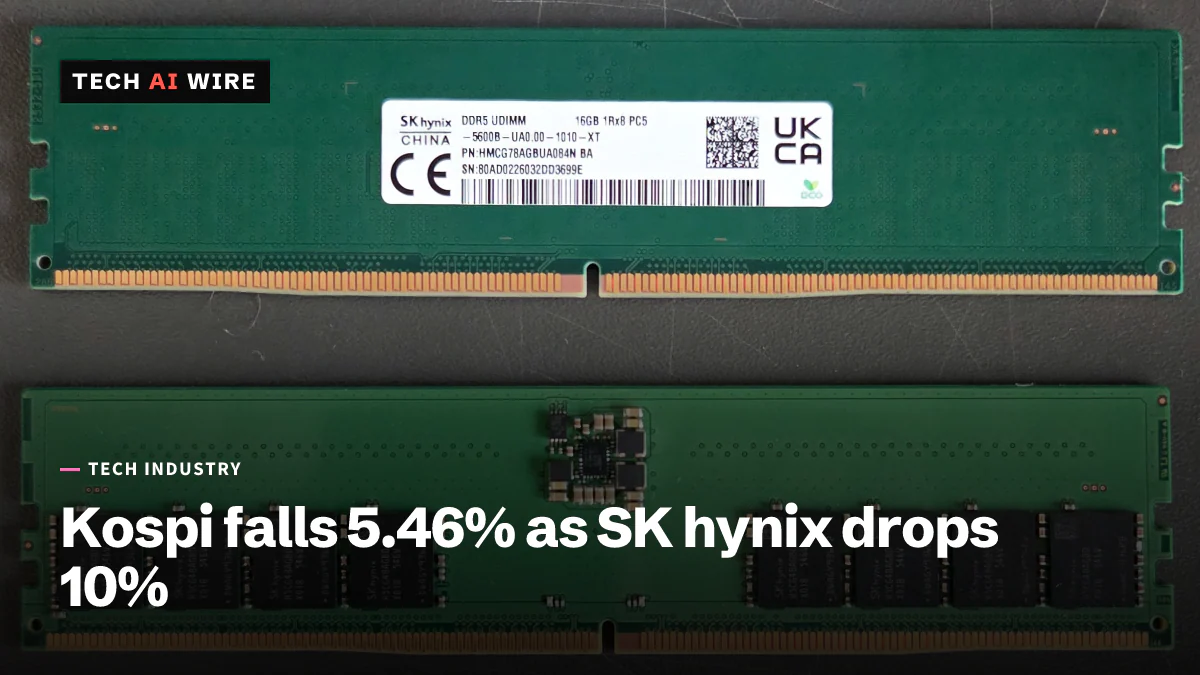
South Korea's Kospi fell 5.46% to 6,035.35 on October 13 as SK hynix dropped 10.09% and Samsung 7.39%, after foreign investors sold memory chip stocks.
3 min read
By the numbers
- Kospi close at 6,035.35 on October 13
- -5.46%
- SK hynix, to 1,443,000 won
- -10.09%
- Samsung Electronics, to 232,000 won
- -7.39%
- record-low forward P/E for the Kospi, per The Korea Times
- 4.54
South Korea's Kospi index fell 5.46% on October 13, 2026, closing at 6,035.35 after dipping below 6,000 during the day. SK hynix dropped 10.09% and Samsung Electronics 7.39%, as foreign investors sold the two memory chip makers. The fall shows how quickly worries about AI demand and Chinese competition now move the companies that make the world's computer memory.
How the day unfolded
The selling started early. According to The Korea Times, a sell-side "sidecar" was triggered at 9:47 a.m. A sidecar briefly pauses automated sell orders when the market falls fast. The Korea Times counts it as the 26th this year. The Korea Herald calls it the first in nearly two months.
| Measure | October 13 close |
|---|---|
| Kospi | 6,035.35, down 5.46% |
| SK hynix | 1,443,000 won, down 10.09% |
| Samsung Electronics | 232,000 won, down 7.39% |
| Kosdaq | 837.03, down 1.43% |
| Won | 1,345.1 per dollar |
The two sources differ on foreign selling. The Korea Times puts foreign net sales at 4.51 trillion won, about $3.36 billion. The Korea Herald puts it at 2.2 trillion won. The Korea Times says institutions bought a net 1.69 trillion won and individual investors 2.23 trillion won.
The Korea Herald says the Kospi has lost more than 1,000 points in five sessions, from above 7,000. The market's value fell by more than 800 trillion won, to below 5,000 trillion won.
Why investors sold
The reports point to several causes at once:
- Chinese memory competition. China's CXMT plans server DDR5 memory with a more compact cell design by year-end. Tech AI Wire covered that announcement on October 12. Han Ji-young of Kiwoom Securities told The Korea Herald that CXMT and weak US chip stocks amplified the swings.
- Doubts about AI spending. The Korea Times cites the Financial Times report that OpenAI's annualized revenue is near $50 billion, not $70 billion. It also cites Toshiba's plan to make more hard drives.
- The end of share buybacks. Samsung's buyback has ended and SK hynix's ends this week, The Korea Times reports. During the August-September sell-off, buybacks soaked up an average of 1.61 trillion won a day.
- US chip stocks. Overnight, Nvidia fell 1.3%, Micron 3.9% and the Philadelphia Semiconductor Index 2.67%, The Korea Herald reports.
Analysts quoted by The Korea Herald said the foreign selling mattered more than any single piece of chip news. "The outflows are too large to be attributed solely to portfolio rebalancing after the rally," said Heo Jae-hwan of Eugene Investment & Securities.
Cheap on paper, nervous in practice
The selloff came days after Samsung guided to a record 107.4 trillion won in third-quarter operating profit. Lee Jae-won of Yuanta Securities told The Korea Herald that memory prices and AI infrastructure spending remain firm.
The market is pricing in something much worse. The Kospi's 12-month forward price-to-earnings ratio closed at a record-low 4.54, The Korea Times reports. That ratio compares share prices with expected profits, and a low number means investors doubt those profits. Lee Kyoung-min of Daishin Securities said the market "is already pricing in a 35 to 51 percent decline in earnings."
KED Global headlined that the Kospi has descended to the world's worst-performing market. The Korea Herald notes it was still up 51% for 2026 as of Monday's close, against more than 70% for Taiwan.
What this means for developers
Share prices do not set memory prices directly, but the same forces drive both.
- Watch server memory quotes. Analysts still describe memory prices as firm. CXMT plans to add DDR5 server memory by year-end, so check whether quotes move once it ships.
- Do not read the selloff as a price cut. Falling chip stocks reflect expected future profits, not today's contract prices. Budget hardware on current quotes.
- Track AI demand signals. The same worries that hit SK hynix, from OpenAI's revenue to Nvidia's shares, drive GPU and server availability too.
- Keep more than one memory supplier qualified. If CXMT's server memory reaches the market, teams buying in volume may gain another option, with its own testing and supply-risk trade-offs.
Sources
Related articles
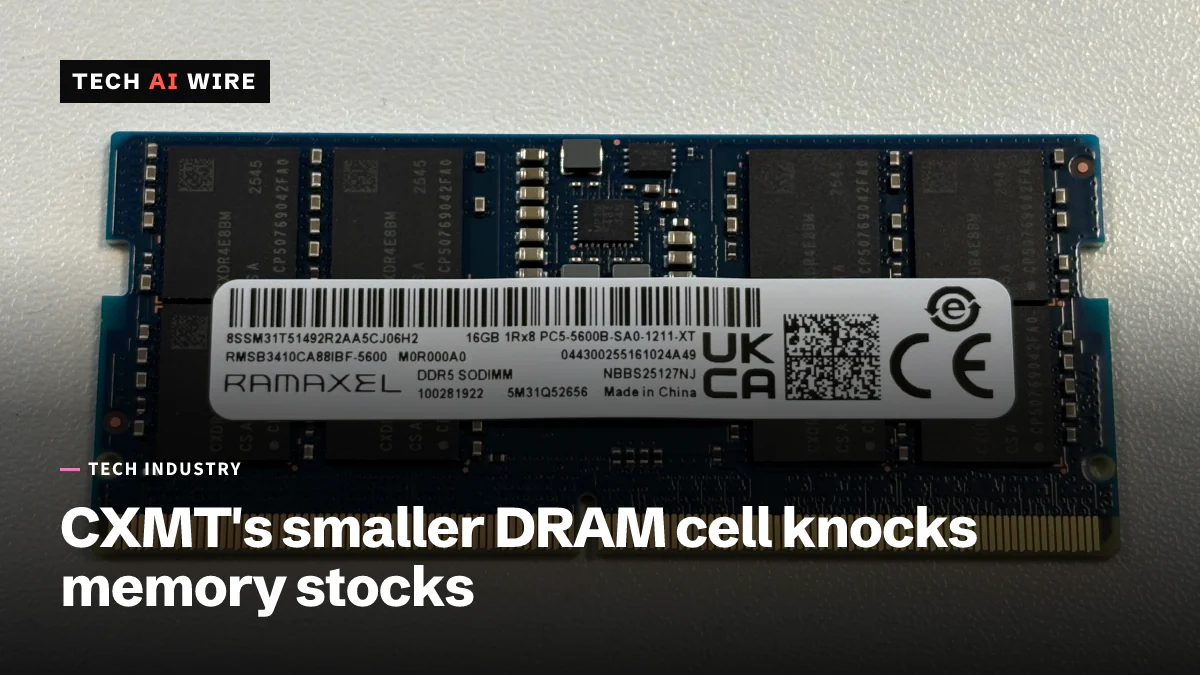
CXMT 4F² DRAM progress knocks Samsung and SK Hynix shares
China's CXMT says it made progress on a smaller 4F² DRAM cell and plans DDR5 server memory by end-2026. Samsung fell 3.6% and SK Hynix 3.4% on October 12.
DeepSeek plans to order 160,000 Huawei chips for new center
DeepSeek plans to order at least 160,000 Huawei Ascend 950DT chips for a new Inner Mongolia data center, using them for inference while still training on Nvidia hardware.
Micron sees tighter memory supply in 2027 and 2028
Micron posted $54.23 billion in fiscal Q4 revenue and guided to $61.5 billion, then warned memory supply will be tighter in 2027 and 2028 than in 2026.
The weekly digest
One email every Friday with the week's top stories from all six desks: AI, dev tools, coding, the tech industry, startups and what's next. Free, no spam.