Qwen's research license, explained
The Qwen Research License lets anyone download Qwen-Image-2.1 but limits it to research or evaluation. Commercial use needs a separate license from Qwen.
5 min read
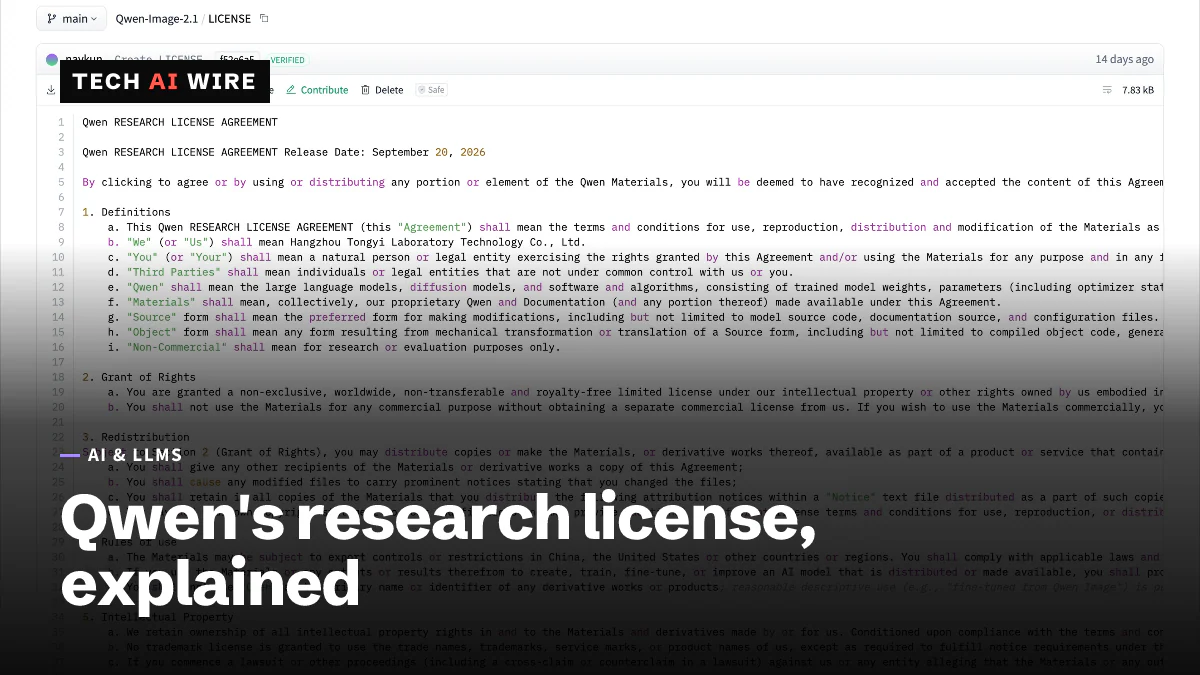
The Qwen Research License Agreement is the set of terms Alibaba's Qwen team attached to its Qwen-Image-2.1 image model. It lets anyone download, run, change and share the model, but only for research or evaluation. Any commercial use needs a separate license, which you must request from Qwen. The license text on Hugging Face carries a release date of September 20, 2026.
That makes Qwen-Image-2.1 "open weights" without making it open source. Open weights means the trained model files are public. Open source, in the usual sense, also means you may use them for any purpose, including paid work. Many developers assume a model on Hugging Face comes with that second freedom. This one does not.
How it works
A license grants rights and then sets limits on them. This one grants a lot and limits one thing: making money.
The grant is broad. The agreement gives you a "non-exclusive, worldwide, non-transferable and royalty-free limited license" to use, copy, share, change and build on the model. Royalty-free means you pay nothing for it. The catch sits in four capitalized words at the end of that clause: "FOR NON-COMMERCIAL PURPOSES ONLY."
The license defines non-commercial in one short phrase: "for research or evaluation purposes only." The rule covers what the text calls the "Materials," meaning "our proprietary Qwen and Documentation." So the model and its documentation fall under the same limit.
The commercial clause is direct. "You shall not use the Materials for any commercial purpose without obtaining a separate commercial license from us," the agreement says. It then names the route: a request sent to model-business@notice.qwencloud.com.
Here is what the main clauses require:
| Clause | What it says |
|---|---|
| Permitted use | Research or evaluation only |
| Commercial use | Forbidden without a separate license from Qwen |
| How to ask | Email model-business@notice.qwencloud.com |
| Sharing copies | Pass on the agreement, mark changed files, keep the copyright notice |
| Models built with it | Show "Built with Qwen" or "Improved using Qwen" in the documentation |
| Breaking the terms | Qwen may end the license, and you must delete the model |
| Disputes | Chinese law, with the People's Courts in Hangzhou City |
| User or revenue limit | None |
The last row matters most. Some licenses only bite above a certain company size, so small teams can use the model commercially for free. This one draws no such line. A one-person startup faces the same rule as a large company.
How it compares with other Qwen licenses
Qwen does not use one license for all of its models. The terms change from release to release, so the license on one Qwen model tells you nothing about the next one.
| License | Commercial use | Size threshold |
|---|---|---|
| Apache 2.0 | Allowed | None |
| Tongyi Qianwen License | Free below the threshold | 100 million monthly active users |
| Qwen Community License 1.0 | Allowed, with conditions | 100 million monthly active users or $20 million monthly revenue |
| Qwen Research License | Not allowed without a separate license | None |
Apache 2.0 is a standard open-source license. It allows paid use, changes and redistribution. The original Qwen-Image, released on August 4, 2025, uses it, according to its Hugging Face model card.
The Tongyi Qianwen License is an older Qwen license. A license guide on canirun.ai says it is free for organizations with fewer than 100 million monthly active users. That means people who use a product at least once in a month. The same guide says it applies to Qwen 2.5 72B.
The Qwen Community License 1.0 sets two separate conditions, according to a guide from Inferya. Above 100 million monthly active users or $20 million in monthly revenue, you must show the model's name in your product. And any company running a "model-as-a-service or AI work assistant business" needs its own license first, at any size. Model-as-a-service means selling other people access to the model. Tech AI Wire covered that license when Qwen3.8-Flash-Next shipped under it.
The Research License is the strictest of the four. It is the only one that rules out paid use at every size.
What changed and when
Qwen-Image moved from the most open of these licenses to the most closed in about 13 months. The first Qwen-Image shipped under Apache 2.0 on August 4, 2025. Qwen-Image-2.1 shipped under the Research License on September 20, 2026.
Tech AI Wire reported the release when Qwen-Image-2.1 shipped its 7B weights under a research license. The model generates and edits images, can produce transparent backgrounds, and accepts up to 10 reference images in one edit. Those features drew attention. The license drew questions.
Some of those questions have no answer in the text. The agreement never defines who owns the images the model makes. It names no price for a commercial license. It also says nothing about whether a request will be approved, or how fast.
Latenode reports that Qwen has said the generated images belong to the user. Latenode adds that this does not make it allowed to run the model for paid work. It also reports that requests sent to the commercial address have bounced back.
What this means for developers
Treat Qwen-Image-2.1 as a research tool until you hold a commercial license in writing. Benchmarks and internal tests are the clearest fit for "research or evaluation." A product that earns money is not, even when the model runs on your own machine. Running it locally changes where the model sits, not what the license allows.
Check each Qwen model's license on its own model card before you build on it. The same team has used at least four different licenses. A workflow built on the first Qwen-Image under Apache 2.0 does not carry over to version 2.1. This is not only a Qwen habit, either. GLM-5.3 also moved its weights to a custom license this year.
If you need commercial rights, ask early and in writing. The license gives one email address and no timeline. Keep a fallback model ready while you wait, and save the request and any reply.
If you share a research model trained or tuned with Qwen-Image-2.1, follow the sharing rules. Pass on the agreement, keep the copyright notice, and add "Built with Qwen" or "Improved using Qwen" to the documentation. Skipping those steps breaks the terms, and breaking the terms lets Qwen end your license.
Sources
- Qwen Research License Agreement (Qwen-Image-2.1) - Hugging Face
- Qwen/Qwen-Image model card - Hugging Face
- Qwen-Image 2.1 says open-source; its licence says no paid work - Latenode
- Qwen Community License 1.0: Commercial Use Explained - Inferya
- Qwen license - can I use this model commercially? - canirun.ai
Related articles
AstaBrief 8B: Ai2's open model writes cited reports
Ai2 released AstaBrief 8B, an Apache 2.0 model on Qwen3-8B that writes cited research reports in 51.1 seconds, 3.5x faster than Asta's Thinking mode.
Holo4 open-weight agent models score 61.7% on OSWorld 2.0
H Company's Holo4-27B scores 61.7% on OSWorld 2.0 at $1.22 a task, but only its Apache 2.0 sibling, 35B-A3B, can be self-hosted commercially.
Qwen-Image-2.1 ships 7B weights under a research license
Qwen-Image-2.1 puts 7 billion parameters and native transparency in a downloadable image model. Its license bars commercial use without permission.
The daily brief
Three to five stories a day, and what each one means for the people who build software. Free, no spam.