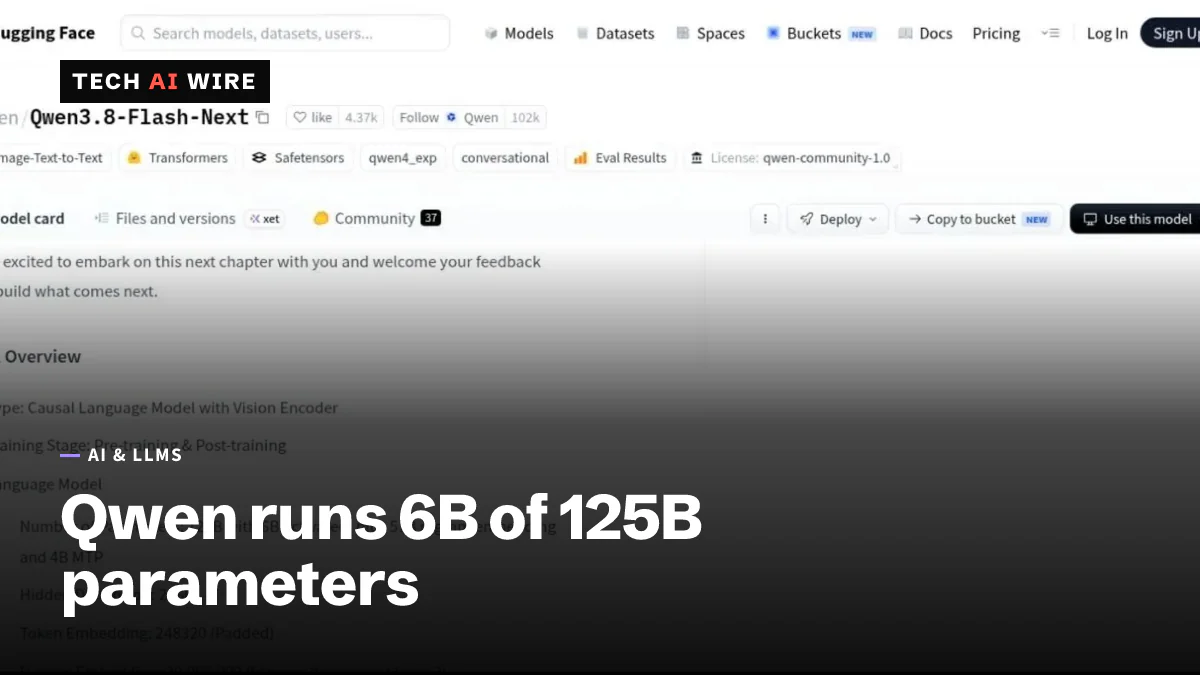
Qwen3.8-Flash-Next holds 125B parameters but runs only 6B
Alibaba released Qwen3.8-Flash-Next on August 26, 2026. It activates 6B of 125B parameters per token, costs $0.16 per million input tokens, and previews Qwen4.
3 min read
By the numbers
- parameters active per token, out of 125B
- 6B
- per million input tokens on QwenCloud
- $0.16
- token context with YaRN extension
- 1M
Alibaba's Qwen team released Qwen3.8-Flash-Next on August 26, 2026. The model holds 125 billion parameters but uses only 6 billion of them for any given token. That ratio is why it can be served at $0.16 per million input tokens, and why it matters to developers watching inference bills.
The release is a preview of the architecture behind Qwen4, the team's next model family. Qwen is publishing the design changes before the full line ships, so the community can examine them first.
How the model stays cheap to run
Qwen3.8-Flash-Next is a mixture-of-experts model. That means the network is split into many specialized sections, and a router picks a small subset for each token. The rest of the weights sit idle, so the memory bill is large but the compute bill is small.
The full checkpoint is bigger than the headline number suggests. MarkTechPost breaks it down as a 125B backbone, a 51B N-gram embedding table and a 4B multi-token prediction module, for about 180B parameters on disk.
Four design changes carry the release, per the Qwen team's own repository:
| Change | What it does |
|---|---|
| Gated DeltaNet + Qwen Sparse Attention | Three of every four layers use Gated DeltaNet; the fourth uses sparse attention |
| Gated Residual | Alters how signal passes between layers |
| N-gram Embedding | A 20-million-entry lookup table that adds capacity cheaply |
| Muon optimizer | A refined training optimizer |
The context window is 262,144 tokens natively. DataCamp and MarkTechPost both report it stretches to about 1 million tokens using YaRN, a technique for extending a model past its trained length.
Qwen also says training cost roughly one-ninth of what its Qwen3.7-Plus predecessor cost. That figure comes from Qwen, and no outside party has verified it.
What the benchmarks show, and who ran them
Every score below is Alibaba's own reporting. No independent lab has confirmed them.
| Benchmark | Qwen3.8-Flash-Next | Claude Opus 4.6 Max |
|---|---|---|
| SWE-bench Pro | 62.5 | 53.4 |
| LiveCodeBench v6 | 91.9 | not given |
| AndroidWorld | 84.5 | not given |
| MathVision | 95.7 | not given |
| Reasoning | 35.9 | 40.0 |
The pattern is more useful than any single number. The model leads on coding and agent tasks and trails on frontier reasoning, where MarkTechPost records 35.9 against 40.0. Qwen's own documentation also lists limitations: the model gets brittle over long agent chains, and it lags on knowledge-heavy evaluations.
The licence is not what "open weights" usually means
The weights are downloadable from Hugging Face and ModelScope. The FP8 checkpoint is 172.78 GiB and the BF16 version is 335.28 GiB, so this is a server-class download, not a laptop one.
The terms deserve a careful read. MarkTechPost reports the release uses the qwen-community-1.0 licence, which requires verification before commercial use. That is a meaningful step away from Apache 2.0 or MIT, where you download and ship. "Open weights" here means you can inspect and run the model, not that you can deploy it commercially without asking.
What this means for developers
Price the active parameters, not the total. A 125B model that fires 6B per token behaves like a small model on latency and cost, and like a large one on memory. If you are sizing hardware, the checkpoint size sets your GPU count; the active count sets your throughput.
Read the licence before you build on it. Check whether the verification step in qwen-community-1.0 applies to your product, and get that answer before you write integration code rather than after. This is the single most expensive thing to discover late.
Do not take the benchmark table at face value. Vendor-run evaluations pick favorable tasks, and the honest read here is a model that is strong at code and weaker at reasoning. Run it on your own tasks, especially long agent chains, where Qwen itself admits the model is brittle.
The strategic point is pricing pressure. At $0.16 input and $0.47 output per million tokens, this class of open-weight MoE sets a floor that hosted frontier models have to answer. That is good for anyone paying an inference bill, whichever model they end up choosing.
Update, September 18, 2026: Alibaba has built Qwen3.8-Omni-Flash on this architecture, and released it through its API with no open weights.
Sources
Related articles
Reflection Beam open weights land under Apache 2.0
Reflection put Beam's 501B-parameter weights on Hugging Face on October 16, 2026 under Apache 2.0. The FP8 and 4-bit versions fit on one 8-GPU server.
StepFun Step 5 Preview: 600B open-weight agent model
StepFun's Step 5 Preview, a 600B-parameter model with 27B active and a 1M-token context, is on Hugging Face after an API-only month at $1/$2.70 per M.
Ling-3.1-flash: Ant Group opens 560B model under MIT
Ant Group's inclusionAI published Ling-3.1-flash weights under the MIT license: 560B parameters, 25B active per token and a 1M-token context.
The weekly digest
One email every Friday with the week's top stories from all six desks: AI, dev tools, coding, the tech industry, startups and what's next. Free, no spam.