OpenAI Decisions API reaches GA with 400 questions a call
OpenAI's Decisions API left beta on October 22, 2026. It still costs $0.10 per 1M input tokens and now takes up to 400 questions per request.
3 min read
By the numbers
- per 1M input tokens, with no output charge
- $0.10
- questions per request, double the beta limit
- 400
- response times OpenAI reports, down from 1-3 seconds
- 100-180 ms
- OpenAI's rank on the Artificial Analysis Decision Index
- 14th
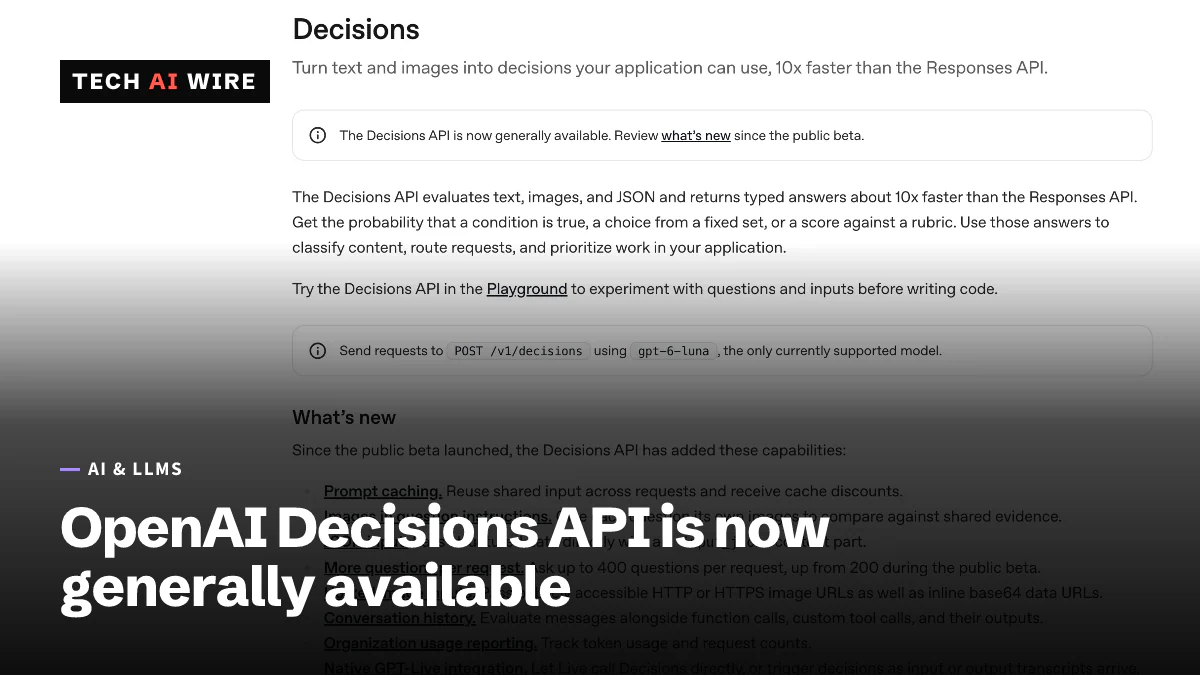
OpenAI's Decisions API became generally available on October 22, 2026, according to Unite.AI. The API answers a fixed question with a probability, a pick from a list or a score, instead of writing text. General availability means it has left beta, so teams can plan production use around it. The price has not changed, but the limits have grown.
TechCrunch reports that OpenAI opened the API to all customers the same day. OpenAI first showed it at its developer day on September 29. It reached public beta earlier in October.
What changed since the beta
Unite.AI lists four additions since the beta:
- More questions per call. One request can now carry 1 to 400 questions, double the previous limit.
- Prompt caching. Requests that share a prefix of at least 1,024 tokens can reuse it.
- Data residency. Processing can stay in the US or in Europe, meaning the EEA plus Switzerland.
- GPT-Live integration. The API now connects to OpenAI's GPT-Live, Unite.AI reports.
Score questions take a rubric with 2 to 10 levels. Zero Data Retention and HIPAA use remain available to eligible customers.
The two reports differ on inputs. TechCrunch says the public version added voice and image support. Unite.AI lists audio, files, item references and file_id as unsupported inputs.
Price and model
The price stays at $0.10 per million input tokens, with no charge for output, according to Unite.AI. Tokens are the small chunks of text a model reads. Unite.AI lists cached input at $0.01 per million tokens. The beta documentation had listed no charge for cache reads. Regional processing and very long inputs still cost extra.
The API runs on GPT-6 Luna, and Unite.AI says it is the only model supported. TechCrunch reports that OpenAI did not train a separate decision model. It reconfigured Luna instead. Nikunj Handa, product lead for OpenAI's APIs, told TechCrunch that speed has been the biggest gain.
How fast it is, by the companies' own numbers
Every speed figure here comes from OpenAI or its customers. None has been measured independently.
| Who | Claim | Reported by |
|---|---|---|
| OpenAI | Response times fell from 1-3 seconds to 100-180 ms | TechCrunch |
| OpenAI | Up to 10x faster than GPT-6 Luna through the Responses API | Unite.AI |
| Speak | Time between actions fell from 1.4 seconds to 0.13 seconds | Both |
| Box | About 5x faster route selection at the same accuracy | Unite.AI |
| Ramp | 4x faster and 30% cheaper than GPT-6 Luna | Unite.AI |
| Sierra | Under 280 ms at p95, about 3x faster, 90% lower cost per call | Unite.AI |
| Datadog | 40x faster p95 latency than comparable frontier models | Unite.AI |
P95 means 95% of requests finished within that time.
Where it ranks against Jev
Decision models are now a crowded field, as our explainer on AI decision models shows. OpenAI is not on top. On the AIM System One Index, TypeSafe's Jev ranks 7th and OpenAI's model ranks 8th, TechCrunch reports. On the Artificial Analysis Decision Index, Jev ranks 3rd and OpenAI's model 14th. TechCrunch gives no raw scores. It also names Liquid's D1 Ultra and Base Lab's Elephant-1 as rivals.
What this means for developers
The Decisions API is now a supported product rather than a test. That changes how to treat it, but not whether it is the best choice.
- Batch your questions. With 400 questions per request, one call can classify a whole page of items. Fewer calls means less overhead per decision.
- Shape prompts for caching. Put your shared instructions first and keep them at 1,024 tokens or more, so repeated calls can hit the cache.
- Check your inputs. Audio and files are listed as unsupported. Test any voice or file workflow before you build on it, since the two reports disagree.
- Run your own benchmark. OpenAI's model ranks below Jev on both public indexes. Test accuracy and cost on your own data before choosing a provider.
- Pick a region on purpose. If your data must stay in Europe, the EEA and Switzerland option now exists. Regional processing costs extra, so budget for it.
Sources
Related articles
OpenAI Decisions API opens to all developers in beta
OpenAI's Decisions API is now in public beta. It returns a probability, a pick or a score instead of text, runs on GPT-6 Luna and costs $0.10 per 1M input tokens.

Mistral Voxtral 3 adds voice agents from $0.0035 a minute
Mistral's Voxtral 3 adds speech-to-text from $0.0035 a minute, a $13 per million character voice model and a voice agent API from $0.04 a minute.
xAI Grok Voice 3.0 ships at $0.08 a minute
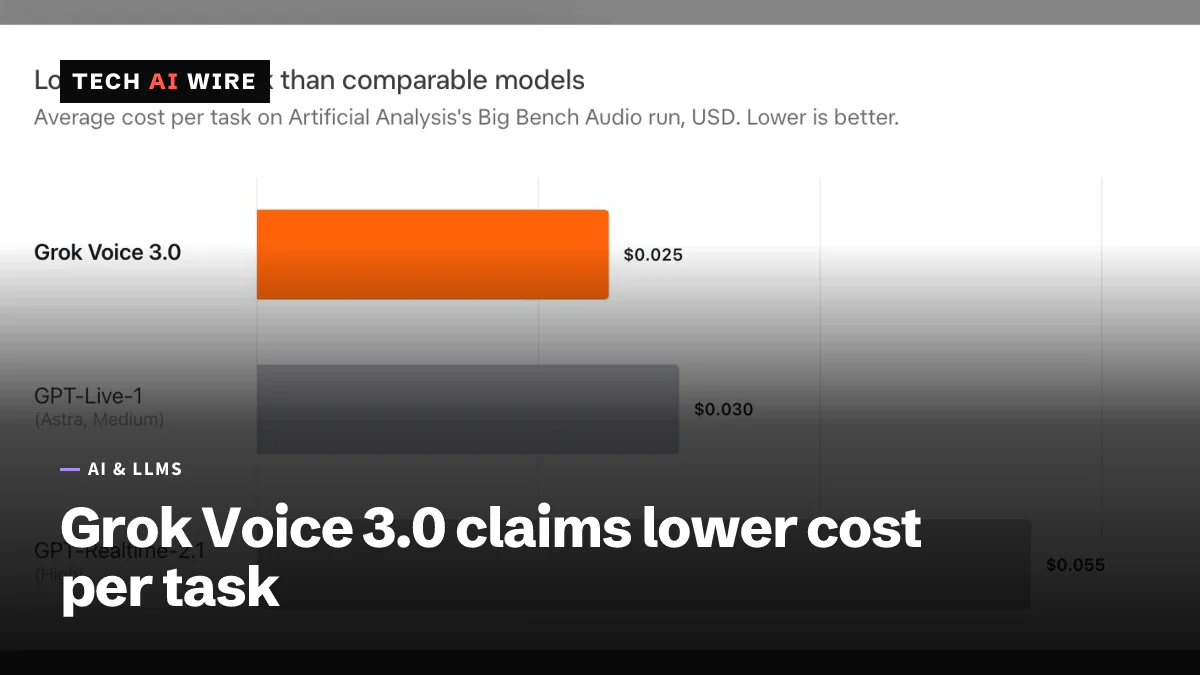
xAI's Grok Voice 3.0 speech model costs $0.08 a minute in its Voice Agent API, the same as 2.0, and scores 86.9 on Artificial Analysis's speech index.
The weekly digest
One email every Friday with the week's top stories from all six desks: AI, dev tools, coding, the tech industry, startups and what's next. Free, no spam.