Nvidia posts $96.2B quarter and guides to $108B for Q3
Nvidia reported $96.2 billion in revenue, up 106% in a year, with data centre sales at $89 billion. Its own release guides to $108 billion for this quarter.
3 min read
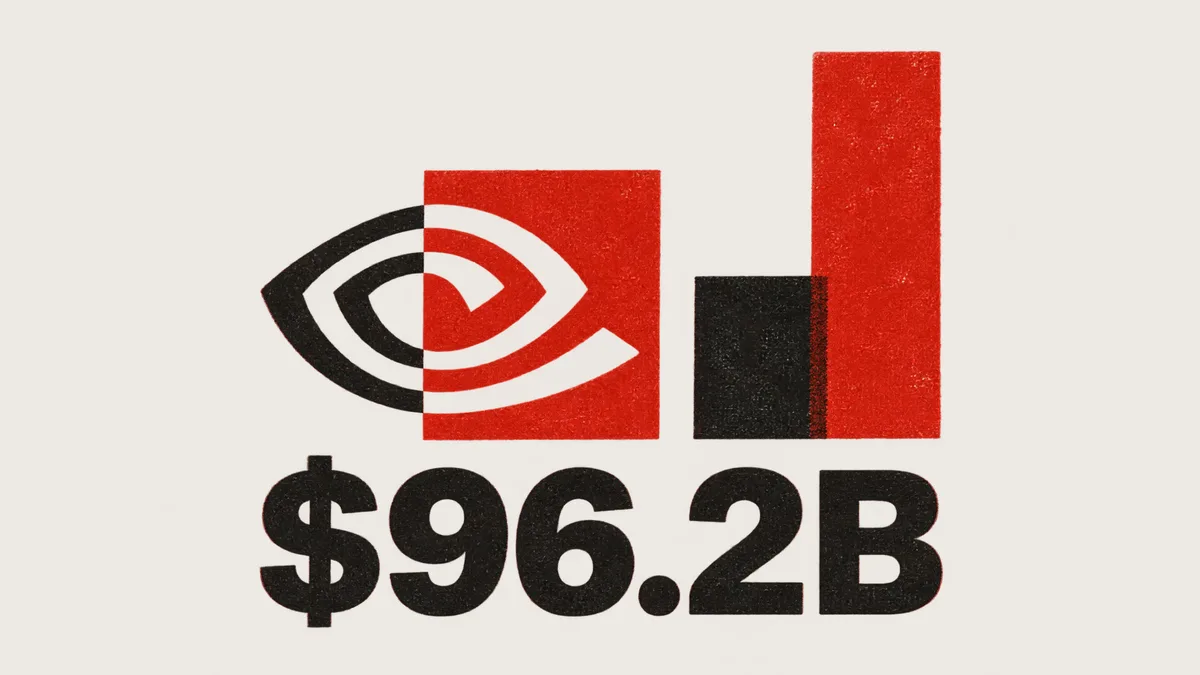
By the numbers
- Q2 FY2027 revenue, up 106% in a year
- $96.2B
- data centre revenue, up 117%
- $89.0B
- GAAP gross margin
- 75.0%
- Q3 revenue guidance, plus or minus 2%
- $108.0B
Nvidia reported revenue of $96.2 billion for its second quarter of fiscal 2027 on 26 August 2026. That is 106% higher than a year earlier and 18% higher than the previous quarter, according to the company's own results release. Data centre sales made up $89.0 billion of it, up 117% in a year. For developers the useful signal is not the size of the number. It is that Nvidia says demand is still accelerating, which shapes how hard GPU capacity will be to get.
The numbers Nvidia reported
The figures below come from Nvidia's results release.
| Measure | Q2 FY2027 |
|---|---|
| Revenue | $96.2 billion |
| Data centre revenue | $89.0 billion |
| GAAP gross margin | 75.0% |
| GAAP net income | $59.688 billion |
| GAAP diluted earnings per share | $2.46 |
| Non-GAAP diluted earnings per share | $2.22 |
| Returned to shareholders | $26.0 billion |
Nvidia also disclosed $99.0 billion still authorised for share repurchases, and a dividend of $0.25 per share payable on 1 October 2026. A gross margin of 75% means Nvidia keeps 75 cents of every revenue dollar after the direct cost of making the product.
CEO Jensen Huang framed the quarter in terms of usage rather than hype. "AI has reached its inflection point. It's doing useful work. Its tokens are productive and profitable," he said in the release.
A guidance figure the sources disagree on
Nvidia's own release sets Q3 FY2027 revenue guidance at $108.0 billion, plus or minus 2%, with expected gross margin of 74.0%. That is the figure from the company itself.
Readers may see a different number elsewhere. Fortune's report on the same results gives Q3 guidance as $91 billion, plus or minus 2%, and describes it as below an average analyst expectation of $103.9 billion. Those two accounts cannot both be right. We are citing Nvidia's own results release as the authoritative figure and flagging the discrepancy rather than quietly picking one.
What the release says beyond the money
Two disclosures matter more to engineers than the revenue line. Nvidia says its Blackwell platform led every category in the MLPerf Training 6.0 benchmark round. MLPerf is an industry benchmark suite for training speed, run in public rounds so vendors can be compared on the same tasks.
The release also says Nvidia's confidential computing GPUs were deployed in Apple's Private Cloud Compute. Confidential computing means the data stays encrypted while it is being processed, so the operator of the machine cannot read it. Nvidia additionally points to partnerships it says are mobilising more than $500 billion for AI infrastructure.
What this means for developers
Treat "demand is accelerating" as a capacity forecast, not a boast. If your 2027 plan assumes on-demand access to top-end GPUs at today's prices, that assumption is the weak point. Reserve capacity earlier than feels comfortable, and price a fallback path on older accelerator generations before you need one.
Read the MLPerf claim precisely. Leading every category in a training benchmark round says a great deal about throughput on well-tuned reference workloads. It says much less about your inference bill, which is where most production spend actually lands. Benchmark wins and cost per served token are different questions, and only the second one appears on your invoice.
The Apple Private Cloud Compute detail is the most practically interesting item in the release. Confidential computing on GPUs moving into a large consumer deployment makes it easier to argue for handling regulated data on hosted accelerators. If you have been told that a workload cannot leave your own hardware for compliance reasons, this is a concrete deployment to cite when that conversation reopens.
One caution on reading the shareholder returns. Nvidia returned $26.0 billion to shareholders this quarter and still has $99.0 billion authorised for buybacks. That is a company with more cash than immediate places to spend it internally, which is usually a sign of pricing power in its market. For a customer, pricing power on the seller's side is not good news. Negotiate multi-year commitments carefully rather than assuming hardware costs fall on their own.
Sources
Related articles
Samsung Q3 2026 profit guidance hits 107.4 trillion won
Samsung guided to about 107.4 trillion won ($80 billion) of Q3 2026 operating profit, nine times a year earlier, as AI demand drives memory prices up.

Micron sees tighter memory supply in 2027 and 2028
Micron posted $54.23 billion in fiscal Q4 revenue and guided to $61.5 billion, then warned memory supply will be tighter in 2027 and 2028 than in 2026.
Firmus pulls $5 billion IPO, turns to private investors
Nvidia-backed Firmus pulled its US$5 billion IPO on October 9, citing volatility. It had sought a US$30.6 billion value, triple its August round.
The weekly digest
One email every Friday with the week's top stories from all six desks: AI, dev tools, coding, the tech industry, startups and what's next. Free, no spam.