Samsung Q3 2026 profit guidance hits 107.4 trillion won
Samsung guided to about 107.4 trillion won ($80 billion) of Q3 2026 operating profit, nine times a year earlier, as AI demand drives memory prices up.
3 min read
By the numbers
- Q3 2026 operating profit guidance
- 107.4T won
- Q3 2026 sales guidance
- 195T won
- operating profit growth year over year, per TradingKey
- 782.5%
- date of the full results
- Oct 29
- Q3 2025
- 12.17T
- Q2 2026
- 89.49T
- Q3 2026 (guidance)
- 107.4T
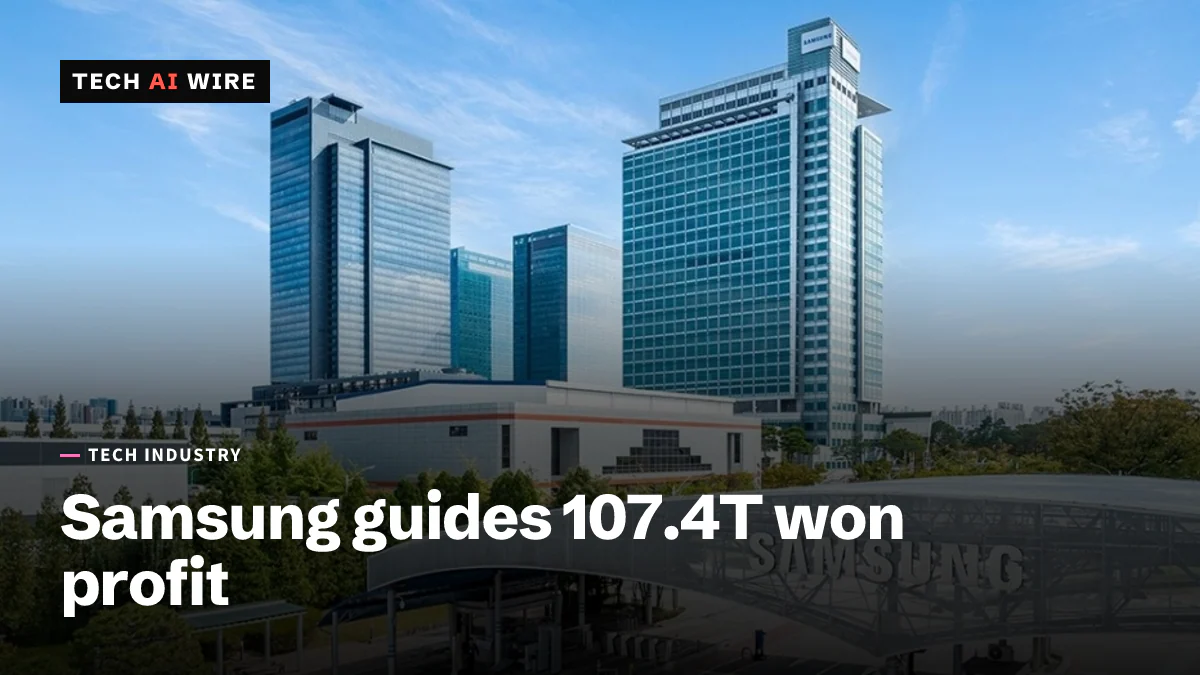
Samsung Electronics expects operating profit of about 107.4 trillion won ($80 billion) for the third quarter of 2026, according to preliminary guidance released on October 8. That is roughly nine times the 12.17 trillion won it earned a year earlier. Demand for memory chips in AI data centers drove the jump, while Samsung's phone business struggles with the same rising chip prices.
The numbers Samsung guided
Samsung publishes preliminary guidance a few weeks before its full results. The figures are rounded estimates, not final accounts. GSMArena reported the guidance alongside the earlier quarters:
| Measure | Q3 2026 (guidance) | Q2 2026 | Q3 2025 |
|---|---|---|---|
| Consolidated sales | about 195 trillion won | 171.5 trillion won | 86.06 trillion won |
| Operating profit | about 107.4 trillion won | 89.49 trillion won | 12.17 trillion won |
TradingKey puts the year-over-year gains at 782.5% for operating profit and 126.6% for sales. Operating profit rose about 20% from the second quarter.
Quartz, citing Reuters, says this is the first time any technology company has posted quarterly operating profit above 100 trillion won. It is also Samsung's fourth straight quarterly profit record. The guidance beat the LSEG consensus forecast of 106.1 trillion won by about 1.2%, TradingKey reports.
Investors shrugged. Quartz reported a 0.2% dip in Samsung shares on Thursday morning. TradingKey later put the fall at 0.93%, to 266,000 won.
Why memory is driving the profit
Memory chips hold the data that processors work on. AI systems need huge amounts of it, especially high-bandwidth memory (HBM). HBM is a stack of memory chips that sits beside an AI processor and feeds it data very quickly.
Samsung's chip business carries the company. In the second quarter, its Device Solutions division earned 89.2 trillion won of the 89.49 trillion won total, according to Quartz. Analyst Douglas Kim of Douglas Research Advisory estimates that Samsung's HBM bit shipments rose about 50% from the previous quarter, Quartz and TradingKey report.
Prices keep climbing. TradingKey cites TrendForce forecasts that conventional DRAM contract prices will rise 10% to 15% in the fourth quarter. It expects NAND flash prices, the memory used for storage, to rise 15% to 20%. Samsung and Micron both expect the gap between memory supply and demand to last through 2028, Quartz reports. Micron said as much on September 30, when it forecast tighter memory supply in 2027 and 2028.
The phone business pays for it
The same price rises hurt Samsung's own phones. Quartz reports that the mobile and foundry units remain unprofitable. The mobile and networks unit lost 700 billion won in the second quarter. Reuters estimates its third-quarter loss at more than $1 billion, per Quartz.
SammyFans expects the mobile division to post a loss for a second straight quarter. GSMArena cites South Korean media reports that the division has begun cutting fourth-quarter smartphone production by up to 30%. An unnamed industry source told GSMArena that Samsung's phones are not profitable when sold.
What comes next
Samsung will publish detailed results, broken down by division, on October 29, according to TradingKey and Quartz. Those figures will show how much profit came from HBM versus conventional memory. They will also show how deep the phone losses run.
What this means for developers
For teams that buy hardware or cloud capacity, Samsung's guidance is a price signal, not only an earnings story.
- Budget for pricier memory. TrendForce expects DRAM contract prices to rise 10% to 15% this quarter. Servers, laptops and GPUs with large memory all carry that cost, so hardware quotes may not hold for long.
- Expect device price changes. Memory costs already pushed Nvidia's Shield TV Pro up $100. Samsung's own production cuts suggest thin margins across consumer devices.
- Watch cloud pricing. Cloud providers buy the same memory. If supply stays tight through 2028, as Samsung and Micron expect, high-memory instances are unlikely to get cheaper soon.
- Right-size memory use. Smaller context windows, quantized models and better caching all cut how much memory an AI workload needs. Those savings are worth more when each gigabyte costs more.
- Read the October 29 breakdown. The division figures will show whether HBM or conventional DRAM is doing the heavy lifting.
Sources
- Samsung Electronics announces its earnings guidance for Q3 2026 - GSMArena
- Samsung's Q3 2026 profit jumps 782% to $80 billion on AI chip demand - SammyFans
- Samsung Q3 Operating Profit Surges Nearly 8-Fold to Record High: What Is the Outlook for Micron, Nvidia, and Memory Stocks? - TradingKey
- Samsung Q3 2026 earnings: $80 billion record profit forecast - Quartz
Related articles
Micron sees tighter memory supply in 2027 and 2028
Micron posted $54.23 billion in fiscal Q4 revenue and guided to $61.5 billion, then warned memory supply will be tighter in 2027 and 2028 than in 2026.
Nvidia posts $96.2B quarter and guides to $108B for Q3
Nvidia reported $96.2 billion in revenue, up 106% in a year, with data centre sales at $89 billion. Its own release guides to $108 billion for this quarter.
DayOne files for a Nasdaq IPO with 962 MW in service
Data center operator DayOne filed for a Nasdaq IPO as DODC. It has 962 MW in service and needs about $11.4B to build the 2,281 MW it has already booked.
The weekly digest
One email every Friday with the week's top stories from all six desks: AI, dev tools, coding, the tech industry, startups and what's next. Free, no spam.