MiniMax M3.1 Flash rolls out, claims 70% cheaper agents
MiniMax's new model costs $0.15 per million input tokens and $0.60 output, and the company says it runs AI agents for 70% less than M3.
3 min read
By the numbers
- per million input tokens
- $0.15
- per million output tokens
- $0.60
- lower agent costs than M3, per MiniMax
- 70%
- DeepSeek V4.1-Flash
- 77%
- MiniMax M3.1 Flash
- 73.7%
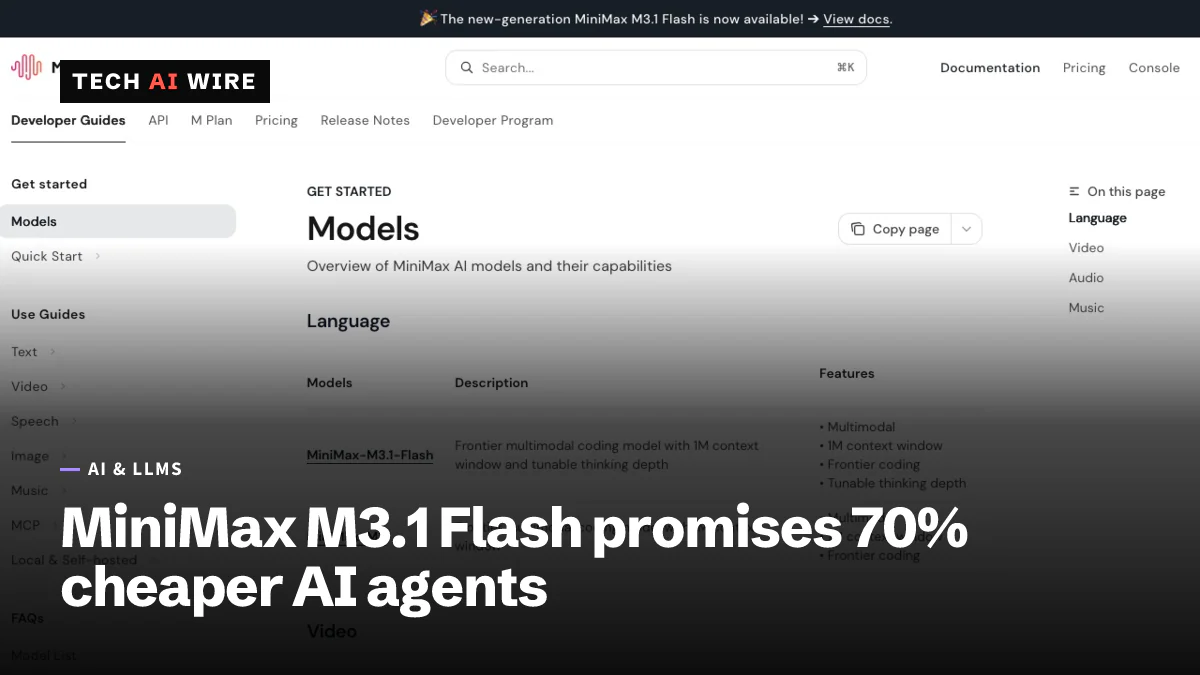
MiniMax began rolling out M3.1 Flash on October 19, 2026, a faster and cheaper version of its M3 AI model. The company says it cuts the cost of running AI agents by 70%. At $0.15 per million input tokens, it competes directly on price with DeepSeek's budget models.
What MiniMax released
MiniMax is a Chinese AI company whose shares trade in Hong Kong. Its M3 model launched in June. M3.1 Flash is an update built for speed and low cost, and MiniMax's announcement says it is "officially rolling out today."
Developers can reach it three ways: the MiniMax API, the M Plan subscription, and the MiniMax Code desktop app. The reports differ on its status. SiliconANGLE calls it a preview, citing MiniMax's developer guide. The company's own post does not use that word.
MiniMax also confirmed one mystery. A model called "Space Bunny" appeared anonymously on OpenRouter, a site that offers many AI models through one API, in September. It was an early build of M3.1 Flash, SiliconANGLE reports.
Price and speed
The prices are per million tokens. A token is a small chunk of text, roughly part of a word.
| Item | M3.1 Flash |
|---|---|
| Input | $0.15 per million tokens |
| Output | $0.60 per million tokens |
| Cached input | $0.015 per million tokens |
| Prompt size | Up to 1 million tokens (SiliconANGLE) |
| Total parameters | 428 billion (SiliconANGLE) |
Cached input means text the service has already seen, such as a long system prompt sent with every request. It costs a tenth of fresh input here.
MiniMax makes two speed claims. Online inference, the work of answering requests, is "nearly three times faster," but the post does not say faster than what. It also says output tops 200 tokens per second in everyday use, with a median above 170. The 70% cost cut is measured against its previous model.
Benchmarks
All scores below come from MiniMax. No outside tests appear in either source.
| Benchmark | What it tests | Score |
|---|---|---|
| OSWorld V2 | Using a computer's apps and desktop | 61.7 |
| BankerToolBench | Finance tasks with tools | 76.2 |
| CyberGym | Security tasks | 82% |
| DeepSWE v1.1 | Fixing real software issues | 73.7% |
| Agents' Last Exam | Hard agent tasks | 29.6 |
On DeepSWE v1.1, M3.1 Flash trails DeepSeek's V4.1-Flash, which scored 77%, SiliconANGLE notes. That comparison matters for MiniMax as a business. Its shares reportedly fell after DeepSeek's V4.1-Flash launched in September.
"Flash represents our ongoing exploration of the balance between efficiency and capability," MiniMax wrote.
Open weights later
The weights for M3.1 Flash, the files needed to run a model on your own hardware, are not out yet. MiniMax says they "will be released later," with no date or license. A larger Pro model is also coming, according to SiliconANGLE.
What this means for developers
M3.1 Flash is one more strong, cheap model for agent work, but its main numbers are the company's own. Treat it as a candidate to test, not a proven swap.
- Run your own agent tasks. The 70% saving and the benchmark scores come from MiniMax. Measure cost per finished task on your workload, not cost per token.
- Use the cache. Cached input costs a tenth of normal input. Keep long instructions identical across calls so they count as cached.
- Check the access path. It is on the API, but one report calls it a preview. Confirm limits and terms in your account before building on it.
- Compare with DeepSeek. DeepSeek's V4.1-Flash scored higher on DeepSWE v1.1. If code repair is your main use, test both.
- Wait for weights if you self-host. No open-weights date or license exists yet. Do not plan on-premises use until MiniMax publishes both.
Sources
- MiniMax M3.1 Flash - MiniMax
- MiniMax launches M3.1 Flash model, says it cuts AI agent costs by 70% - SiliconANGLE
Related articles
AI decision models, explained
A decision model picks from fixed answers and returns a probability for each, instead of writing text. Hosted prices start at $0.02 per million tokens.

Meta Muse Wonder launches as its first frontier model
Meta released Muse Wonder on October 12 at $4 per million input tokens and $20 per million output, with a larger Wonder Full kept for Muse Code.
Xiaomi MiMo-V2.6-Pro ships 1T open weights under MIT
Xiaomi's MiMo-V2.6-Pro has 1.02 trillion parameters, 42 billion active, a 1M-token context and MIT-licensed weights, but needs about 680 GB of GPU memory.
The weekly digest
One email every Friday with the week's top stories from all six desks: AI, dev tools, coding, the tech industry, startups and what's next. Free, no spam.