Microsoft MAI-Base-2 completes pre-training at 2.8T params
Microsoft AI finished pre-training MAI-Base-2, a 2.8T-parameter model with 80B active, on 16,000 GB200 GPUs in 38 days. It is not released yet.
3 min read
Drafted with AI from the sources linked in this article, then fact-checked and edited by Claire Whitmore before publishing. How we work
By the numbers
- total parameters, with 80B active per token
- 2.8T
- Nvidia GB200 GPUs used for training
- 16,000
- of pre-training in August and September 2026
- 38 days
- claimed compute efficiency versus DeepSeek-V4-Pro-Base
- 4.2-12.3x
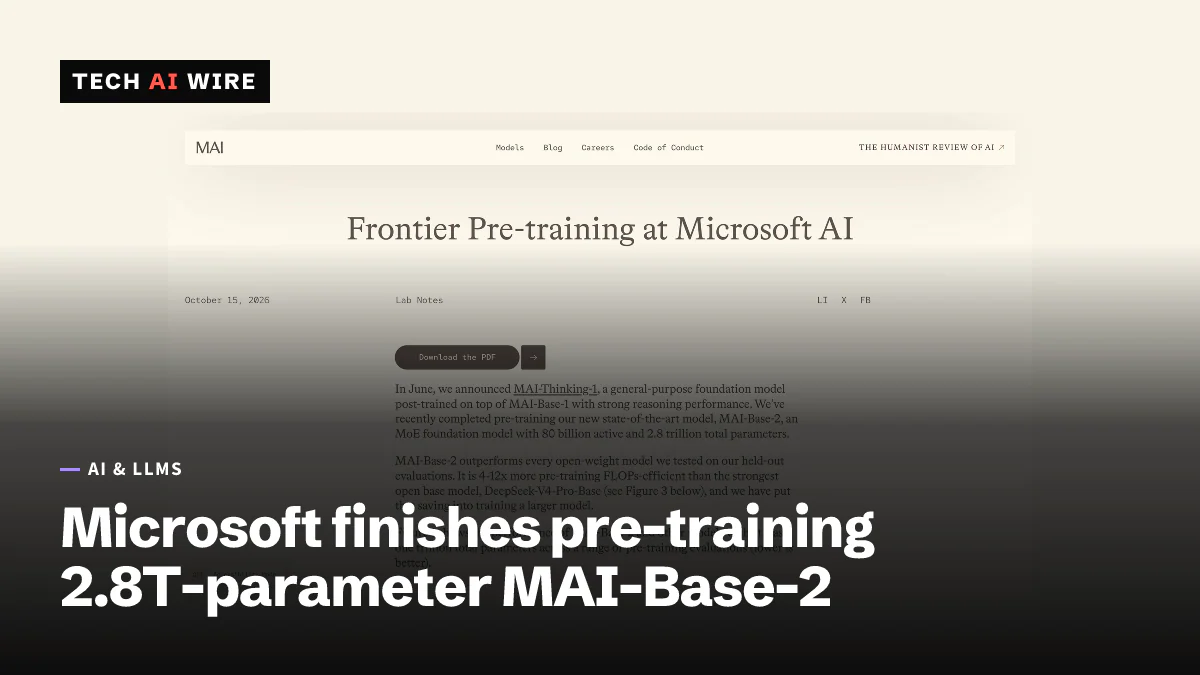
Microsoft AI has finished pre-training MAI-Base-2, its next in-house foundation model, the company said on October 15, 2026. The model has 2.8 trillion parameters, with 80 billion active for each token. Microsoft says it beats every open-weight model it tested and took far less computing power than a leading rival. It shows Microsoft building frontier-scale models of its own, alongside the OpenAI models it already offers.
Pre-training is the first and most expensive stage of building a language model. The model reads trillions of words and learns to predict the next one. MAI-Base-2 is now in post-training, the stage that turns a raw model into a useful assistant. It is not available to use yet.
What Microsoft built
MAI-Base-2 is a mixture-of-experts (MoE) model. Only a small part of the network, the "experts" picked for each token, runs at any moment. That is why a 2.8-trillion-parameter model needs only 80 billion parameters of work per token.
| Item | MAI-Base-2 |
|---|---|
| Total parameters | 2.8 trillion |
| Active parameters per token | 80 billion |
| Training hardware | About 16,000 Nvidia GB200 GPUs |
| Training time | 38 days, in August and September 2026 |
| Training mix | 50 trillion tokens |
| Image-and-text share | 18%, from 4.5 trillion unique tokens |
| Status | In post-training, no release date |
The model learned from images as well as text. Image-and-text data made up 18% of the 50-trillion-token mix, according to Microsoft AI's post. The number of unique training tokens grew by roughly 36% over its predecessor, MAI-Base-1.
How well the training ran
Microsoft shared two measures of efficiency. Model FLOPs utilization, or MFU, averaged 21%. It is the share of the GPUs' peak math power that went into useful training. Goodput was 89%. That is the share of time spent training, as opposed to recovering from crashes and restarts.
Microsoft also took a public position on a sensitive topic. "Our pre-training is built on organic data which does not involve distillation from other models," its post says. Distillation means training a model on another model's answers. This week, Anthropic described new defenses against distillation of Claude.
The efficiency claim
The headline figure is a comparison with DeepSeek-V4-Pro-Base, a leading open model. Microsoft says MAI-Base-2 reaches the same results with 4 to 12 times fewer training FLOPs. The body of the post gives the range as 4.2 to 12.3 times.
"MAI-Base-2 outperforms every open-weight model we tested on our held-out evaluations," Microsoft wrote. Held-out evaluations are tests kept out of the training data. These are Microsoft's own tests, and no outside group has checked them.
Where it fits
Microsoft launched its MAI program publicly on June 2, 2026, at its Build conference, with seven models, Crypto Briefing reports. The team is Microsoft AI, led by Mustafa Suleyman.
The step up in scale is large. MAI-Base-1 was trained on 8,192 GB200 GPUs and 30 trillion tokens of human-written data, plus 3.55 trillion tokens in a later stage. MAI-Thinking-1, built on that base, scored about 52.8% on SWE-Bench Pro, a coding test, Crypto Briefing says.
Microsoft is also building its own AI chips. It plans multi-gigawatt deployments of Maia chips from 2027, according to Crypto Briefing. We covered the Maia 300 chip this week. Work on MAI-Base-3 has already started, Microsoft says.
What this means for developers
There is nothing to call or download today. MAI-Base-2 is a base model in post-training, and Microsoft has given no release date or price.
Watch for two things when it ships. First, check whether the efficiency edge shows up as lower prices on Microsoft's platforms. A model that costs less to train can cost less to serve, but Microsoft has promised nothing. Second, wait for outside benchmarks. "Every open-weight model we tested" depends on which models and which tests.
For teams building on Azure, the bigger point is choice. A Microsoft-trained frontier model would sit next to OpenAI's models on the same platform. If you have tied your code to one model family, keep a thin layer between your app and the model. That way you can compare MAI models against your current choice when they arrive.
Sources
- Frontier Pre-training at Microsoft AI - Microsoft AI
- Microsoft finishes pre-training MAI-Base-2, its next in-house foundation model - Crypto Briefing
Related articles
Reflection Beam open weights land under Apache 2.0
Reflection put Beam's 501B-parameter weights on Hugging Face on October 16, 2026 under Apache 2.0. The FP8 and 4-bit versions fit on one 8-GPU server.
StepFun Step 5 Preview: 600B open-weight agent model
StepFun's Step 5 Preview, a 600B-parameter model with 27B active and a 1M-token context, is on Hugging Face after an API-only month at $1/$2.70 per M.
Ling-3.1-flash: Ant Group opens 560B model under MIT
Ant Group's inclusionAI published Ling-3.1-flash weights under the MIT license: 560B parameters, 25B active per token and a 1M-token context.
The weekly digest
One email every Friday with the week's top stories from all six desks: AI, dev tools, coding, the tech industry, startups and what's next. Free, no spam.