KDE Plasma 6.8 beta brings Kup backups and Wayland fixes
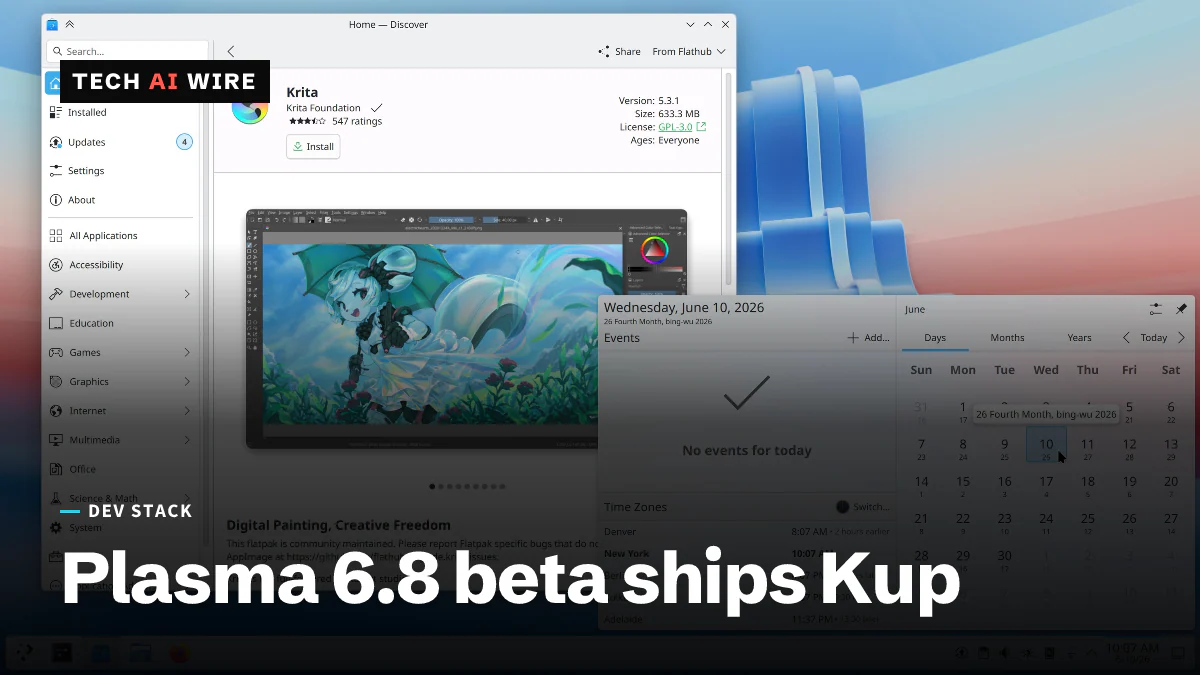
KDE shipped the Plasma 6.8 beta as version 6.7.90 on September 10, 2026. It adds Kup as the desktop's backup scheduler, with stable due October 14.
3 min read
By the numbers
- version string for the 6.8 beta
- 6.7.90
- scheduled stable release
- Oct 14
KDE has released the beta of Plasma 6.8, and the headline addition is a backup tool that ships with the desktop rather than sitting beside it. KDE's announcement is dated Thursday, September 10, 2026, and carries the version string 6.7.90. The stable release is scheduled for October 14, 2026.
Plasma is the desktop environment KDE builds, and the one shipped by default on distributions including Fedora KDE and openSUSE. The beta version number is worth explaining: KDE labels the beta of 6.8 as 6.7.90, so a machine reporting 6.7.90 is running pre-release 6.8 code, not an older 6.7 build.
What Kup adds
The change both sources lead with is the same. "kup: Backup scheduler for the Plasma desktop," reads KDE's own announcement.
Kup is not new software, but shipping it as the desktop's backup scheduler makes it part of the default experience rather than something each user or distribution wires up separately. For anyone who packages or supports Plasma systems, that moves backups from a per-install decision to a platform feature.
The Wayland work
Wayland is the display protocol that has been gradually replacing X11 on Linux. Phoronix reports that "from the Wayland angle there has been a lot of polishing and fine tuning for Plasma 6.8."
Three specific items stand out. KWin, the Plasma window manager, gains support for the commit-timing protocol, which lets a compositor and a client agree on when a frame should appear. There is dwell clicker support, an accessibility feature that clicks when the pointer rests in place. Remote desktop support was also improved.
Smaller changes worth knowing
The rest of the release is spread across graphics handling and screen management.
| Change | What it affects |
|---|---|
| vRAM usage optimizations | Memory pressure on the GPU |
kscreenctl | A tool for screen configuration |
| Server-side drop shadows | The compositor draws shadows instead of each app |
| Multi-GPU handling | Systems with more than one graphics card |
| Multi-monitor improvements | Multi-display layouts |
| Union theme engine | Plasma's theming system |
KDE points to its community wiki for the full changelog, and neither source carried a bug-fix count, a commit count or a contributor number.
This is the third Linux desktop release this site has covered today. GNOME 51 added custom pointer acceleration and COSMIC Epoch 1.8 shipped in the same window, which is an unusually busy day for desktop environments.
What this means for developers
Treat this as a testing window, not an upgrade. A beta of a desktop environment is the point at which your application's odd interactions surface, and there is roughly a month before stable on October 14.
Two of these changes can alter how your app renders without you changing a line. Server-side drop shadows move shadow drawing into the compositor, so an application that draws its own shadow may end up with two, or with none. The commit-timing protocol affects when frames are presented, which matters if you have your own animation or frame-pacing logic rather than letting the toolkit handle it.
If you maintain a Plasma widget or applet, the sources read for this article did not list API changes, deprecations, or the Qt and KDE Frameworks versions this release requires. That information exists on KDE's community wiki changelog rather than in the announcement, so check there before assuming your widget still builds.
The multi-GPU and vRAM work is the part to test if you ship anything graphics-heavy. Both are the kind of change that fixes problems for most people and creates a new one for a specific hardware combination. Finding that is exactly what a beta period is for.
Phoronix notes that the October 14 stable date coincides with KDE's 30th anniversary. Neither source stated the project's founding year, so treat the anniversary as the reason the date was chosen rather than a verified milestone.
Update: the stable release shipped on schedule, and our Plasma 6.8 release coverage covers what changed.
Sources
Related articles
COSMIC Epoch 1.11 adds xdg-dialog-v1, hybrid GPU fixes
COSMIC Epoch 1.11 keeps modal dialogs on top with Wayland's xdg-dialog-v1 and sends games to the right GPU on hybrid laptops, 12 days after 1.10.
KDE Plasma 6.8 ships on KDE's 30th birthday without X11
KDE released Plasma 6.8 on October 14, 2026, its 30th anniversary. It retires the X11 session, ships the Kup backup tool and adds a dwell clicker.
OpenSSH 10.6 adds post-quantum signatures, speeds releases
OpenSSH 10.6, out October 6, adds a post-quantum signature type, turns off LZ77 compression and promises faster fixes as AI bug reports pour in.
The weekly digest
One email every Friday with the week's top stories from all six desks: AI, dev tools, coding, the tech industry, startups and what's next. Free, no spam.