GNOME 51 adds custom pointer acceleration profiles
GNOME 51, shipping September 16, 2026, lets users define a custom pointer acceleration curve instead of picking one fixed speed profile.
3 min read
By the numbers
- GNOME 51 release date
- Sept 16
- Mutter merge request that implements the feature
- #4296
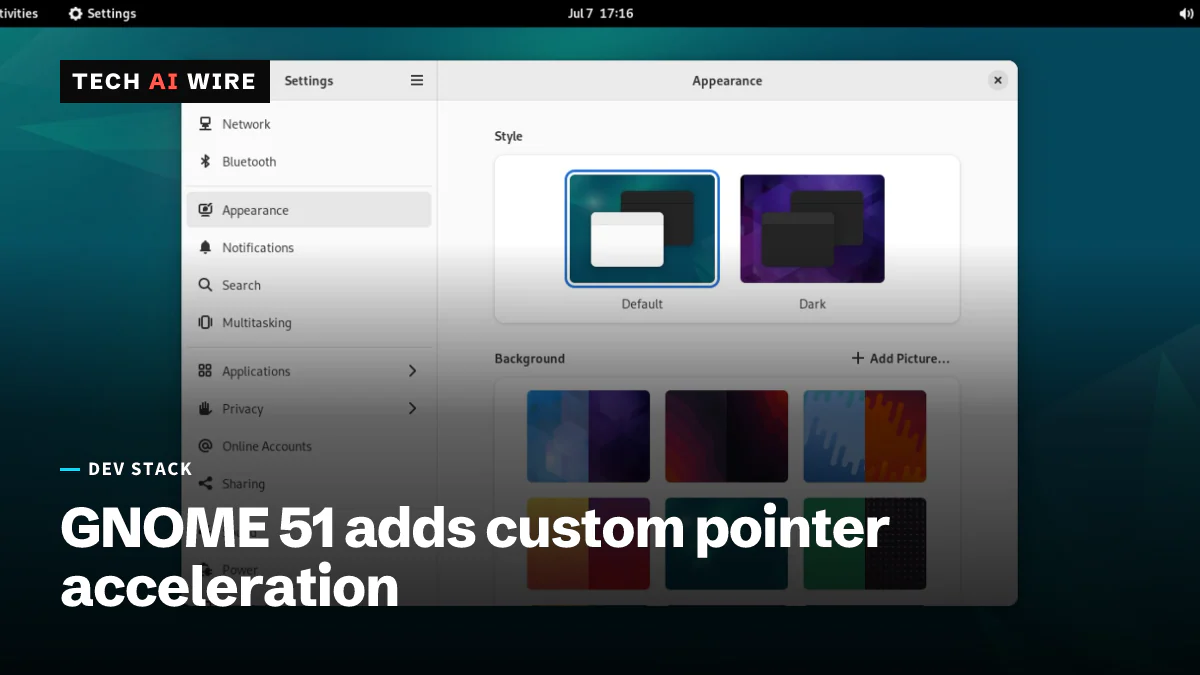
GNOME 51 will let users set a custom pointer acceleration curve, instead of choosing from a handful of built-in speed profiles. The change lands in Mutter, GNOME's window manager, and in gsettings-desktop-schemas, the shared settings backend GNOME apps read from. Phoronix reported the addition on September 10, 2026, six days before GNOME 51 itself ships on September 16, 2026.
Pointer acceleration is the software layer that decides how far your cursor moves on screen for a given hand movement. Most desktops offer only a few fixed choices, such as a single flat curve with no acceleration at all. GNOME's change builds on libinput, the input-handling library GNOME already depends on. libinput could already accept a custom acceleration curve from an application. GNOME 51 is the first version to expose that option directly to users, through GNOME's own settings.
Why the change took a year and a half
The feature reached GNOME through Mutter merge request #4296, titled "input-settings: Custom acceleration profile support." GNOME contributor Yves Auxier opened the merge request in February 2025, about a year and a half before it landed. It closes GNOME issue #2971, and it depended on related settings-schema work landing first in gsettings-desktop-schemas.
That gap is ordinary for a change to core input handling. A setting that affects every pointer device on the system needs review in two separate GNOME projects, Mutter and gsettings-desktop-schemas, before either project can ship it.
The two projects handle different halves of the work. gsettings-desktop-schemas defines the setting itself. It sets the data format a custom acceleration curve is stored in, the same format apps and the Settings panel read from. Mutter, as the compositor, is the code that actually talks to the mouse or trackpad hardware through libinput. It applies whichever curve is configured. A change to only one of the two projects would not have been enough. The setting has to exist before Mutter can read it. And Mutter has to apply it before the setting does anything for the user.
What a custom acceleration profile actually changes
GNOME previously shipped one flat curve as the default, plus a short list of alternatives. The new setting lets a user define exactly how cursor speed scales with hand movement, instead of picking from that list. That helps anyone whose hand movements do not match GNOME's built-in assumptions. One example is a user who wants small, precise cursor movements at low speed, but fast, large movements across a wide monitor at high speed.
What this means for developers
If you write a GNOME extension, or any app that reads pointer settings directly, check whether your code assumes only GNOME's built-in acceleration profiles exist. A user with a custom curve is now a real case to test, not just a hypothetical one.
If you maintain input-handling code anywhere on Linux, this is a sign that libinput's custom-curve support is moving from a developer-only feature into a user-facing setting. Wayland compositors outside GNOME that also use libinput, such as KDE Plasma or a wlroots-based compositor, could plausibly expose the same option next. Nothing in this release confirms that plan; it is worth watching for, not assuming.
GNOME 51 ships on September 16, 2026. It reaches most desktop Linux users through their distribution's next release. Ubuntu 26.10 and Fedora Workstation 45 are both confirmed to include GNOME 51 out of the box. That release has now arrived, with the frame-scheduling work as its headline change.
Sources
Related articles
KDE Plasma 6.8 ships on KDE's 30th birthday without X11
KDE released Plasma 6.8 on October 14, 2026, its 30th anniversary. It retires the X11 session, ships the Kup backup tool and adds a dwell clicker.
GNOME 51 ships reworked frame scheduling in Mutter
GNOME 51 arrived September 16 with smoother frame scheduling, FIDO2 passkey login, and one removal developers should note: legacy NVIDIA EGLStreams.

GNOME OS Preview offers stable GNOME 51.1 builds
GNOME OS Preview, announced October 16, 2026, builds GNOME's own operating system from stable GNOME 51.1 instead of nightly code, for early adopters.
The weekly digest
One email every Friday with the week's top stories from all six desks: AI, dev tools, coding, the tech industry, startups and what's next. Free, no spam.