ElevenLabs Eleven Realtime voice agents reply in 570 ms
ElevenLabs' Eleven Realtime v1 Max answers in 570 ms and scores 98.8% on Big Bench Audio, per the company. Its API copies OpenAI's Realtime format.
4 min read
By the numbers
- v1 Max time to first audio, per ElevenLabs
- 570 ms
- v1 Max score on Big Bench Audio
- 98.8%
- languages supported
- 90+
- Eleven Realtime v1 Max
- 98.8%
- Grok Voice 3.0
- 98.5%
- Gemini 3.8 Live Extended Thinking
- 97.7%
- Eleven Realtime v1 Mini
- 75.9%
ElevenLabs launched Eleven Realtime on October 20, 2026: two voice models that listen and talk back in one step, for building voice agents. The company says the larger one, v1 Max, starts answering in 570 milliseconds and leads a standard voice-reasoning test. For developers, the bigger news may be the API, which copies OpenAI's Realtime format so existing code can switch with two changes.
A voice agent is software that holds a spoken conversation, such as a support line that answers calls. Most are built as a chain: speech-to-text, then a language model, then text-to-speech. Each link adds delay. ElevenLabs sells Eleven Realtime as speech-to-speech, meaning audio goes in and audio comes out of one service.
Two models: v1 Max and v1 Mini
The ElevenLabs announcement splits the family by job. The smaller v1 Mini is for "natural conversation at low cost," such as simple chats where speed matters most. The larger v1 Max is for "complex tasks and multi-step workflows," including calls that use tools.
ElevenLabs says the analysis firm Artificial Analysis evaluated both models independently. It does not name who measured tool use.
| Measure | v1 Max | v1 Mini |
|---|---|---|
| Time to first audio, per ElevenLabs | 570 ms | 620 ms |
| Big Bench Audio (spoken reasoning) | 98.8% | 75.9% |
| Full-Duplex-Bench (conversation flow) | 94.1% | 95.8% |
| Speech Agent Arena (human preference) | 998 | 988 |
| Tool-use tasks completed | 87.1% | 60.3% |
Big Bench Audio asks 1,000 spoken questions. Full-Duplex-Bench measures how naturally a model handles turn-taking, like pauses and interruptions. Mini edges out Max on that one, which fits its pitch as the conversational model.
The latency figures conflict. ElevenLabs' blog and product page give 570 ms for Max and 620 ms for Mini. Journal du Net, a French tech outlet, reports 470 ms and 500 ms without naming a source. Journal du Net also lists rivals. Grok Voice 3.0 takes 810 ms and scores 98.5% on voice reasoning, and Gemini 3.8 Live Extended Thinking scores 97.7%. OpenAI's GPT-Realtime-2 (High) takes 1.14 seconds.
Built on OpenAI's Realtime format
The Realtime API follows OpenAI's Realtime specification, according to ElevenLabs. Moving an existing app means changing the endpoint URL and the model name, and OpenAI's own SDK works unchanged. The product page shows the model ID eleven_realtime_v1_mini.
There are limits. The API runs over WebSocket only, with no WebRTC version at launch, so browser apps built on WebRTC must change transport. Phone lines, WhatsApp, contact centers, knowledge bases, guardrails and monitoring all require ElevenLabs' separate ElevenAgents platform, not the bare API.
Tech Times adds a caveat about the design. ElevenLabs confirms Eleven Realtime is a chain of components inside, despite the speech-to-speech label. Developers cannot inspect, configure or swap those parts, and there is no text transcript of the middle step.
Pricing and compliance are not settled
ElevenLabs has published no prices for the models. The Realtime API is charged per minute of connected audio plus tokens, with the same token prices on every plan. ElevenAgents uses its standard per-minute pricing plus the language model's cost. Journal du Net says the per-token price was not announced at launch.
The compliance picture also differs by source. The product page lists HIPAA compliance and a Zero Retention Mode for the platform. Tech Times reports that v1 Mini has neither. It says v1 Max supports both only with US or EU data residency, not India or Singapore.
Both models speak more than 90 languages. Voice-agent use is growing fast: ElevenAgents handled 15 million conversations a week, three times its February 2026 volume, according to Tech Times. That growth is part of why the company doubled its valuation to $22 billion this month.
What this means for developers
The OpenAI-compatible API makes a test cheap. If you already use OpenAI's Realtime API over WebSocket, point a branch at ElevenLabs and compare on your own calls.
- Pick the model by job. Max for agents that call tools or follow steps; Mini for simple, chatty conversations.
- Measure latency yourself. Two sets of numbers are circulating, 570 ms and 470 ms for Max. Time first audio on your own network and region.
- Check what you lose without a transcript. If you log calls, audit answers or run checks on the text between steps, this design gives you none of that.
- Confirm compliance per model and region. Healthcare and regulated teams should get the HIPAA and data-residency terms in writing before building on Mini.
- Wait for prices before committing. With no per-minute or per-token rates published, compare cost against rivals such as Mistral's Voxtral 3 voice agents only once ElevenLabs posts them.
Sources
Related articles
Mistral Voxtral 3 adds voice agents from $0.0035 a minute
Mistral's Voxtral 3 adds speech-to-text from $0.0035 a minute, a $13 per million character voice model and a voice agent API from $0.04 a minute.

Elorian Glimpse model rechecks images while it reasons
Elorian's first model, Glimpse, costs $0.60 per million input tokens and looks back at images as it reasons. It beat GPT-6 Astra on 4 of 11 tests.
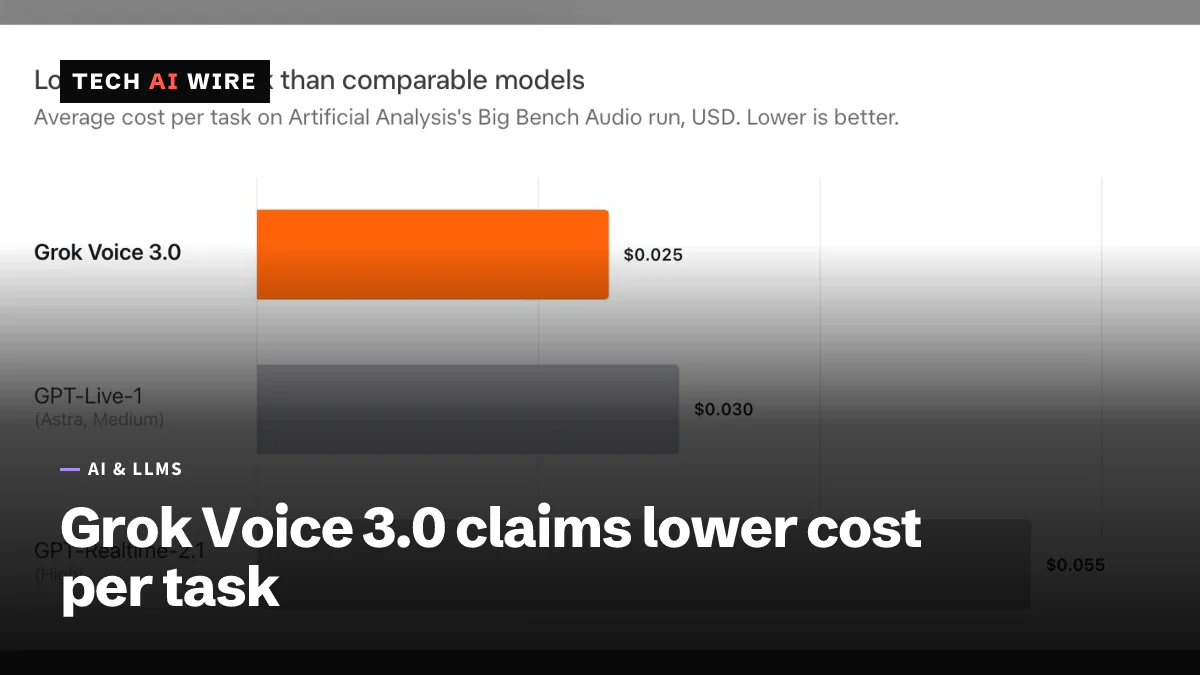
xAI Grok Voice 3.0 ships at $0.08 a minute
xAI's Grok Voice 3.0 speech model costs $0.08 a minute in its Voice Agent API, the same as 2.0, and scores 86.9 on Artificial Analysis's speech index.
The weekly digest
One email every Friday with the week's top stories from all six desks: AI, dev tools, coding, the tech industry, startups and what's next. Free, no spam.